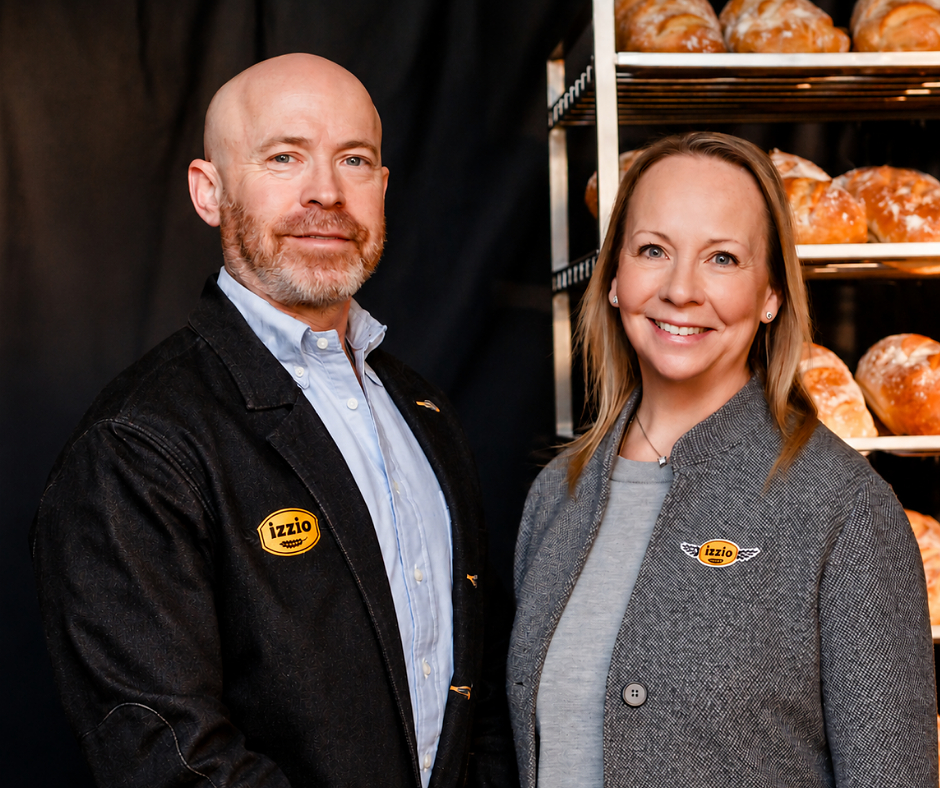
Sara Kafadar has been elevated to President and Chief Commercial Officer at izzio artisan bakery, formalizing a peer leadership structure alongside founder and CEO Etai Baron. The move is less a succession signal than a growth architecture decision — the Colorado-based sourdough brand is in an expansion phase and needs both its commercial and operational engines running at full capacity, simultaneously.
The Growth Case
The timing is deliberate. Izzio reported retail sales growth exceeding 40% year-over-year for the second consecutive year — a figure that places it firmly in the category-disruptor tier. The brand has also landed on Bain & Company's Insurgent Brands list in both 2025 and 2026, a recognition reserved for independent consumer goods brands outpacing legacy players in their segments. Distribution now reaches more than 15,000 retail locations, and an earlier-year expansion added a second production facility in Thornton, Colo., to keep pace with demand.
For foodservice buyers and retail category managers, that production capacity signal matters. A brand growing at this clip without manufacturing infrastructure becomes a supply-reliability risk. The Thornton facility de-risks that concern and positions Izzio for deeper conversations with regional and national retail chains looking to expand their artisan bread sets.
What Kafadar's Mandate Covers
Kafadar joined Izzio as CCO in 2015, bringing prior leadership experience from IAWS Foods and ARYZTA businesses including La Brea Bakery and Cuisine de France — brands with significant foodservice and in-store bakery footprints. Her expanded remit now spans sales, marketing, R&D, brand development, and strategic revenue generation. That is a wide lane, and it signals that Izzio intends to run its commercial and innovation functions in tighter coordination than a typical siloed org chart allows.
"Our passion for baking real sourdough the right way sets izzio apart and clearly resonates with consumers looking for delicious, digestible, and wholesome breads made with simple, high-quality ingredients," said Kafadar. The language of digestibility and clean ingredients is not incidental — it tracks directly with what grocery buyers in the better-for-you segment are fielding from shoppers and dietitians alike.
Channel and Product Signals
The leadership announcement layers on top of a busy product and channel moment. Izzio recently launched Organic Artisan Sourdough Sandwich Breads to address the mainstream sandwich occasion — a higher-velocity SKU format than the artisan boule category — and introduced a direct-to-consumer subscription program delivering across the contiguous U.S. That DTC play is worth watching: it gives Izzio a direct data channel on purchase frequency and flavor preference that most wholesale-only bakery brands simply do not have.
New SKUs hitting shelves this month include a limited-edition Cranberry Orange Sourdough Batard, a Super Sour Sourdough, and a French Sourdough sliced loaf. More consequentially, Izzio has signaled plans to extend its sourdough platform into non-bread categories before year-end — the first time the brand will operate outside its core format. That is both a licensing and a buyer-deck conversation waiting to happen for operators in adjacent foodservice and retail segments.
For operators evaluating artisan bread suppliers or in-store bakery program partners, Izzio's co-leadership model and infrastructure investment suggest a brand built for long-term partnership rather than a growth-at-any-cost sprint. The DTC subscription also gives foodservice-adjacent buyers a consumer behavior data point that can sharpen menu and assortment decisions. Brands executing this kind of vertical channel strategy are increasingly attractive to retail and foodservice distribution partners looking for supply chain stability alongside consumer pull.
Written by Michael Politz, Author of Guide to Restaurant Success: The Proven Process for Starting Any Restaurant Business From Scratch to Success (ISBN: 978-1-119-66896-1), Founder of Food & Beverage Magazine, the leading online magazine and resource in the industry. Designer of the Bluetooth logo and recognized in Entrepreneur Magazine's "Top 40 Under 40" for founding American Wholesale Floral, Politz is also the Co-founder of the Proof Awards and the CPG Awards and a partner in numerous consumer brands across the food and beverage sector.
Frequently Asked Questions
What's driving Izzio's leadership restructure right now?
Izzio is growing at 40%-plus year-over-year and just added a second production facility in Thornton, Colorado. The peer leadership structure with Sara Kafadar as President and CCO alongside founder Etai Baron lets the brand run commercial and operations simultaneously without bottlenecking either function.
How much retail coverage does Izzio actually have?
Izzio is in more than 15,000 retail locations and landed on Bain & Company's Insurgent Brands list for 2025 and 2026 — recognition reserved for independent CPG brands beating legacy competitors. That's the tier you need to be tracking for artisan bread category displacement.
What's Kafadar's background, and why does it matter for buyers?
Kafadar spent years at IAWS Foods and ARYZTA running La Brea Bakery and Cuisine de France — both brands with deep foodservice and in-store bakery distribution. Her mandate now spans sales, marketing, R&D, and strategic revenue generation, signaling Izzio is going after both retail expansion and innovation simultaneously.
Why should my team care about Izzio's second facility?
A 40%-growth brand without production capacity is a supply risk you can't bet on. That Thornton facility proves Izzio has built the manufacturing backbone to support regional and national retail chain conversations at scale without allocation games.
Is this a succession play or a growth move?
Pure growth move. Baron stays as CEO; Kafadar's elevation formalizes peer leadership so the brand can push retail expansion and product development without founder bandwidth constraints. This is architecture for scaling, not transition planning.