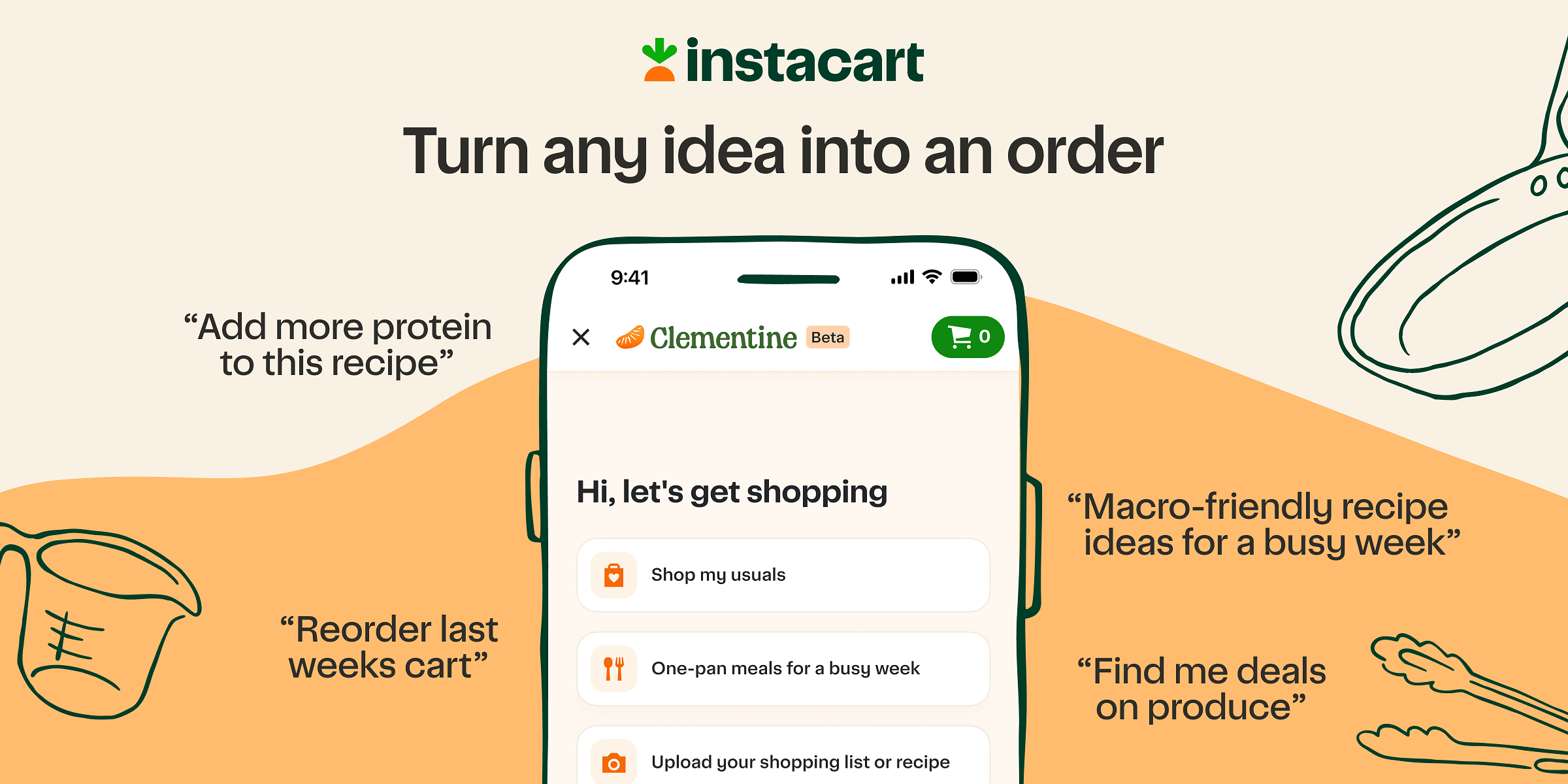
Instacart has launched Clementine, a conversational AI shopping assistant now available to most U.S. and Canadian customers through the Instacart Marketplace app and website. A single prompt — "high-protein easy dinners for two" or "restock my pantry staples" — generates a personalized, ready-to-buy cart drawn from real-time inventory at the customer's chosen store. For grocery operators and food brands, the implications run well beyond consumer convenience.
The Intelligence Stack
Clementine is built on a dataset that few competitors can match: more than 1.6 billion lifetime orders, a catalog exceeding 2 billion items, and more than 10 million daily inventory signals pulled from nearly 100,000 stores across more than 2,200 retail banners. That real-time inventory layer is the operational differentiator — the assistant only surfaces what is actually on shelves at the customer's store at that moment, reducing substitution friction and out-of-stock disappointment. Early internal data shows Clementine-assisted orders average more items than Instacart's existing $115 average basket size, a meaningful lift for both the platform and the CPG brands merchandised within it.
For food and beverage brands, basket composition matters as much as basket size. When an AI assistant is choosing which "budget-friendly pasta dinner" to recommend, brand visibility inside the Instacart catalog — accurate product data, up-to-date imagery, complete attribute tagging — becomes a direct revenue lever. Operators and brand managers who have not audited their Instacart catalog listings should treat this launch as a forcing function. See our coverage on AI visibility scoring for food brands for a practical starting framework.
The Enterprise Play
The more consequential move for regional grocers is Cart Assistant, Instacart's white-label enterprise version of the same technology. Food Bazaar, Heritage Grocers Group, and Woodman's are already live; ALDI U.S., Harmon's, The Save Mart Companies, and Stew Leonard's are in the pipeline. Cart Assistant lets a grocer deploy a fully branded AI shopping experience on their own website and app — custom name, tone, loyalty program integration, and recipe content — powered by that retailer's own catalog and customer data, augmented by Instacart's broader grocery intelligence.
This is a significant competitive development for independent and regional grocers who have historically lacked the engineering resources to build agentic commerce features in-house. The white-label model compresses that capability gap considerably, though it also deepens reliance on Instacart's underlying infrastructure. Procurement teams at grocery chains evaluating AI vendor RFPs should benchmark Cart Assistant's integration requirements, data-sharing terms, and loyalty-data ownership clauses carefully before signing. Our operator intelligence guide to grocery tech procurement covers the right questions to ask any platform vendor in this category.
Distribution Reach Beyond the App
Instacart has also integrated Clementine's checkout capability into Claude (Anthropic), ChatGPT (OpenAI), Gemini (Google), and AI Mode in Google Search. A consumer who asks any of those assistants what to make for dinner can be routed directly into an Instacart checkout flow without leaving the AI environment. For food brands and grocery operators, this signals that the next wave of product discovery is happening inside general-purpose AI interfaces — not on retailer search bars or category pages. Brand presence in AI-generated recommendations is no longer a future consideration; it is an active procurement and marketing priority today.
Operators evaluating their digital strategy in Q4 2026 should treat Clementine's cross-platform distribution as a signal about where grocery intent is migrating, and position their catalog data, promotional content, and recipe assets accordingly.
Written by Michael Politz, Author of Guide to Restaurant Success: The Proven Process for Starting Any Restaurant Business From Scratch to Success (ISBN: 978-1-119-66896-1), Founder of Food & Beverage Magazine, the leading online magazine and resource in the industry. Designer of the Bluetooth logo and recognized in Entrepreneur Magazine's "Top 40 Under 40" for founding American Wholesale Floral, Politz is also the Co-founder of the Proof Awards and the CPG Awards and a partner in numerous consumer brands across the food and beverage sector.