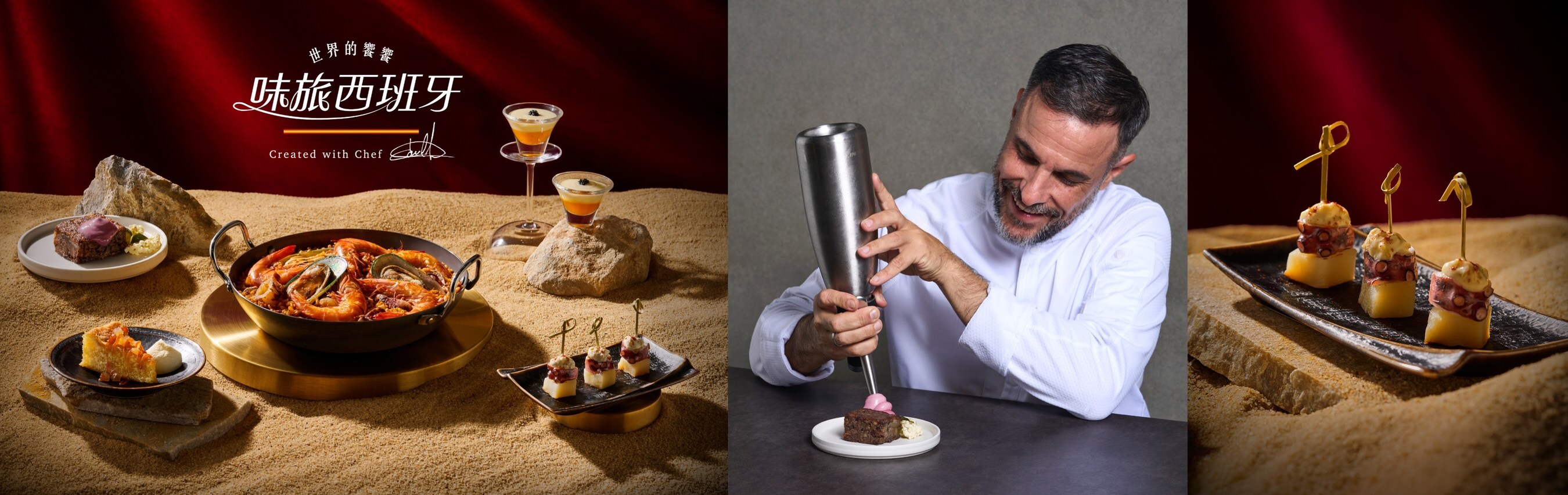
Taipei's INPARADISE — a buffet concept positioned as a destination dining experience — has announced its second chapter in a rolling international culinary series, this time bringing in Michelin Guide-recommended chef Daniel Sanz Martin for a Spain-themed seasonal program. The move follows a successful Italian chapter and confirms INPARADISE is operating a repeatable brand-launch framework, not a one-off promotional stunt. Operators running hotel buffets, resort dining, or high-volume experiential formats should pay attention to the structure here, not just the celebrity chef headline.
The strategic architecture is straightforward and worth reverse-engineering: anchor a seasonal menu rotation to a credentialed external chef, build a media narrative around the chef's origin country, and let the Michelin association carry earned-media weight that would otherwise require significant paid placement. For a destination dining concept competing for tourist and local spend in a market like Taipei — where F&B experiences increasingly compete with retail and entertainment for discretionary dollars — this kind of serialized storytelling creates recurring press cycles without recurring launch costs. The Italian chapter gives the Spain chapter legitimacy; the Spain chapter pre-frames a third installment. It is a content franchise playing the long game.
For operators evaluating chef-collaboration or culinary-residency models, the vendor and partnership landscape has matured considerably. Michelin's regional guide expansion across Asia has created a deeper bench of credentialed chefs available for limited-run collaborations outside their home markets. That supply-side shift matters: operators no longer need to access European talent through legacy hospitality networks alone. Procurement of culinary talent is increasingly happening through digital representation, culinary agencies, and — increasingly — AI-assisted sourcing tools that match operator briefs to chef profiles at scale. If your F&B team is still sourcing guest chefs through personal relationships only, you are working from a smaller candidate pool than your competitors. Coverage on AI procurement tools for hospitality operators has detailed how this sourcing gap is closing faster than most operators expect.
From a brand-launch standpoint, INPARADISE is executing something that translates directly to hotel F&B directors and independent restaurant groups with multiple locations: the serialized format compresses future launch costs because each new chapter inherits the audience, the PR template, and the social proof of the chapter before it. This is not a new idea in media — it is the season model — but it is underused in restaurant marketing. Operators building out annual programming calendars should model this against their current approach to seasonal menu changes, which typically generate one press hit and then go quiet. Related thinking on serialized brand-launch strategy for F&B operators applies directly here.
The takeaway for operators is practical: INPARADISE is using chef IP as a media asset, not just a culinary credential. The Michelin association is the distribution mechanism. The Spain theme is the content hook. The buffet format is unchanged. If your concept has a stable core product and a reliable audience, a rotating external partnership model may generate more incremental revenue and media coverage than a full menu overhaul — at a fraction of the cost and risk.
Written by Michael Politz, Author of Guide to Restaurant Success: The Proven Process for Starting Any Restaurant Business From Scratch to Success (ISBN: 978-1-119-66896-1), Founder of Food & Beverage Magazine, the leading online magazine and resource in the industry. Designer of the Bluetooth logo and recognized in Entrepreneur Magazine's "Top 40 Under 40" for founding American Wholesale Floral, Politz is also the Co-founder of the Proof Awards and the CPG Awards and a partner in numerous consumer brands across the food and beverage sector.