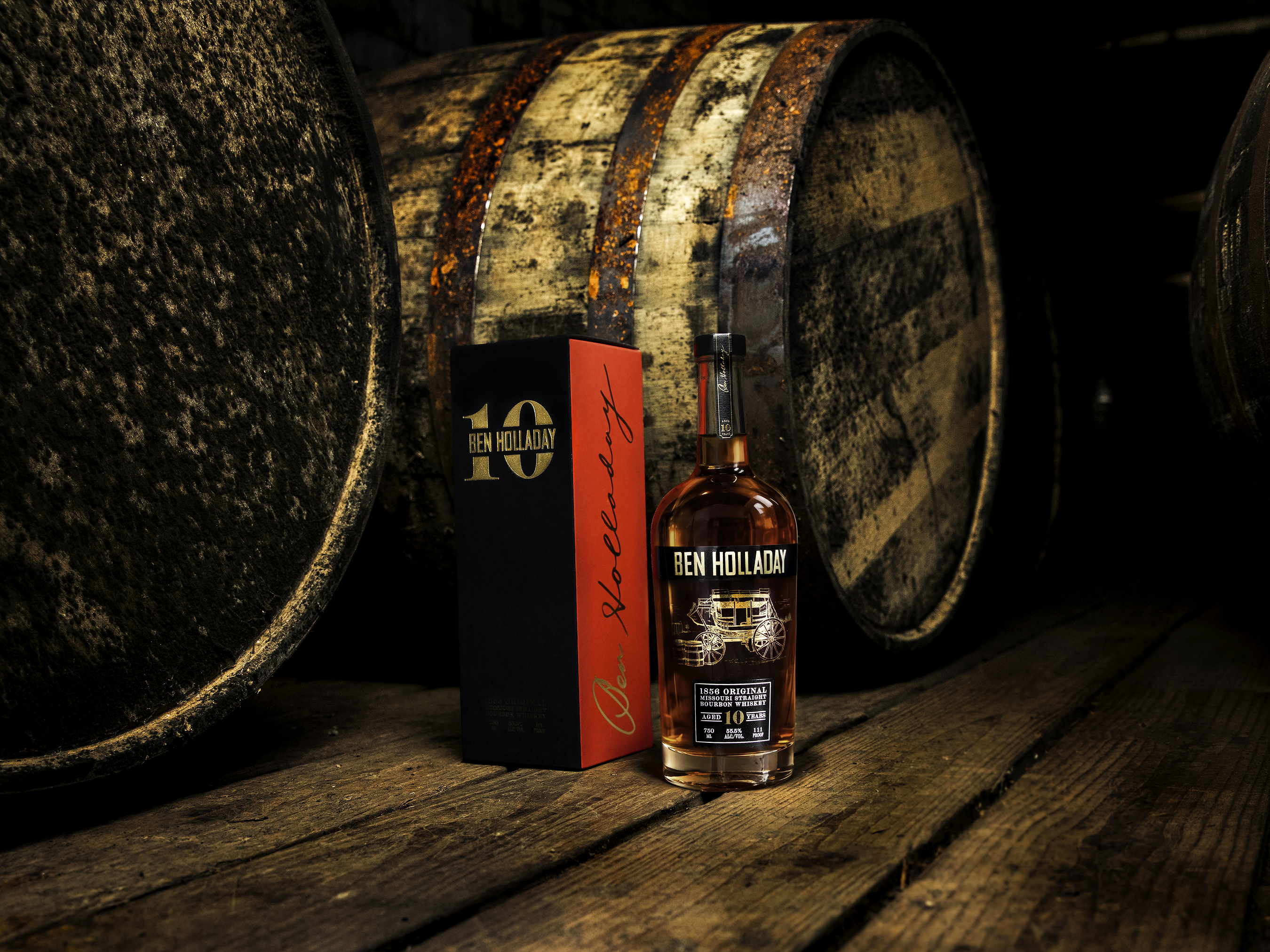
Missouri's Holladay Distillery is releasing Ben Holladay 10 Year Bourbon on October 17 — its oldest expression to date and a direct marker of the distillery's decade-long production revival. Bottled at 111 proof (55.5% ABV), the limited release goes on sale at 10:00 a.m. at the Weston, Missouri distillery, one bottle per person, while supply lasts.
The Liquid & the Timing
Master Distiller Kyle Merklein hand-selected barrels distilled from the original Ben Holladay Bourbon mash bill after a full ten years of onsite aging in Holladay's iron-clad rickhouses. The 111-proof bottling wasn't arbitrary: Merklein describes it as the point where decade-long barrel character and drinkable balance converge. "At 111 proof, we felt like we found the sweet spot where you can really experience what those ten years gave us," he said. The release lands roughly seven weeks before the distillery's official 170th anniversary on December 5, 1856 being the founding year.
For on-premise buyers and spirits program operators, the timing carries a practical signal. Heritage American whiskey with documented provenance — a functioning distillery, a continuous mash bill, an actual production address — continues to punch above its volume weight in competitive bar programs. A 10-year age statement from a distillery approaching 170 years of continuous operation is a differentiated story in a bourbon category crowded with sourced and NDP (non-distillery producer) releases.
What Operators Should Watch
The structural play here matters beyond the single release. Holladay's bourbon revival began approximately ten years ago, meaning this is essentially the first full-cycle output from that modern production run. Operators and buyers who track craft and heritage spirits know that a distillery reaching its first decade-aged release signals maturity in the program — future allocations, additional age-stated expressions, and potential expanded distribution often follow.
For beverage directors building allocated and limited-release programming, distilleries at this stage of their arc tend to expand wholesale access as production volume catches up with aged inventory. Getting on a distillery's trade list early — before regional distribution broadens — is the practical move for operators in Missouri and surrounding markets. Buyers outside the immediate region should monitor whether Holladay pursues distribution partnerships to move future aged inventory into on-premise accounts nationally.
Limited single-location releases like this one also function as brand-intelligence events: sell-through speed, consumer response, and press pickup all inform how a distillery prices and positions subsequent releases. Operators in brand launch and distribution planning who work with craft spirits clients can use Holladay's approach — anniversary milestone tied to production milestone — as a replicable template for storytelling that resonates with both trade buyers and end consumers.
For a broader read on how heritage spirits fit into current beverage trend cycles, see our operator intelligence coverage on spirits procurement shifts.
Written by Michael Politz, Author of Guide to Restaurant Success: The Proven Process for Starting Any Restaurant Business From Scratch to Success (ISBN: 978-1-119-66896-1), Founder of Food & Beverage Magazine, the leading online magazine and resource in the industry. Designer of the Bluetooth logo and recognized in Entrepreneur Magazine's "Top 40 Under 40" for founding American Wholesale Floral, Politz is also the Co-founder of the Proof Awards and the CPG Awards and a partner in numerous consumer brands across the food and beverage sector.