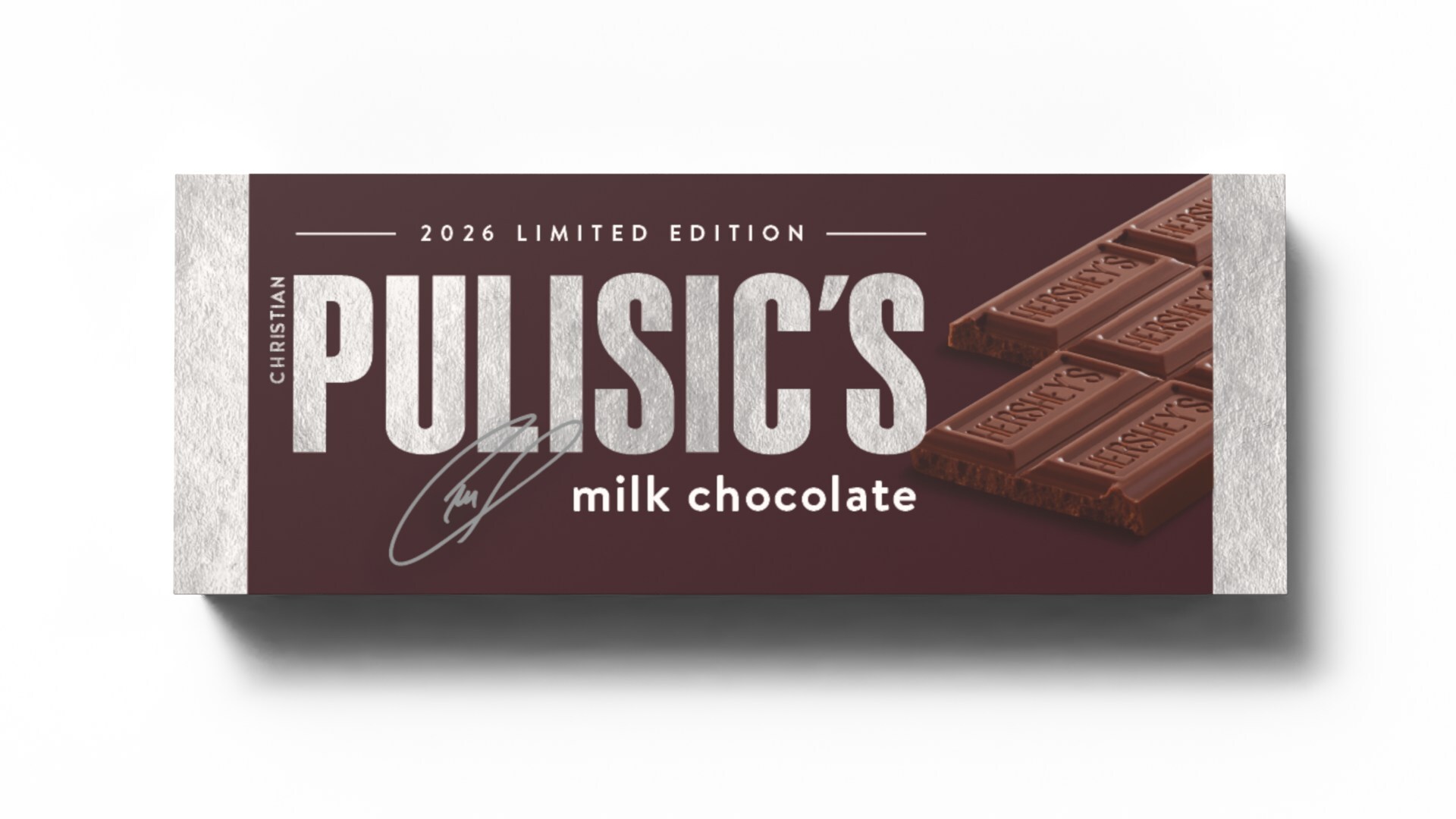
Hershey's is rolling out limited-edition PULISIC'S Milk Chocolate Bars this summer, featuring custom wrappers with AC Milan midfielder Christian Pulisic's printed signature. The launch is anchored in Hershey, Pa. — Pulisic's literal hometown — before expanding to a national retail footprint. For operators and buyers, the move is less about nostalgia and more about how a legacy confectionery brand is using a World Cup moment to drive incremental velocity at retail.
The timing is deliberate. The 2026 FIFA World Cup is hosted across North America, and U.S. soccer viewership has been climbing steadily, particularly among the 18–34 demographic that drives impulse confectionery purchases. Co-branded limited editions tied to cultural moments — athlete partnerships, film releases, local pride — have consistently outperformed standard SKUs on secondary placement and endcap sell-through. Hershey's is not inventing the playbook here; it is executing a well-worn one with an unusually strong local-story hook.
For food and beverage brands evaluating licensed or athlete co-brand programs, the Pulisic partnership is a useful benchmark. The structural elements — limited SKU count, signature wrapper customization, geographic launch origin tied to authentic narrative — keep production complexity low while maximizing earned media surface area. Brands considering similar activations should note that the authenticity of the origin story (Pulisic genuinely grew up in Hershey) compresses the PR lift required to make the campaign land. Manufactured athlete alignments without that connective tissue rarely generate the same organic pickup. Retail buyers receiving pitches for co-branded confectionery or snack SKUs this cycle should pressure-test the narrative depth before committing shelf space. See how brands are structuring retail-ready launch packages for buyer decks.
From a distribution and sampling standpoint, the national rollout following a Hershey, Pa. origin launch is a replicable regional-to-national sequencing model. It gives local press and community media a first-mover story, builds social proof before broad distribution, and reduces the risk of the product feeling like a generic licensed cash-in. Operators running hotel gift shops, stadium concessions, or travel retail — particularly venues near World Cup host cities — should be tracking availability windows and requesting early wholesale allocations if the SKU aligns with their guest demographics.
The broader signal here is that heritage CPG brands are increasingly willing to invest in short-run, culturally timed packaging as a growth lever rather than relying solely on core SKU advertising. That shift has downstream implications for packaging vendors, co-manufacturers running limited runs, and agency partners being asked to build campaign infrastructure around a 90-day retail window. If you are advising a brand on a similar play, the Hershey's-Pulisic structure is worth dissecting: authentic talent, constrained SKU, clear cultural moment, and a local-to-national narrative arc. Operators tracking CPG launch trends for on-premise retail can benchmark against recent brand launch intelligence here.
Written by Michael Politz, Author of Guide to Restaurant Success: The Proven Process for Starting Any Restaurant Business From Scratch to Success (ISBN: 978-1-119-66896-1), Founder of Food & Beverage Magazine, the leading online magazine and resource in the industry. Designer of the Bluetooth logo and recognized in Entrepreneur Magazine's "Top 40 Under 40" for founding American Wholesale Floral, Politz is also the Co-founder of the Proof Awards and the CPG Awards and a partner in numerous consumer brands across the food and beverage sector.