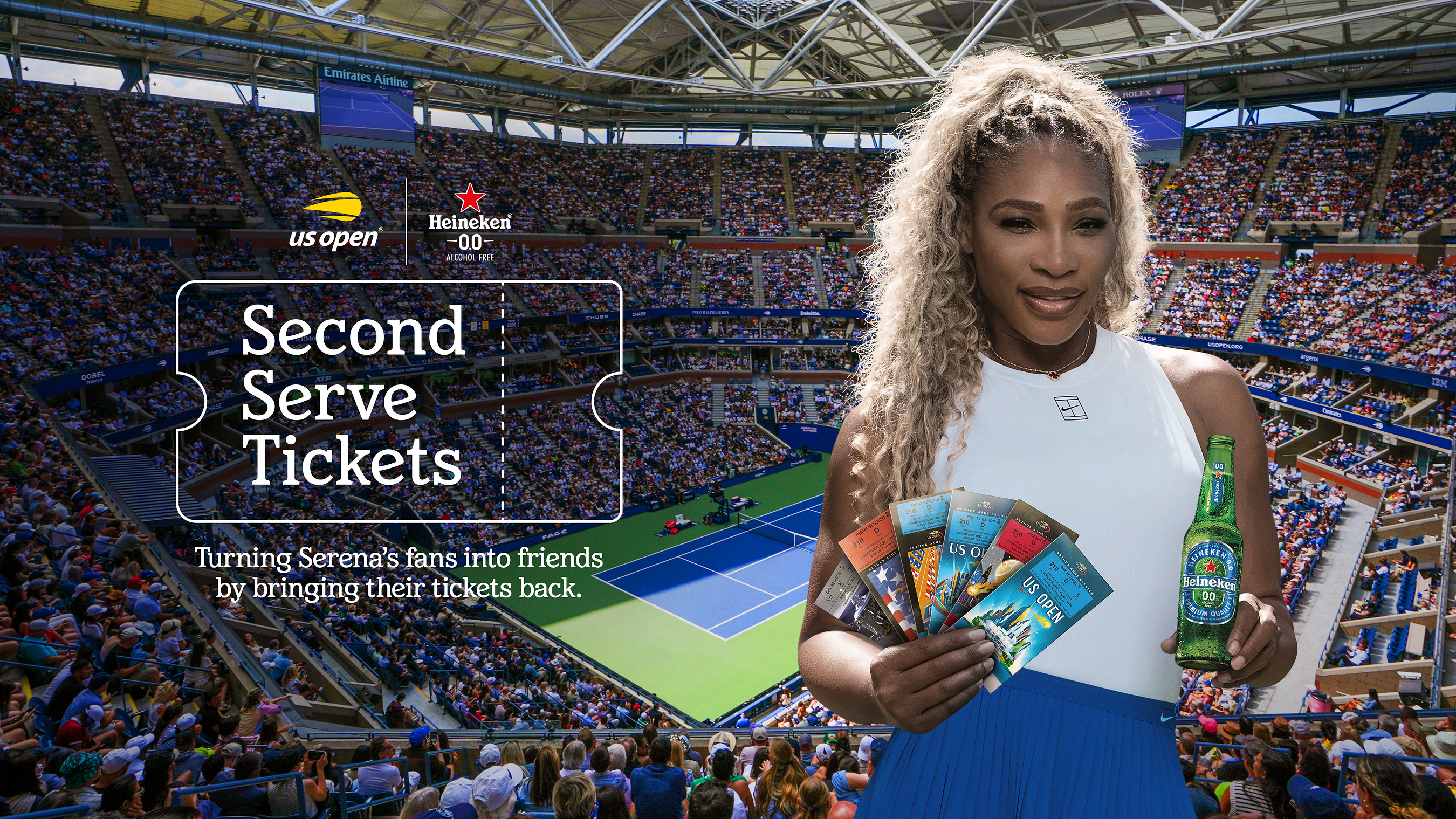
Heineken 0.0 is turning old ticket stubs into new hospitality access at the 2026 US Open, activating a campaign that puts the non-alcoholic beer brand at the center of premium sports hospitality through the end of August.
The program, called Second Serve Tickets, invites fans to submit a photo of any ticket from a past Serena Williams US Open match alongside a personal memory. Winners receive seats in the exclusive Heineken Suite at Arthur Ashe Stadium during the 2026 tournament. The contest runs through August 16 and is open to U.S. residents 21 and older. Alongside the contest, HEINEKEN USA is selling limited-edition Heineken 0.0 cans — six designs, each inspired by one of Williams' US Open championship wins — exclusively at the tournament beginning August 24.
Why Operators Should Pay Attention
This activation is less a consumer promotion and more a blueprint for non-alc brand positioning inside premium venues. Heineken 0.0 has reportedly sold out at the US Open in each of the past two years, a data point HEINEKEN USA CEO Maggie Timoney cited directly when framing why the brand anchors the campaign around a non-alcoholic product. For food and beverage operators managing venue or stadium accounts, that sell-out velocity is a signal: non-alc is no longer a courtesy SKU at major sports events — it's a category with demonstrated throughput.
The limited-edition packaging play also carries an operational intelligence note. Collectible, event-specific packaging drives incremental purchase beyond default consumption — a tactic that translates to hotel F&B outlets, airport concessions, and any premium on-premise channel where dwell time is high and impulse purchase is real. Operators sourcing non-alc beer for event season should be asking their distributor reps whether exclusive or limited packaging tiers are available for their venues, and whether sell-through data from comparable activations can inform buy quantities.
The Non-Alc Trajectory
The broader non-alcoholic beer category continues to outpace total beer growth in on-premise channels. Heineken 0.0's US Open presence fits a pattern visible across major sports properties: brand owners are investing hospitality budgets into non-alc SKUs specifically because those products reach guests who would otherwise not be purchasing a beer at all — expanding the spend-per-head equation rather than cannibalizing alcoholic beer volume.
The campaign also operates inside Heineken's global Fans Have More Friends platform, which spans football, Formula 1, and music festivals in addition to US Open tennis. For operators and venue F&B directors evaluating beverage sponsor partners, that cross-property consistency matters: brands running integrated, multi-event campaigns tend to bring more co-marketing support, staff training resources, and POS investment to individual venue relationships.
For operators tracking non-alc category trends and beverage procurement shifts, this activation reinforces that placement at high-visibility events is now a core part of how non-alc beer earns its velocity story — and that story directly affects shelf and tap allocation decisions downstream. Brands with documented sell-out data at marquee venues carry significantly more leverage in distributor conversations and retail buyer pitches.
Written by Michael Politz, Author of Guide to Restaurant Success: The Proven Process for Starting Any Restaurant Business From Scratch to Success (ISBN: 978-1-119-66896-1), Founder of Food & Beverage Magazine, the leading online magazine and resource in the industry. Designer of the Bluetooth logo and recognized in Entrepreneur Magazine's "Top 40 Under 40" for founding American Wholesale Floral, Politz is also the Co-founder of the Proof Awards and the CPG Awards and a partner in numerous consumer brands across the food and beverage sector.