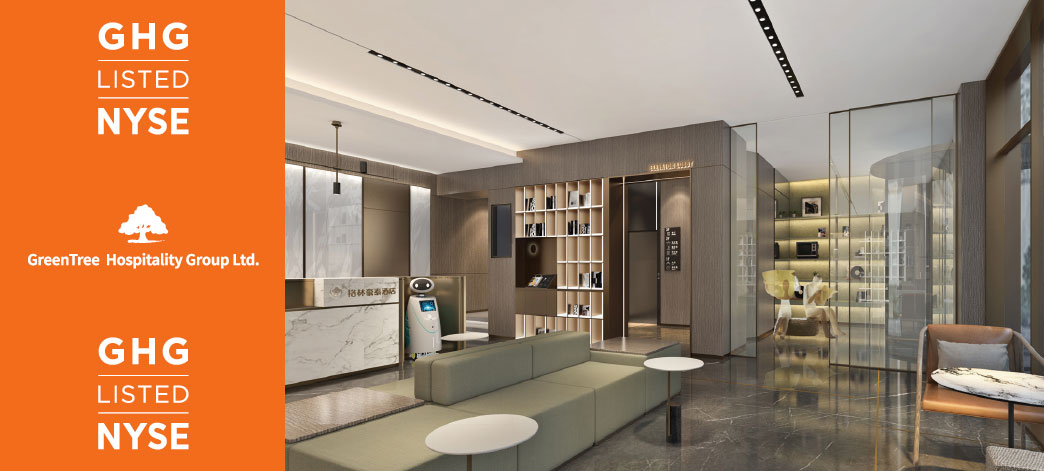
China's GreenTree Hospitality Group (NYSE: GHG) posted Q2 2026 total revenues of $34.7 million (RMB 235.1 million), an 18.7% year-over-year decline, as the company continued a deliberate contraction of its leased-and-operated hotel and restaurant footprint. For operators and vendors tracking China's hospitality and foodservice recovery, the numbers tell a more nuanced story than the headline suggests: the same quarter produced a 4.4% increase in core net income (non-GAAP) and an adjusted EBITDA margin of 29.3%, up from 27.1% a year ago.
Restaurant Segment Pressure
The food-and-beverage arm absorbed the sharpest hits. Restaurant revenues fell 33.5% year over year to $4.5 million (RMB 30.5 million), driven by a 20.3% decline in average daily sales per store (ADS), a 15.5% drop in average check (AC) to RMB 36, and a net closure of two leased-and-operated restaurant locations. The company's 198-unit restaurant portfolio — anchored by its Da Niang Dumplings (180 locations) and Bellagio (18 locations) brands — is now operating at a blended ADS of RMB 2,893, down from RMB 3,629 in Q2 2025. Franchised restaurant count, however, grew from 168 to 185, indicating that unit-level expansion is continuing even as corporate-operated volume shrinks. For foodservice suppliers and franchise consultants, that divergence matters: the company is actively reducing exposure to the capital-intensive L&O model while growing a lighter-touch F&M network.
Hotel Side Holds Operating Income Flat
On the hotel side, GreenTree's 4,615-property network — which spans economy through mid-to-upscale segments across 347 Chinese cities — generated hotel revenues of $30.2 million (RMB 204.6 million), down 16.2%. The blended RevPAR fell 9.1% to RMB 103, with occupancy at 65.2% and ADR at RMB 157. Despite the revenue compression, income from operations across both segments came in at $7.1 million (RMB 48.2 million), nearly flat versus the RMB 49.2 million reported in Q2 2025. The stability was achieved through cost discipline: G&A expenses dropped 35.0% year over year, and operating costs fell 20.0%. The restaurant segment actually swung from an operating loss of RMB 1.0 million in Q2 2025 to operating income of RMB 1.6 million in Q2 2026 — a material turn that suggests the L&O culls are cleaning up the P&L.
Flagship Expansion Signals Upscale Push
Two development moves warrant attention from operators and brand builders watching China's hospitality landscape. GreenTree took possession in July 2026 of a hotel property opposite the Twin Towers in Kuala Lumpur, acquired in 2025, which will anchor its Southeast Asian expansion strategy. Separately, the company has won a competitive bid for a landmark Huangpu River waterfront site in Shanghai's Yangpu District, which it plans to develop into a signature flagship hotel. Crucially for the F&B angle, that Shanghai property will include a curated regional lifestyle center with food-and-beverage programming designed to generate recurring ancillary revenue alongside the hotel operation — a format increasingly favored by mixed-use hospitality developers in Asia and one that mirrors strategies gaining traction among U.S. hotel operators integrating food and beverage as a revenue driver. Full year 2026 hotel revenue guidance holds at a 10%–15% decline versus 2025, while the board has authorized a $5 million share repurchase program.
For procurement teams, distribution partners, and foodservice brands assessing China market exposure, GreenTree's results are a reminder that unit count growth in the franchise channel can coexist with same-store sales pressure — and that the operators most likely to stabilize are the ones cutting direct-operated overhead while building recurring revenue through F&B amenity programming. The liquidity position remains strong: total cash and equivalents, restricted cash, short-term investments, and time deposits stood at $294.8 million (RMB 2,000.3 million) as of June 30, 2026.
Written by Michael Politz, Author of Guide to Restaurant Success: The Proven Process for Starting Any Restaurant Business From Scratch to Success (ISBN: 978-1-119-66896-1), Founder of Food & Beverage Magazine, the leading online magazine and resource in the industry. Designer of the Bluetooth logo and recognized in Entrepreneur Magazine's "Top 40 Under 40" for founding American Wholesale Floral, Politz is also the Co-founder of the Proof Awards and the CPG Awards and a partner in numerous consumer brands across the food and beverage sector.