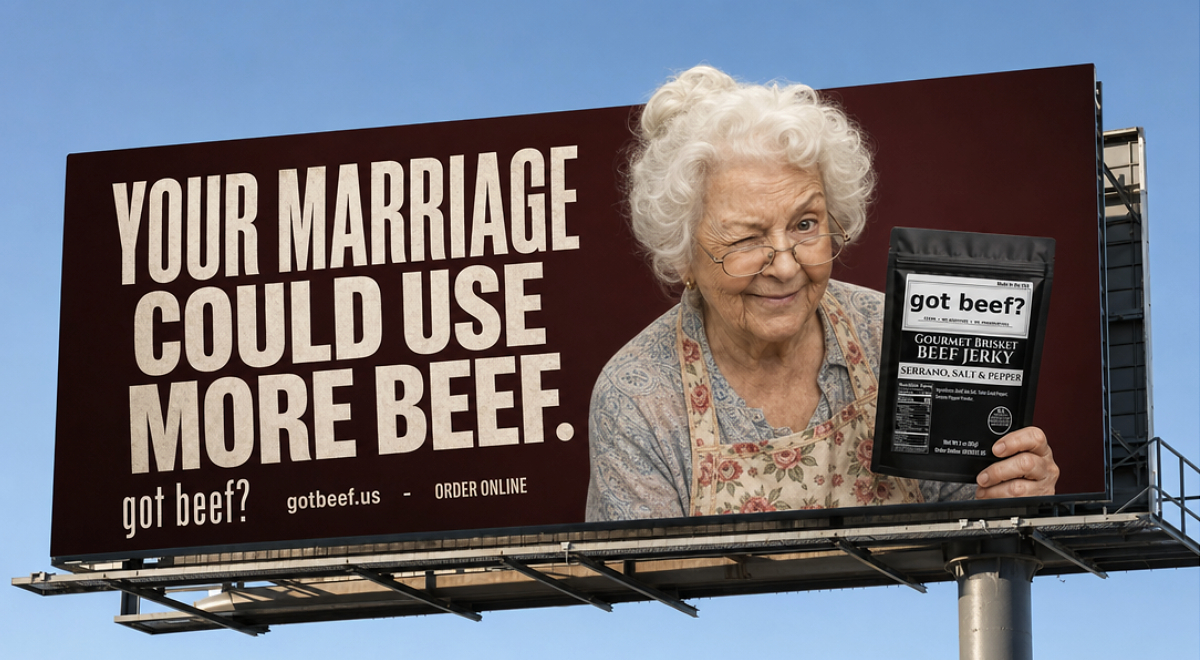
Got Beef, a Sacramento-based direct-to-consumer grass-fed beef jerky brand, has launched an AI-generated spokesperson named 'Granny' — a photorealistic character built entirely with artificial intelligence tools — to anchor its social content and a new out-of-home billboard campaign. For operators watching the cost curve on content production, this is a data point worth filing: a small CPG brand just ran what looks like a full creative campaign without a traditional agency or on-camera talent.
The move lands at a moment when AI-generated creative is crossing from novelty into operational infrastructure for food and beverage brands. Midsize and emerging brands have traditionally been priced out of sustained spokesperson campaigns — production costs, talent fees, and usage rights stack up fast. AI-generated characters sidestep all three. The Got Beef model, built around a single recurring AI persona deployed across YouTube and OOH, mirrors a content architecture that larger hospitality and CPG brands are beginning to adopt as generative video tools mature.
For procurement and marketing teams evaluating AI content vendors, the Got Beef rollout illustrates what a lean AI-native brand stack looks like in practice: a defined character, a consistent visual identity, and distribution across paid and organic channels — without the overhead of a content agency retainer. The billboard component is particularly notable; it suggests the brand is not treating AI creative as a social-only experiment but as a full-funnel asset capable of holding up at scale and in public-facing formats. That's a higher bar than most AI content clears.
The deeper signal here is for DTC food brand operators mapping their content and distribution roadmap: AI-generated characters are no longer a stunt — they are becoming a legitimate budget allocation decision. The question shifts from 'can AI produce credible creative?' to 'which AI tools, at what cost per asset, deliver the reach metrics our media mix requires?' Got Beef hasn't published performance data yet, but the architecture they've built is reproducible, and the category — grass-fed, protein-forward snacks — is competitive enough that content velocity matters.
Written by Michael Politz, Author of Guide to Restaurant Success: The Proven Process for Starting Any Restaurant Business From Scratch to Success (ISBN: 978-1-119-66896-1), Founder of Food & Beverage Magazine, the leading online magazine and resource in the industry. Designer of the Bluetooth logo and recognized in Entrepreneur Magazine's "Top 40 Under 40" for founding American Wholesale Floral, Politz is also the Co-founder of the Proof Awards and the CPG Awards and a partner in numerous consumer brands across the food and beverage sector.