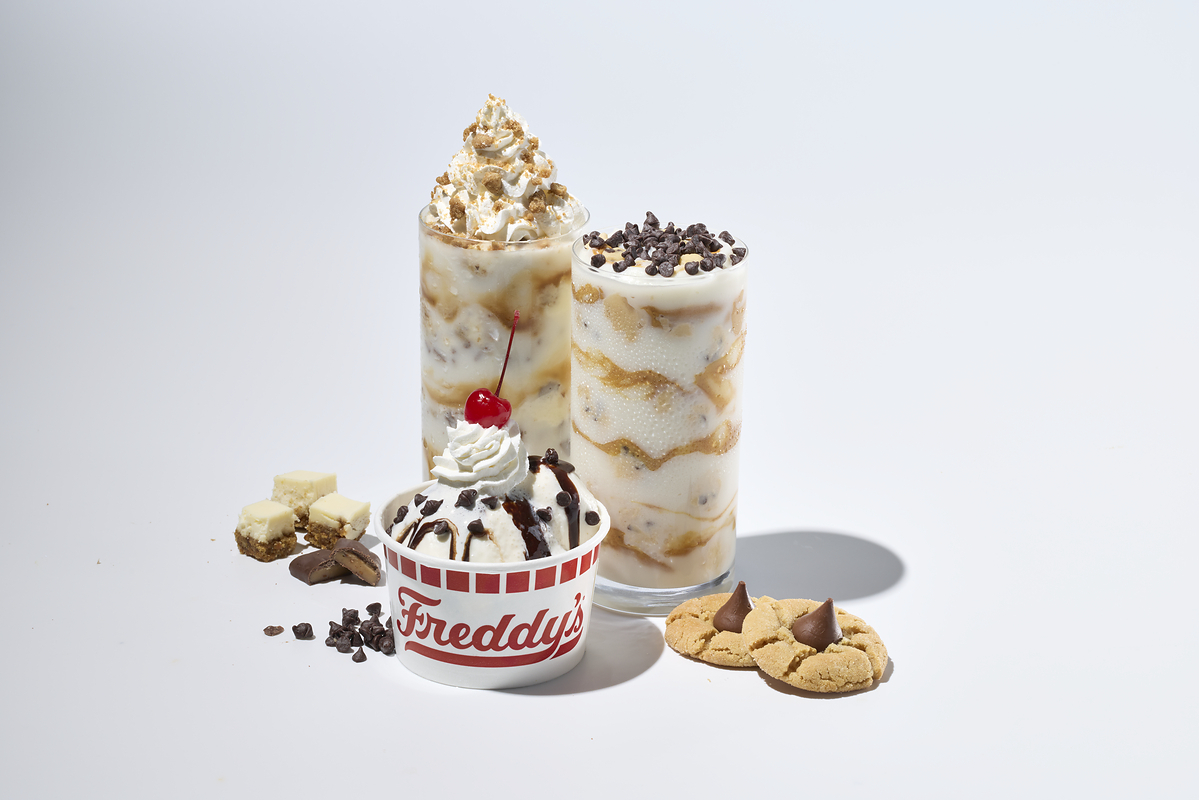
Starting November 4 through January 5, Freddy's Frozen Custard & Steakburgers is running a multi-SKU co-branded window with The Hershey Company — three new frozen custard concretes built around HEATH, REESE'S, and HERSHEY'S equity, plus the return of its fan-driven French Onion Steakburger. The simultaneous activation across drive-thru, dine-in, app, and delivery is a textbook two-track LTO: a licensed ingredient play on the dessert side, a nostalgia callback on the entrée side. At over 600 units in the U.S. and Canada, the footprint gives the promotion real signal value for operators watching how mid-scale fast-casual brands are structuring seasonal windows.
The Co-Brand Mechanics
The three Hershey-anchored items — a HEATH Caramel Cheesecake Concrete, a Peanut Butter Blossom Cookie Concrete, and a HERSHEY'S Snowfall Sundae — all anchor to recognizable sub-brands (HEATH toffee, REESE'S peanut butter sauce, HERSHEY'S chocolate chips and sauce) rather than the Hershey master brand alone. That granularity matters: using ingredient-level sub-brands lets each item carry its own flavor story without requiring the guest to do brand translation work at the point of sale. For operators considering co-brand or white-label ingredient partnerships, this is a replicable architecture — identify a CPG partner with licensed sub-brands that map cleanly to your existing menu format, then build the item around the sub-brand's sensory signature, not around the logo.
The promotional overlay — buy-two-get-two movie tickets for the Hershey theatrical release on November 25 — adds a traffic incentive with a defined expiration. That kind of entertainment cross-promotion is relatively uncommon at this scale in fast-casual; it suggests Hershey's brand team is treating the Freddy's footprint as a media distribution channel, not just a product placement. Operators and their agency partners should note the structure: a CPG brand paid to activate inside a restaurant's LTO window doubles as a promotional vehicle for its own external marketing campaign.
What This Signals for Operators
Freddy's ranking at No. 6 on Fast Casual's Top 100 Movers + Shakers and No. 85 on Entrepreneur's Franchise 500 reflects consistent unit growth and franchise health — the kind of system metrics that attract CPG co-brand interest in the first place. For franchisees and multi-unit operators, the Hershey partnership is a reminder that brand equity at scale becomes a negotiating asset with ingredient suppliers and CPG companies. If you are operating a regional concept with 50 or more locations, structured co-brand conversations with licensed ingredient partners are a legitimate revenue and traffic lever, not just a tactic reserved for national chains.
The French Onion Steakburger return is worth a separate note. Bringing back a retired or seasonal item based on demand signals is a low-cost, high-return LTO strategy — it requires no new supplier onboarding, reduces R&D risk, and generates organic social lift from guests who have been requesting it. For operators evaluating their own menu archives, the Freddy's model suggests a disciplined cadence: retire items intentionally, track request volume, and re-introduce them inside a broader promotional window to amplify the moment. Coverage of how operators are structuring seasonal menu strategy and LTO calendars continues to be one of the most-read beats in hospitality trade media.
From a channel perspective, the full availability stack — drive-thru, dine-in, mobile app, and third-party delivery — is now the baseline expectation for any LTO worth promoting. Operators who have not yet unified their promotional calendar across all four channels are leaving measurable attach-rate on the table. For more on how fast-casual brands are managing digital ordering and app-driven promotions, the growth mechanics are increasingly inseparable from the menu strategy itself.
Written by Michael Politz, Author of Guide to Restaurant Success: The Proven Process for Starting Any Restaurant Business From Scratch to Success (ISBN: 978-1-119-66896-1), Founder of Food & Beverage Magazine, the leading online magazine and resource in the industry. Designer of the Bluetooth logo and recognized in Entrepreneur Magazine's "Top 40 Under 40" for founding American Wholesale Floral, Politz is also the Co-founder of the Proof Awards and the CPG Awards and a partner in numerous consumer brands across the food and beverage sector.