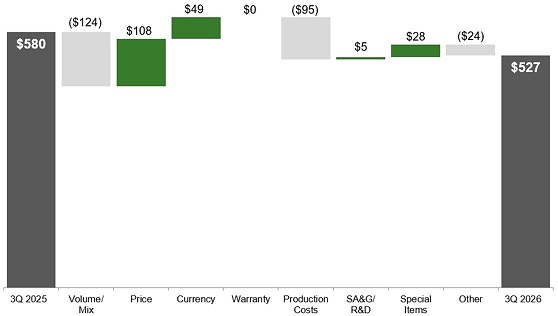
Deere & Company (NYSE: DE) posted third-quarter net income of $1.379 billion on revenues of $12.608 billion — a 5.0% top-line gain year-over-year — then raised its full-year net income forecast to a range of $4.750 billion to $5.000 billion. For food and beverage operators and buyers tracking upstream agricultural conditions, the report carries a clear signal: the farm equipment cycle that has compressed crop production capacity may be approaching its floor.
Chairman and CEO John C. May cited "stable U.S. market conditions" and improving used-equipment inventory as evidence the downturn is easing. That matters downstream. When farmers defer equipment purchases, planting capacity and harvest efficiency can soften — eventually feeding through to commodity availability and input costs for food manufacturers, distributors, and restaurant operators.
Where the Numbers Land
The headline figures mask a split story across Deere's three equipment segments. Production & Precision Agriculture — the division that powers large-scale grain and row-crop farming — saw Q3 net sales fall 6.0% year-over-year to $3.998 billion, with operating margin contracting slightly to 13.2% from 13.6%. Lower shipment volumes and higher production costs were the primary drag, partially offset by favorable pricing. By contrast, Small Agriculture & Turf delivered an 18.4% operating margin on a 12.0% sales increase to $3.383 billion, and Construction & Forestry more than doubled operating profit to $436 million on an 18.0% revenue jump to $3.618 billion.
Deere also recorded $382 million in tariff recoveries through the first nine months of fiscal 2026, embedded primarily in production costs. That line item is worth watching: tariff exposure on steel, electronics, and imported components remains a live variable for equipment pricing and, by extension, for the farm-level economics that shape commodity supply.
What This Signals for Procurement
For operator intelligence readers, the most actionable data point is the early order program trend. Deere's management stated that order book momentum and normalizing used-equipment inventories reinforce their view that 2026 marks the cyclical bottom. Historically, an ag equipment recovery leads improved planting confidence by one to two seasons, which can stabilize grain, protein feed, and produce input costs within 12 to 18 months.
Food and beverage procurement teams budgeting commodity exposure into 2027 should factor a gradual easing of supply-side constraints driven by renewed equipment investment — particularly in large-scale row-crop states. The company also cited growing customer adoption of precision agriculture technologies, which tend to improve per-acre yield efficiency and can incrementally expand effective supply without requiring additional acreage.
For operators running brand launch or sourcing strategies tied to domestically grown ingredients, the improving farm-equipment outlook is a mild tailwind worth building into scenario planning. Deere's Construction & Forestry surge — operating profit up 84.0% in Q3 — separately points to continued infrastructure investment, which supports foodservice real estate expansion and distribution network builds in growth corridors.
Full fiscal 2026 guidance sits at $4.750 billion to $5.000 billion in net income, a range Deere characterized as achievable through disciplined execution even as large-ag industry volumes in the U.S. and Canada remain projected down 15.0% to 20.0% versus prior year. The company's Financial Services segment contributed $219 million in Q3 net income, up 7.0%, supported by favorable financing spreads — another indicator of farmer balance-sheet resilience that supports future equipment and input purchases.
Takeaway for Operators
Deere's upgraded guidance and order-book commentary represent the clearest signal yet that the agricultural downcycle limiting farm-level investment is nearing its end — a development with meaningful upstream implications for food and beverage supply chains.
Written by Michael Politz, Author of Guide to Restaurant Success: The Proven Process for Starting Any Restaurant Business From Scratch to Success (ISBN: 978-1-119-66896-1), Founder of Food & Beverage Magazine, the leading online magazine and resource in the industry. Designer of the Bluetooth logo and recognized in Entrepreneur Magazine's "Top 40 Under 40" for founding American Wholesale Floral, Politz is also the Co-founder of the Proof Awards and the CPG Awards and a partner in numerous consumer brands across the food and beverage sector.