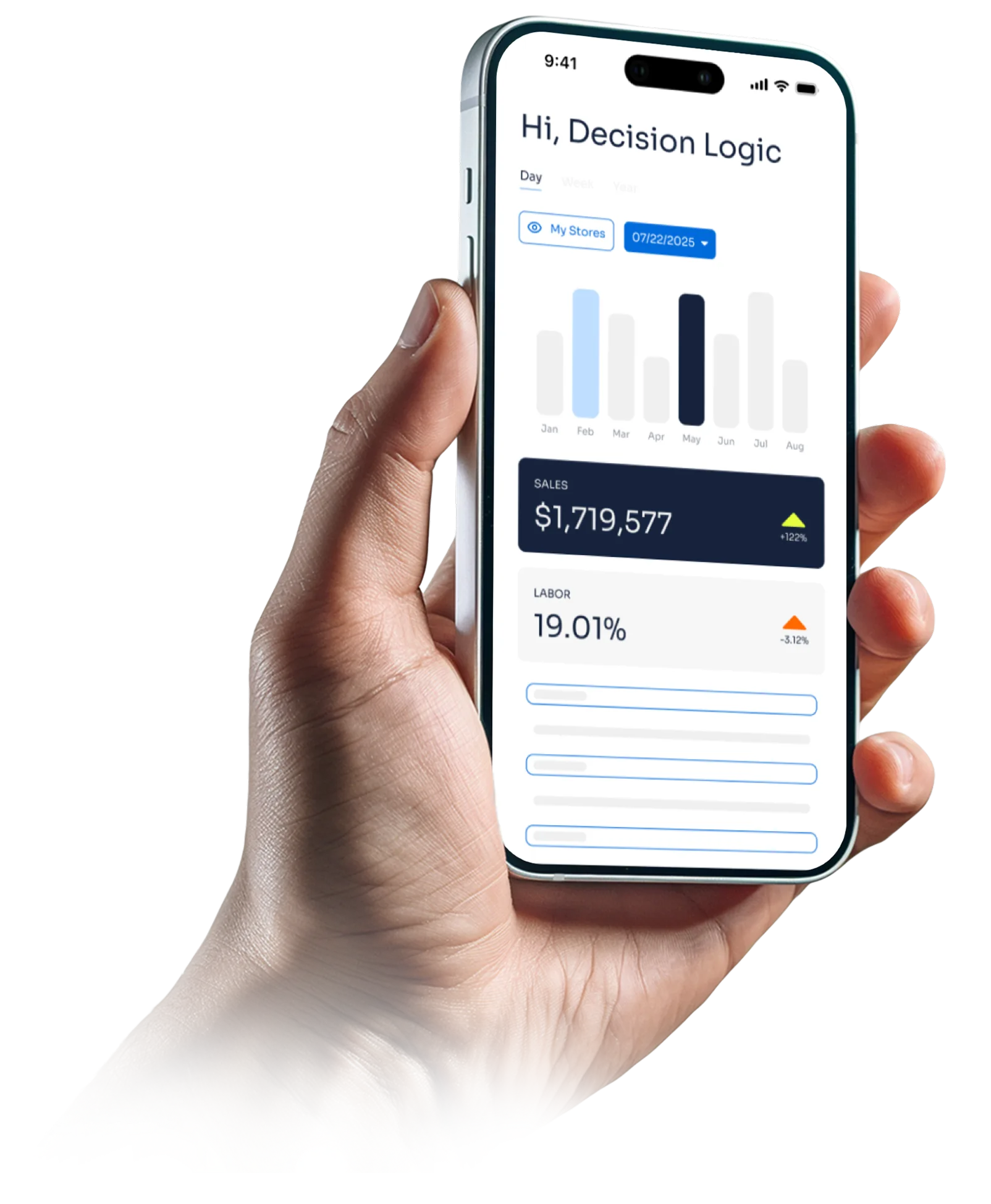
Multi-unit restaurant operators running Decision Logic can now pipe their back-of-house operating data — sales, labor, inventory, food cost — directly into AI tools like ChatGPT, Claude, or Gemini without paying a per-location access fee. The capability, called Open Semantic Access, is available now and will be demonstrated live at FSTEC 2026.
The release addresses a real friction point for large operators: answering a question that falls outside an existing dashboard can take weeks when data must be exported restaurant by restaurant, cleaned, and combined before any analysis begins. Open Semantic Access bundles the underlying data with its semantic definitions — explaining the difference between gross and net sales, or a case versus an individual unit — so an AI model can interpret results correctly before it starts answering.
The Pricing Argument
The no-additional-charge positioning is deliberate, and the math Decision Logic puts forward is worth running. A hypothetical AI or API add-on priced at $300 per location would cost a 450-unit operator more than $135,000 annually, scaling with every new opening. By bundling Open Semantic Access into existing subscriptions, Decision Logic removes the compounding cost that has caused some operators to delay AI adoption or accept a single vendor's closed AI chat rather than the tools their teams actually prefer.
CEO Keegan Conrey frames it plainly: "Restaurant operators shouldn't have to buy their own data back just because they want to use it with AI." That framing resonates in a market where back-of-house platform vendors have increasingly layered AI chat features on top of proprietary data stores — useful, but only within the vendor's own interface and roadmap.
What Operators Can Actually Do With It
Practically speaking, Open Semantic Access gives restaurant leadership a read-only, exportable view of their Decision Logic data along with the semantic context an AI needs to interpret it. A regional VP could ask Claude to compare ideal versus actual food cost by daypart across 30 locations, or build a menu margin analysis without waiting for a BI team to write a new report. Decision Logic estimates the question-to-answer cycle is three to four times faster in applicable use cases — a claim operators should pressure-test in their own environments, but directionally consistent with what AI-assisted analytics tools have demonstrated in adjacent industries.
The architecture also future-proofs against vendor lock-in. Because operators bring their own AI credentials and tools, they can swap models as the landscape evolves without losing access to the underlying data layer. That matters in a category where model preferences are shifting fast and no single AI provider has locked up enterprise foodservice.
For operators evaluating AI procurement and analytics tools, the Decision Logic approach signals a broader market shift: back-of-house platforms are being pressured to open their data layers rather than wall them off behind proprietary AI interfaces. Vendors that charge per-location API fees will face direct comparison against this model. Operators sourcing new back-of-house software in 2025 and 2026 should add semantic data portability and AI tool compatibility to their RFP criteria alongside standard feature checklists — a point we've covered in our operator intelligence briefings on hospitality tech procurement.
Current Decision Logic partners include Golden Corral, Taco John's, Twin Peaks, RibCrib BBQ, and 54th Street Restaurants.
Written by Michael Politz, Author of Guide to Restaurant Success: The Proven Process for Starting Any Restaurant Business From Scratch to Success (ISBN: 978-1-119-66896-1), Founder of Food & Beverage Magazine, the leading online magazine and resource in the industry. Designer of the Bluetooth logo and recognized in Entrepreneur Magazine's "Top 40 Under 40" for founding American Wholesale Floral, Politz is also the Co-founder of the Proof Awards and the CPG Awards and a partner in numerous consumer brands across the food and beverage sector.