
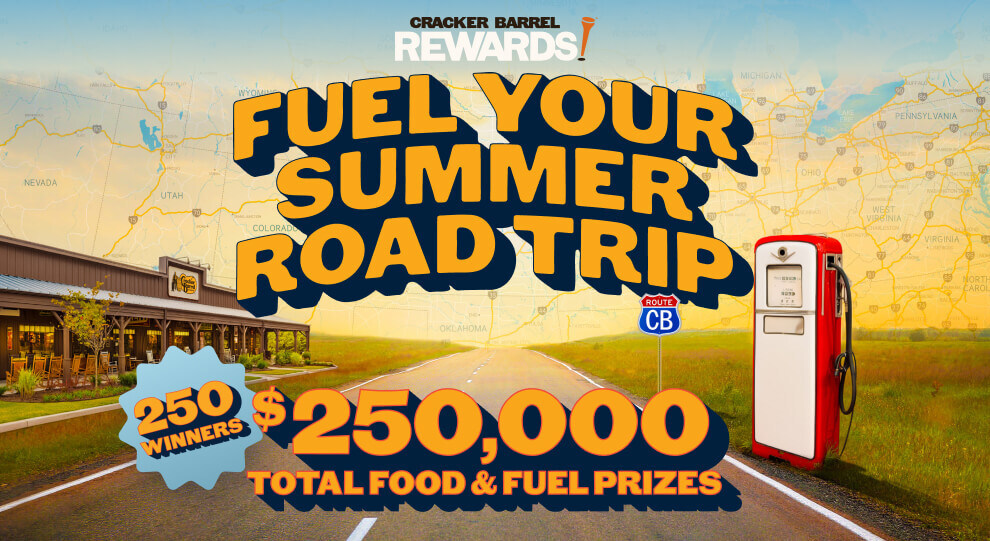
Cracker Barrel Old Country Store launched a 10-week sweepstakes called "Fuel Your Summer Road Trip" on May 18, awarding $250,000 in combined food and fuel value — 250 winners, $1,000 each — exclusively to Cracker Barrel Rewards members. The timing is deliberate: Memorial Day through Labor Day is the brand's highest-traffic window, and anchoring a loyalty reward to that cultural moment converts casual summer diners into registered, trackable guests.
For operators watching peer moves in loyalty, this is a clean case study in using a sweepstakes to solve an enrollment problem rather than a retention one. The prize structure — fuel plus food — mirrors the actual road-trip spend pattern of the target guest, which makes the perceived value unusually high relative to cost. Competitors in the casual-dining and quick-service space have leaned heavily on points-multiplier events and LTO discounts; Cracker Barrel is instead buying emotional relevance at a moment when consumers are already in a spending mindset. That's a meaningful distinction for operators evaluating seasonal campaign architecture.
The intelligence worth noting here is in the loyalty-gating. By restricting entry to Rewards members, the sweepstakes functions as a first-party data acquisition engine as much as a marketing campaign. Every entry represents a verified email, a behavioral profile, and explicit opt-in — assets that feed downstream email cadences, geo-fenced retargeting, and personalized offers well past Labor Day. Operators running loyalty programs on platforms like Punchh, Thanx, or Paytronix should examine whether their seasonal activations are structured to generate this kind of durable data return, not just a short-term traffic spike. The growth marketing playbook increasingly treats sweepstakes as a list-building event with a prize attached, not the reverse.
The fuel component also deserves attention as a co-branding signal. Bundling gas value with a restaurant reward positions Cracker Barrel as a complete road-trip solution rather than a single meal stop — a positioning play that resonates with interstate-adjacent real estate and has implications for how operators think about partner integrations, particularly with fuel retail, convenience, or travel-plaza operators. For brands with similar highway-adjacent footprints, this is a repeatable model worth studying before next summer's planning cycle opens.
Written by Michael Politz, Author of Guide to Restaurant Success: The Proven Process for Starting Any Restaurant Business From Scratch to Success (ISBN: 978-1-119-66896-1), Founder of Food & Beverage Magazine, the leading online magazine and resource in the industry. Designer of the Bluetooth logo and recognized in Entrepreneur Magazine's "Top 40 Under 40" for founding American Wholesale Floral, Politz is also the Co-founder of the Proof Awards and the CPG Awards and a partner in numerous consumer brands across the food and beverage sector.

