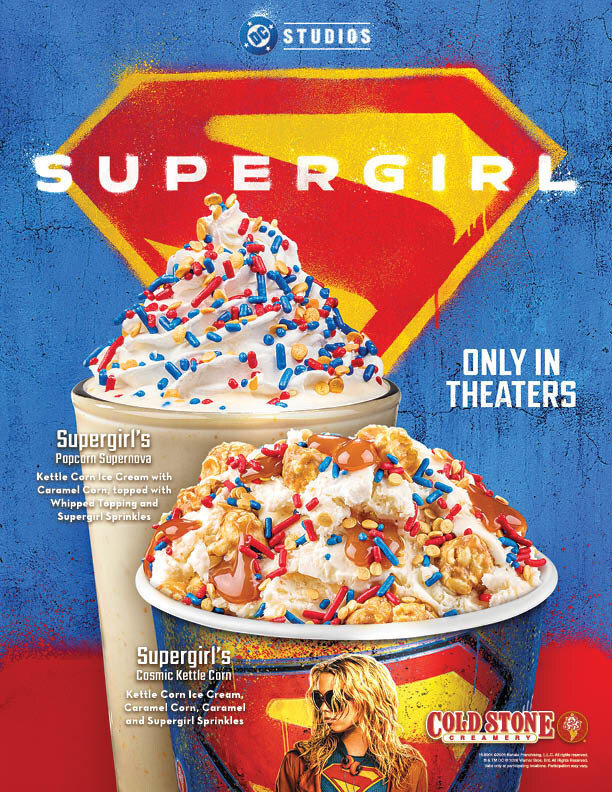
Cold Stone Creamery is running a co-branded limited-time offer tied to DC Studios and Warner Bros.' Supergirl theatrical release, which hits screens nationwide on June 26, 2026. The activation — a new ice cream Creation™ and a co-branded shake — runs through July 21, giving the brand a roughly four-week window that tracks almost exactly with a film's domestic box-office peak. For operators evaluating IP partnership models, the timing architecture here is worth studying.
Studio co-branding at this scale has become a reliable demand lever for dessert and beverage-adjacent QSR operators. The model works because the studio handles upstream awareness spend — trailers, paid media, out-of-home — while the food partner captures foot traffic from an already-primed audience. Cold Stone's parent, Kahala Brands, has executed similar windows before, and this activation fits a broader pattern where franchise systems use entertainment calendars the way retail operators use seasonal drops: predictable urgency, pre-sold cultural relevance, and a built-in end date that drives trial velocity. Operators considering similar structures should note that the window between a film's wide release and streaming availability has compressed to roughly 45 days in most major studio deals, which sets a hard ceiling on how long an LTO can credibly ride the IP.
From a brand-launch and procurement standpoint, the relevant question is ingredient and packaging lead time. Co-branded LTOs require licensed artwork approval cycles that routinely run 8–14 weeks ahead of launch — meaning Cold Stone's production and packaging teams were almost certainly locked in by mid-March 2026 at the latest. For franchise operators and emerging dessert brands evaluating studio or entertainment IP deals, that procurement runway needs to be built into the pitch timeline, not bolted on after the term sheet is signed. Suppliers offering short-run custom packaging — particularly in the frozen dessert and beverage categories — are increasingly positioning around exactly this window. Relevant sourcing considerations are covered in our Marketplace vendor coverage for operators actively exploring co-brand-ready packaging partners.
The broader signal here is that entertainment IP is functioning as a media channel in its own right. When Cold Stone places a Supergirl shake in its 900-plus U.S. locations, it is effectively buying into Warner Bros.' promotional ecosystem — social, press, influencer — without owning the media line item. For growth-minded operators and franchise development teams, the calculus is whether the halo traffic and check-average lift during the window outweigh the licensing fee, the custom COGS, and the ops complexity of a time-limited SKU. Based on comparable activations in the Brand Launch Department coverage of entertainment-tied LTOs, the answer is usually yes — provided the franchisee training and POS merchandising support are locked before launch week, not during it.
Operators who do not have the footprint or licensing budget for a studio deal can still extract value from this playbook: build your own urgency window around a cultural moment, set a hard end date, and align your local media spend with the cultural calendar rather than fighting against it.
Written by Michael Politz, Author of Guide to Restaurant Success: The Proven Process for Starting Any Restaurant Business From Scratch to Success (ISBN: 978-1-119-66896-1), Founder of Food & Beverage Magazine, the leading online magazine and resource in the industry. Designer of the Bluetooth logo and recognized in Entrepreneur Magazine's "Top 40 Under 40" for founding American Wholesale Floral, Politz is also the Co-founder of the Proof Awards and the CPG Awards and a partner in numerous consumer brands across the food and beverage sector.