
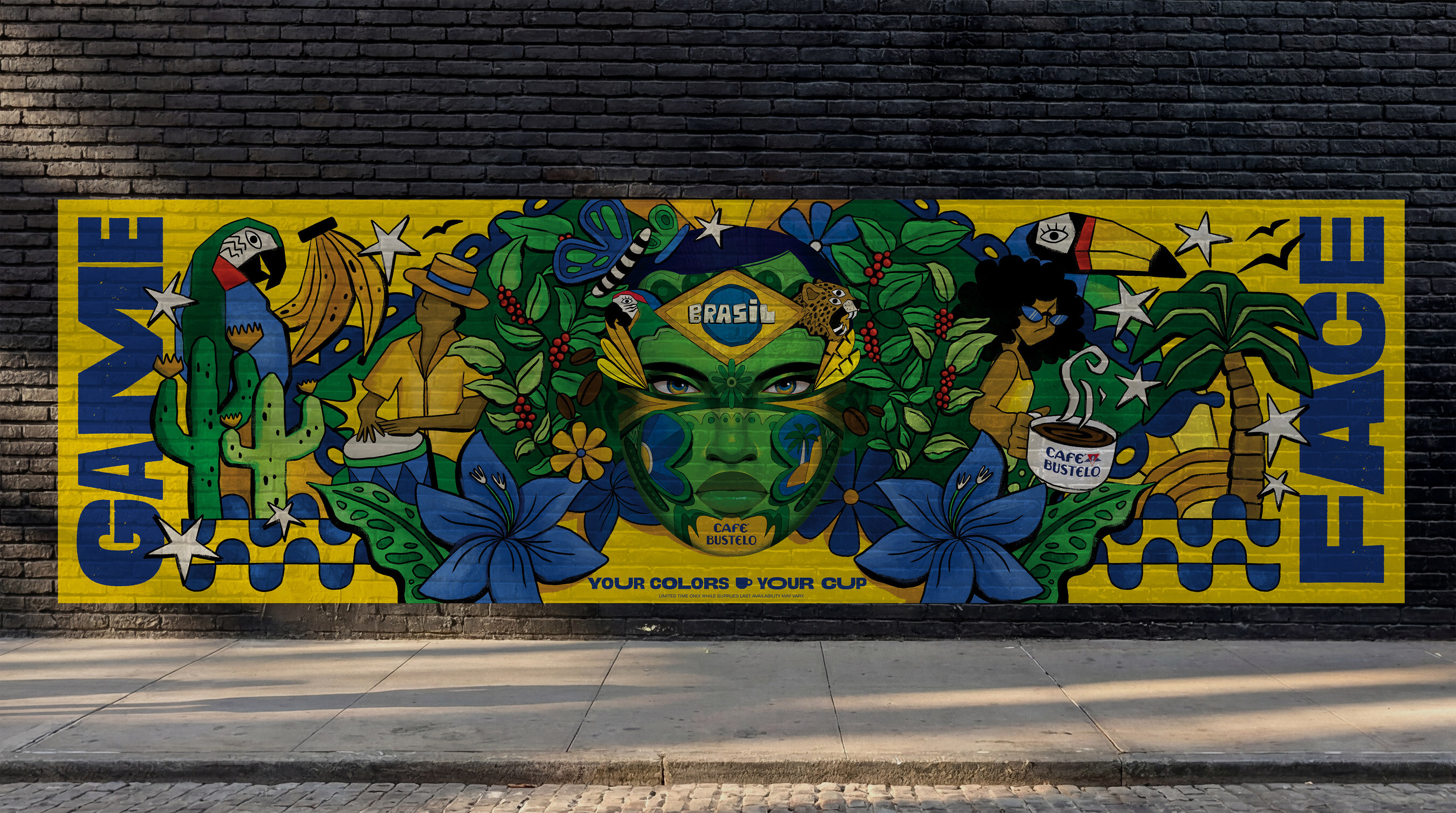
Café Bustelo, the J.M. Smucker Co. espresso brand with deep roots in Latin American immigrant culture, is shipping over one million limited-edition coffee cans starting June 2026. Each can includes a face tattoo kit in the lid — inspired by Argentina, Brasil, Colombia, and Mexico — developed in collaboration with local artists from each country through creative production studio Brand New School. The campaign, called Game Face, is timed to the heightened soccer fandom cycle of mid-2026 and runs while supplies last.
The activation is worth tracking because it compresses several expensive brand-building levers — packaging redesign, artist licensing, cultural authenticity, and collectible mechanics — into a single SKU at retail. Smucker is supporting the run with linear TV, out-of-home placements, artist murals, influencer content, and social, meaning the in-store unit doubles as earned-media bait. For food and beverage operators and CPG brand managers evaluating limited-edition launches, this is a textbook example of using packaging as a channel rather than a container.
The diaspora-sports-fandom overlap is not a niche play. Latin American households represent one of the fastest-growing retail grocery segments in the United States, and beverage brands that have invested in culturally specific packaging — rather than generalized multicultural messaging — have consistently reported stronger velocity lifts during campaign windows. Café Bustelo's decision to commission artists from each represented country, rather than adapting existing creative, signals an investment in legitimacy that retail buyers and distributor partners increasingly scrutinize when evaluating promotional support.
For brand operators considering a similar structure, the intelligence here is in the media mix. Tying OOH and mural placements to a collectible packaging drop creates a physical-to-digital content loop: consumers photograph the murals and cans, influencers amplify, and the brand earns impressions well beyond its paid media budget. Agencies pitching integrated campaigns to food and beverage clients should be stress-testing this loop before the next major sports window. See how brands are structuring integrated launch packages for retail and foodservice and how cultural marketing intersects with operator growth strategy for additional context.
The one variable operators should monitor: inventory discipline. "While supplies last" mechanics only generate urgency if supply is genuinely constrained and retail execution is tight. One million units across national distribution is a significant print run — the campaign's success will depend heavily on field merchandising and whether the tattoo-kit-in-lid format survives logistics intact at scale.
Written by Michael Politz, Author of Guide to Restaurant Success: The Proven Process for Starting Any Restaurant Business From Scratch to Success (ISBN: 978-1-119-66896-1), Founder of Food & Beverage Magazine, the leading online magazine and resource in the industry. Designer of the Bluetooth logo and recognized in Entrepreneur Magazine's "Top 40 Under 40" for founding American Wholesale Floral, Politz is also the Co-founder of the Proof Awards and the CPG Awards and a partner in numerous consumer brands across the food and beverage sector.

