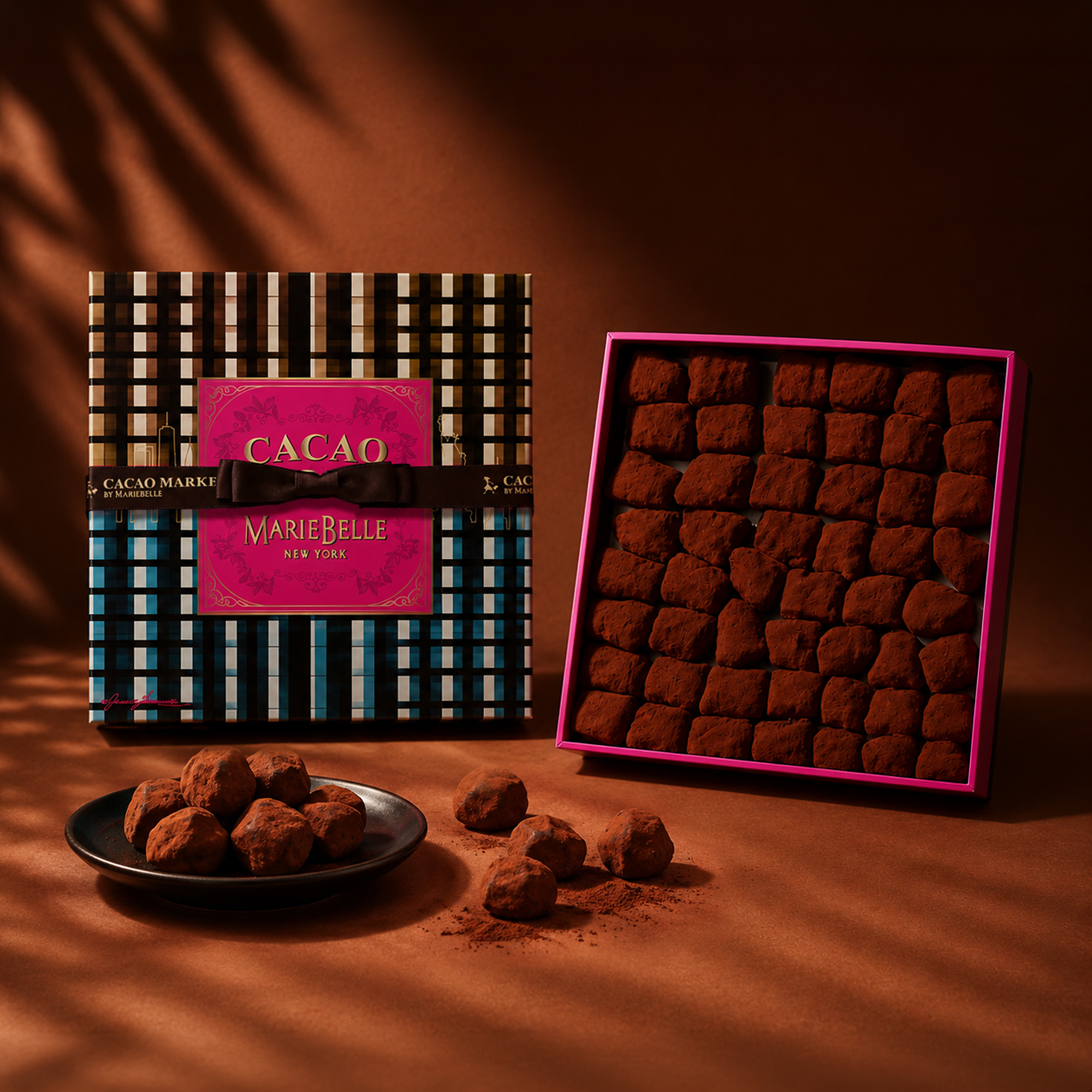
A luxury chocolate brand's mass-channel pivot just got a real-world test. Cacao Market by MarieBelle New York has placed its 50-piece Dark Chocolate Truffles in select Costco warehouses across Brooklyn, Long Island, Staten Island, and New Jersey, with a three-box bundle available nationwide on Costco.com for $84.00. The individual box retails at $21.99 and is also available through Instacart. The launch is timed to holiday gifting — one of the highest-velocity windows in specialty food retail.
The move is a case study in brand architecture. MarieBelle New York operates SoHo boutiques and a Japan outpost at the premium end; Cacao Market is the sub-brand engineered to travel into higher-volume channels without diluting the parent brand's luxury positioning. That separation — distinct name, distinct geometric packaging influenced by artist Jacques Lieberman, distinct price tier — is exactly the structure wholesale buyers and retail category managers look for when a fine-food brand approaches a mass club account.
The Channel Mechanics
Costco's roadshow program is doing real work here. Cacao Market will run weekly in-warehouse sampling events at participating locations, a format that converts browsers into buyers faster than shelf placement alone. For operators and brand-launch teams watching this, the roadshow is both a trial mechanism and a data engine: it surfaces real-time consumer response, generates volume velocity numbers that strengthen future buyer conversations, and gives the brand a live presence that digital ads cannot replicate in a membership warehouse environment. Brands that use Costco roadshows strategically treat them as paid media with a direct sales overlay — the sampling cost is essentially a customer-acquisition spend with an immediate purchase attached.
What Retail Buyers Are Watching
The $21.99 price point for 50 pieces threads a specific needle. It is accessible enough to sit comfortably in a Costco basket alongside pantry staples, but high enough to signal that this is not a commodity truffle. For specialty food brands considering a similar tier-down sub-brand strategy, the Cacao Market model is worth mapping: maintain a flagship brand at full premium positioning, spin a separate SKU architecture into club or grocery channels, and use differentiated packaging to hold the brand equity wall between the two. That approach is increasingly common in beverage and snack categories, and chocolate is catching up.
For foodservice operators, hotel gift shops, and corporate gifting buyers specifically, the Costco placement signals that Cacao Market volume pricing and multi-box bundles are now in play for institutional purchasing — without requiring a direct wholesale relationship. The three-box bundle at $84.00 lands at a per-unit cost that works for amenity programs or catered event gifting at scale. Operators sourcing holiday gifting inventory should note the limited-time availability window and warehouse-specific distribution before planning around it.
This is also a clean example of retail-ready brand launch execution — sampling activation, e-commerce availability, regional warehouse placement, and bundle pricing all moving in coordination rather than sequentially. Brands preparing for a similar club-channel entry can use this rollout as a structural benchmark.
Written by Michael Politz, Author of Guide to Restaurant Success: The Proven Process for Starting Any Restaurant Business From Scratch to Success (ISBN: 978-1-119-66896-1), Founder of Food & Beverage Magazine, the leading online magazine and resource in the industry. Designer of the Bluetooth logo and recognized in Entrepreneur Magazine's "Top 40 Under 40" for founding American Wholesale Floral, Politz is also the Co-founder of the Proof Awards and the CPG Awards and a partner in numerous consumer brands across the food and beverage sector.