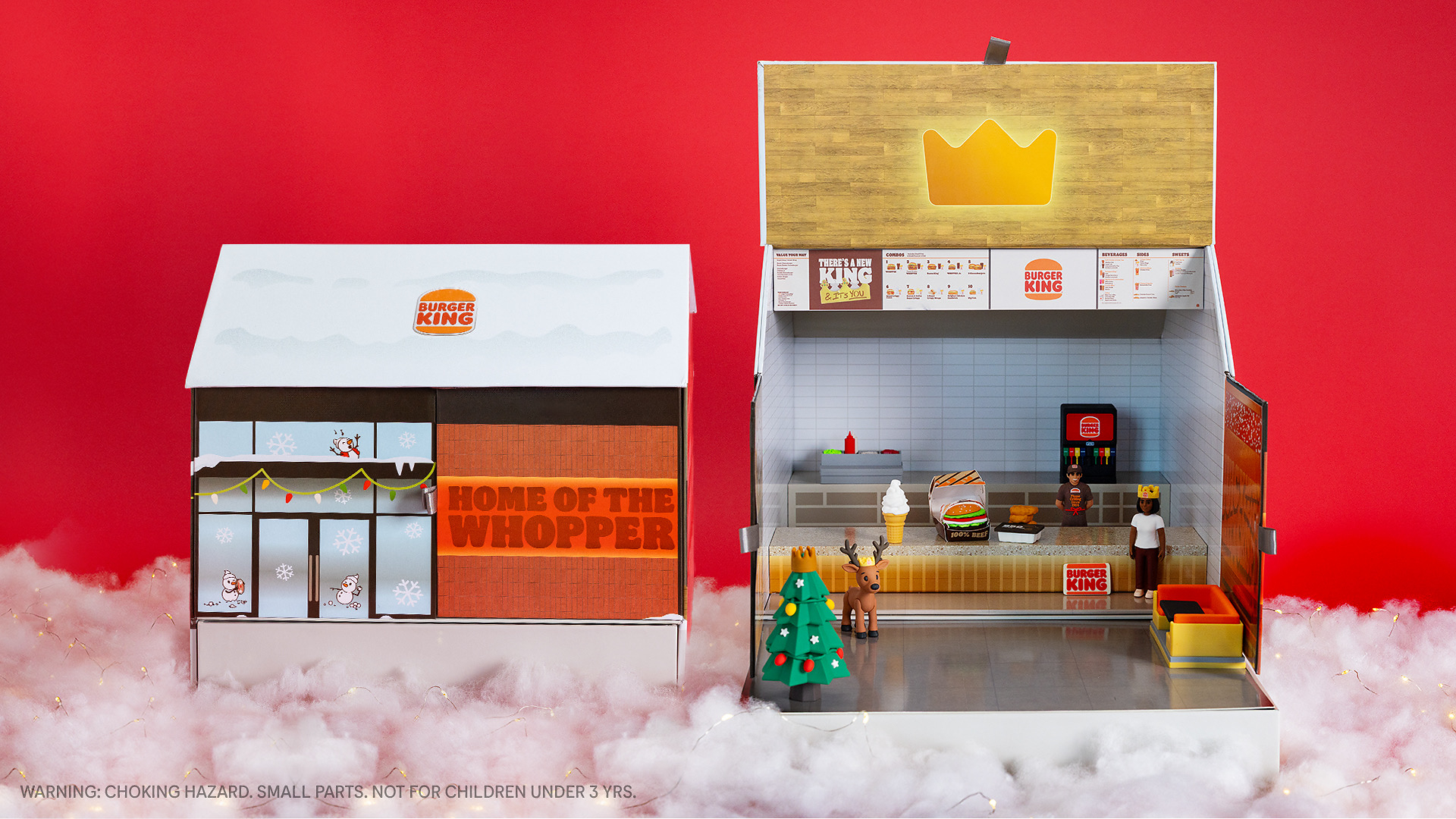
Burger King is releasing its 2026 BK Advent Calendar on November 16 through November 20, pricing the collectible at $19.54—a figure that nods to the chain's founding year—and limiting availability to 110 units per day while supplies last. The calendar sold out in under five minutes in each of the past two years, and the brand is leaning into that track record as a marketing asset, not a supply-chain problem.
The product itself is a 12-piece miniature Burger King restaurant build-out: a Whopper in updated box packaging, nuggets with sauce, a soda machine, King's Booth seating, a team member figure, and holiday props including a reindeer and tree. All pieces assemble into a displayable miniature restaurant on Day 12. Royal Perks members also unlock a miniature $5 digital coupon inside the final door.
The Scarcity Mechanic
For foodservice operators and QSR brand teams watching limited-edition merchandise strategy, the BK calendar is a clean case study in demand manufacturing through artificial scarcity. The chain is not trying to maximize unit revenue—$19.54 at 110 units per day over five days represents a ceiling of roughly 550 total calendars, a volume that generates almost no meaningful direct revenue at that scale. The play is entirely in earned media, loyalty activation, and Royal Perks enrollment. Joel Yashinsky, Chief Marketing Officer for Burger King US&C, framed the drop explicitly around the loyalty layer: the Day 12 digital coupon is redeemable only through the BK app by logged-in Royal Perks members, making the calendar a physical acquisition funnel for the digital loyalty program.
This mechanic is worth noting for hotel F&B teams, fast-casual operators, and CPG brands planning holiday campaigns. The drop structure—daily limited windows, single-unit-per-household enforcement, direct-to-consumer e-commerce only—eliminates retail margin, creates appointment commerce, and generates social urgency without discounting the core product. It is a tighter loop than a traditional bounce-back coupon or seasonal LTO.
What Operators Should Take Away
The mini-collectible format also rides a documented trend in consumer packaged goods and QSR merchandise: miniaturized versions of brand icons consistently outperform standard promotional items in earned social reach, particularly on platforms where unboxing and display content performs well. Brands exploring brand launch and merchandise strategy in foodservice should note that the production complexity here—12 unique injection-molded pieces with detailed paint applications—is not a low-cost execution. The calendar's value is built into the perceived craftsmanship, not just the IP.
For operators considering loyalty-integrated promotions, the Royal Perks redemption gate is the structural detail most worth studying. Rather than offering the digital coupon broadly, BK requires app login and membership, creating a data capture event inside a physical product. That approach mirrors what several hotel loyalty programs have done with key card collectibles and amenity drops—tangible objects that unlock digital rewards. Operators building out their own CRM and loyalty stacks should explore how loyalty-linked promotional mechanics fit within broader growth-marketing frameworks.
The calendar ships the week of November 30, with free standard shipping to the 48 contiguous states.
Written by Michael Politz, Author of Guide to Restaurant Success: The Proven Process for Starting Any Restaurant Business From Scratch to Success (ISBN: 978-1-119-66896-1), Founder of Food & Beverage Magazine, the leading online magazine and resource in the industry. Designer of the Bluetooth logo and recognized in Entrepreneur Magazine's "Top 40 Under 40" for founding American Wholesale Floral, Politz is also the Co-founder of the Proof Awards and the CPG Awards and a partner in numerous consumer brands across the food and beverage sector.