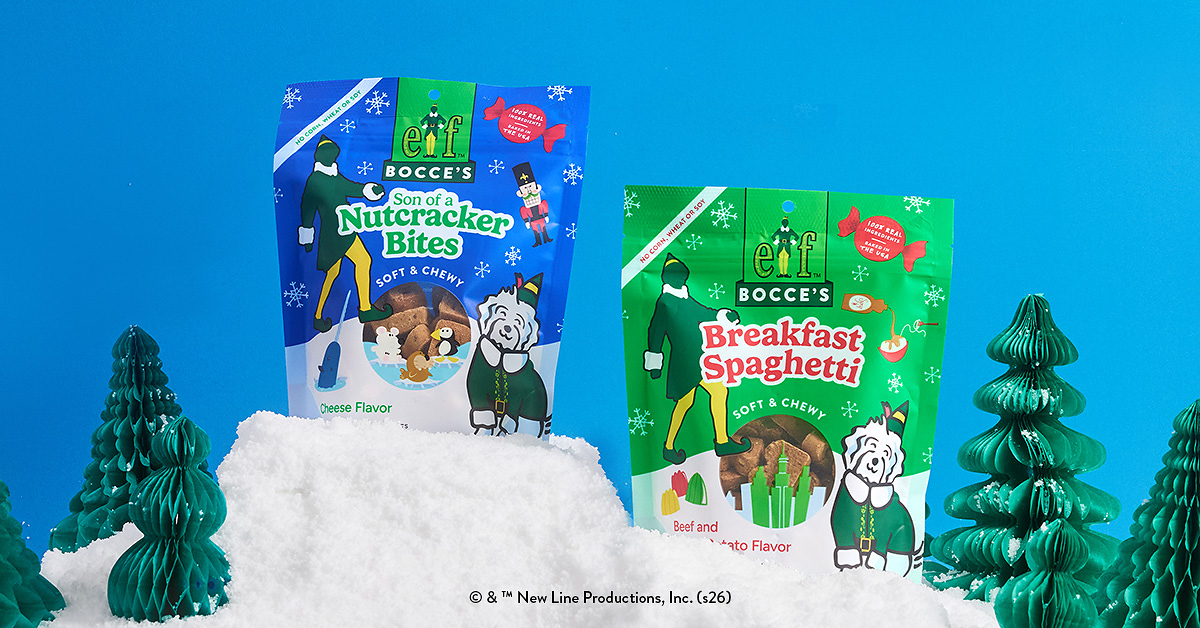
Limited-ingredient pet treat brand Bocce's Bakery is entering the holiday season with a licensed product partnership, releasing two new soft-and-chewy dog treat flavors tied to the Warner Bros. film Elf. The SKUs — Breakfast Spaghetti (beef and sweet potato) and Son of a Nutcracker Bites (cheese) — are available now at Target, PetSmart, Petco, Amazon, and Chewy, as well as direct-to-consumer via boccesbakery.com. For food and beverage operators tracking adjacent consumer spending and pet-humanization trends, this launch is a useful retail-velocity signal: IP-licensed seasonal SKUs are increasingly a demand-generation lever, not just a novelty.
The Licensing Angle
Partnering with Warner Bros. Global Consumer Products gives Bocce's a built-in cultural hook during the most competitive shelf period of the year. Rather than competing on price or pack size alone, the brand is leaning into recognizable IP to drive trial and basket attachment — a strategy familiar to food and beverage marketers who have watched licensed co-brands move volume at holiday more reliably than unbranded line extensions. For specialty and mass retail buyers, a Warner Bros. tie-in also simplifies the in-store storytelling pitch: endcap placement and seasonal signage practically write themselves when the IP is already in consumers' heads.
The two new flavors join an existing festive lineup that includes Reindeer Tracks (chicken and pumpkin) and Bocce's Frosted Cran Crumble (cranberry and yogurt), plus a feline-targeted Feast of Fishies Lickables (tuna and salmon) — signaling that the brand is building a full seasonal assortment rather than a single promotional item. That depth matters to retail planners who need to fill holiday sets and to e-commerce merchandisers building gift-guide collections.
What This Signals for Operators
Pet food and treat purchasing now tracks closely with broader specialty food behavior: limited ingredients, transparent sourcing, and U.S. manufacturing are table-stakes claims across both categories. Bocce's formulations carry no wheat or artificial preservatives and are baked domestically — positioning that resonates with the same consumer cohort driving premium growth in better-for-you food and beverage.
For foodservice and hospitality operators building retail-ready or gift-channel revenue — hotel gift shops, restaurant merchandise lines, subscription boxes — the mechanics of this launch are worth studying. A licensing partnership compresses the brand-building timeline, gives retail buyers a margin-friendly story, and creates a natural social media moment that the licensor's existing fan base amplifies at no additional media cost. Wendy Wen, CEO of Bocce's, framed the rationale concisely: treating the brand's core limited-ingredient commitment as non-negotiable even inside a licensed collaboration keeps the product credible with existing buyers while reaching new ones.
For brands considering seasonal product launches and retail distribution introductions, the Bocce's model — anchor the innovation in a recognizable cultural property, stay on-formula with clean ingredients, and syndicate across mass and specialty channels simultaneously — is a repeatable playbook that Q4 2026 will put to a real-world stress test.
Written by Michael Politz, Author of Guide to Restaurant Success: The Proven Process for Starting Any Restaurant Business From Scratch to Success (ISBN: 978-1-119-66896-1), Founder of Food & Beverage Magazine, the leading online magazine and resource in the industry. Designer of the Bluetooth logo and recognized in Entrepreneur Magazine's "Top 40 Under 40" for founding American Wholesale Floral, Politz is also the Co-founder of the Proof Awards and the CPG Awards and a partner in numerous consumer brands across the food and beverage sector.