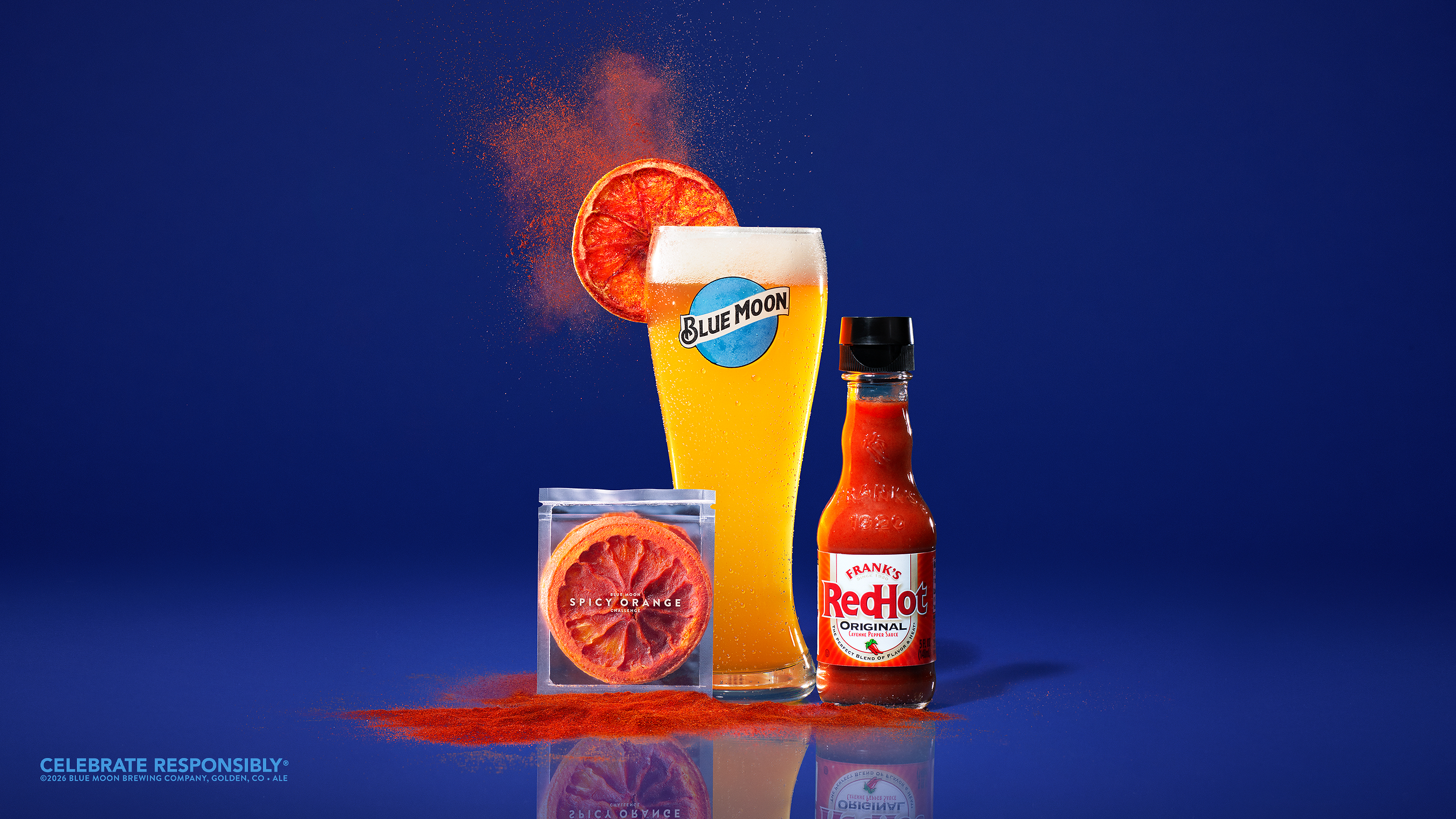
Blue Moon is turning its signature orange garnish into a consumer activation, launching the Spicy Orange Challenge in partnership with Frank's RedHot — a limited-edition kit that pairs a ghost-pepper-coated dried Valencia orange slice with a branded glass, a gift card toward a 6-pack, and a bottle of Frank's Original Hot Sauce. The kits, priced at $19.95 each, are available in drops of 100 units on July 20 and July 27 at the Blue Moon online shop. For on-premise operators and beverage directors, the move is worth watching less for the kit itself and more for the insight baked into the brief.
The Trend Behind the Stunt
Molson Coors is citing IPSOS Bar Community data from May 2026 showing that 90.0% of Blue Moon drinkers report liking or loving spicy foods, and that nearly 70.0% of beer drinkers already pair beer with spicy dishes. Those numbers point to a consumption occasion that most beer programming still ignores. Elizabeth Hitch, VP of Marketing, Above Premium Beer at Molson Coors Beverage Company, framed it plainly: most consumers know the orange-and-Blue Moon pairing, but the spicy-food pairing has been an undercommunicated story. This activation is the brand's attempt to own that narrative before a competitor does.
The Frank's RedHot partnership is strategically efficient. Frank's, a McCormick & Company brand with approximately $7 billion in annual McCormick sales across 150 countries, carries its own broad consumer recognition — particularly among 21–35 bar-going demographics who associate it with wings and game-day occasions. Co-branding here does double duty: it signals heat credibility and borrows a food-occasion association that beer marketers have long ceded to spirits and hard seltzers.
What Operators Should Take From This
The 100-kit cap is deliberately scarce, which means most operators will never stock or serve the official challenge kit. But the activation logic is fully replicable at the bar level. A spicy-citrus garnish riff — whether a Tajín-rimmed wheat beer, a jalapeño-orange tincture, or a house spicy-beer cocktail — costs pennies in food cost and creates exactly the kind of shareable, participatory moment this campaign is engineered to generate. Beverage directors at casual dining chains and sports bars should treat this as a concept test Molson Coors is running on their behalf.
For procurement teams evaluating tap handles and feature rotations, the broader signal is that above-premium domestic craft-positioned SKUs are competing on experience architecture, not just liquid quality or ABV. Blue Moon's oat-based, creamy body is being actively positioned as a spice buffer — a functional flavor argument that could inform how distributors and on-premise teams pitch the brand in spicy-menu contexts. See how other beverage brands are building occasion-based positioning and review how co-branded activations are reshaping bar program procurement.
The spicy-food trend has proven durable across foodservice segments. Ghost peppers, hot honey, and gochujang have all migrated from chef menus to fast casual to grocery center aisles. Beer brands have been slow to claim any piece of that occasion. This activation suggests Molson Coors is moving to close that gap — and smaller craft operators should read it as a category cue, not just a Molson Coors marketing moment.
Written by Michael Politz, Author of Guide to Restaurant Success: The Proven Process for Starting Any Restaurant Business From Scratch to Success (ISBN: 978-1-119-66896-1), Founder of Food & Beverage Magazine, the leading online magazine and resource in the industry. Designer of the Bluetooth logo and recognized in Entrepreneur Magazine's "Top 40 Under 40" for founding American Wholesale Floral, Politz is also the Co-founder of the Proof Awards and the CPG Awards and a partner in numerous consumer brands across the food and beverage sector.