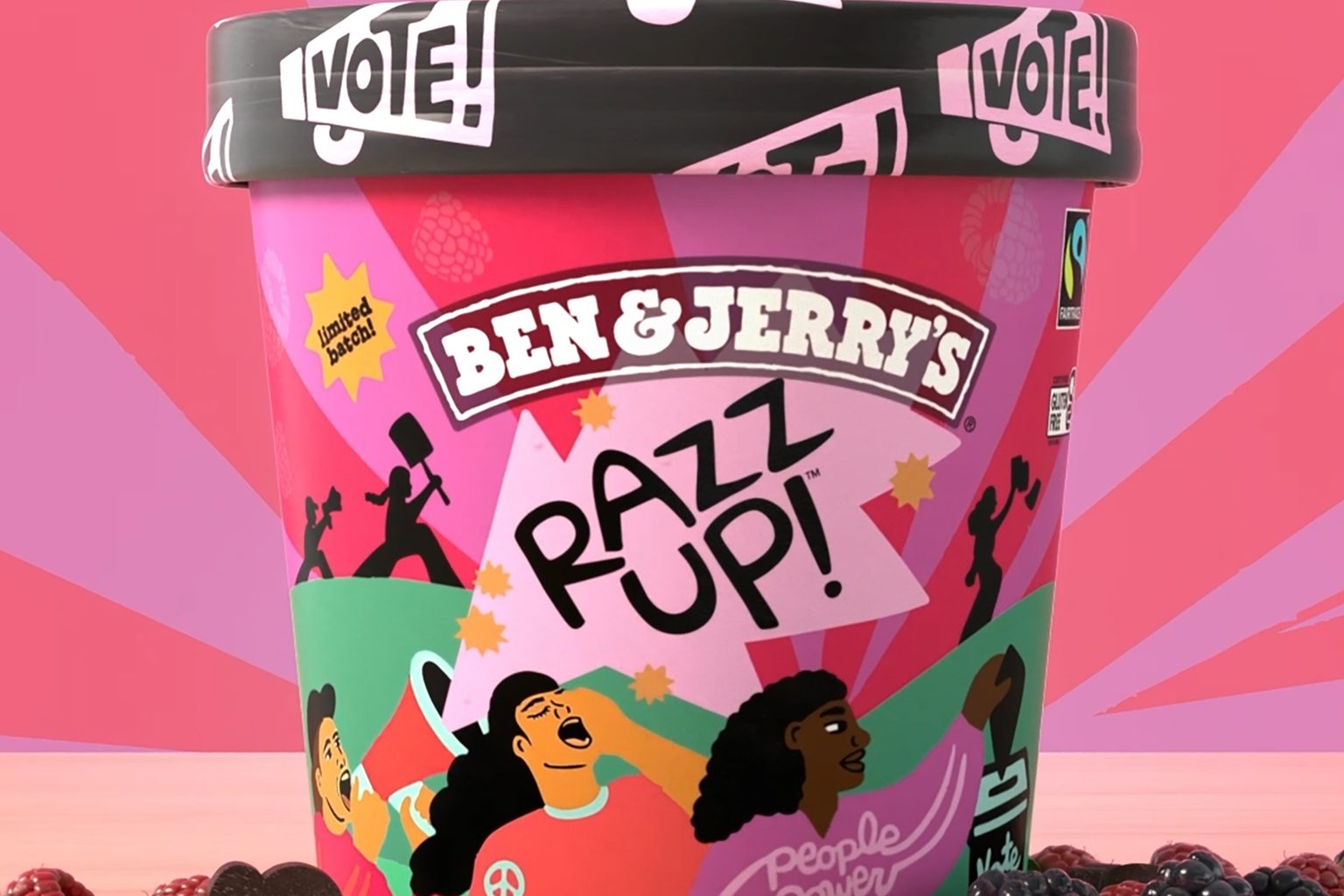
Ben & Jerry's is launching Razz Up!, a new flavor tied directly to a voter-mobilization campaign targeting the 2026 midterm elections. The campaign frames the product as a vehicle for civic action — explicitly calling out what the brand describes as threats to voting rights and immigrant communities — making it one of the more direct political activations from a major CPG food brand in recent memory.
For operators and brand marketers watching the CPG space, the move is worth dissecting beyond its political messaging. The mechanics here — a named limited-edition SKU, a campaign microsite, multichannel paid and earned media, and a cause-marketing call to action — represent a well-established brand-launch playbook accelerated to meet a cultural moment.
Cause as Campaign Architecture
What Ben & Jerry's is executing is less a PR stunt than a structured brand-launch sequence. A flavor serves as the hook; the campaign narrative provides the content engine; earned media amplification (political coverage, social sharing) does the distribution work that a conventional media buy would otherwise require. For emerging food and beverage brands weighing activist positioning, this model demonstrates that cause alignment, when it is authentic to the brand's documented history, can compress the awareness-building timeline significantly.
Ben & Jerry's has run this playbook before — flavors including Pecan Resist and Justice ReMix'd preceded Razz Up! — which means the brand carries an established consumer expectation for this kind of activation. Newer brands attempting to replicate it without that track record face a credibility gap that no media budget easily closes. Retail buyers and foodservice distributors are increasingly attuned to that distinction when evaluating mission-driven brand pitches.
What the Activation Model Signals
From a brand launch standpoint, the Razz Up! rollout reinforces a trend visible across better-for-you and values-led food brands: the product launch and the campaign launch are now the same event. There is no quiet retail seeding followed by a marketing push. The flavor name, the campaign name, and the media moment are engineered as a single unit.
For operators and buyers in foodservice, this matters because it shapes consumer expectations around the brands they stock. A consumer who discovers Razz Up! through a voter-registration activation arrives at the freezer case with a different relationship to the product than one who found it through a price promotion. That distinction carries implications for operator intelligence around how mission-driven SKUs perform across different retail and foodservice channels.
The broader signal for the food and beverage industry is that values-led brands are moving toward tighter integration between product development, campaign strategy, and earned media — a model that demands cross-functional coordination most emerging brands are not yet staffed to execute without outside support.
Written by Michael Politz, Author of Guide to Restaurant Success: The Proven Process for Starting Any Restaurant Business From Scratch to Success (ISBN: 978-1-119-66896-1), Founder of Food & Beverage Magazine, the leading online magazine and resource in the industry. Designer of the Bluetooth logo and recognized in Entrepreneur Magazine's "Top 40 Under 40" for founding American Wholesale Floral, Politz is also the Co-founder of the Proof Awards and the CPG Awards and a partner in numerous consumer brands across the food and beverage sector.