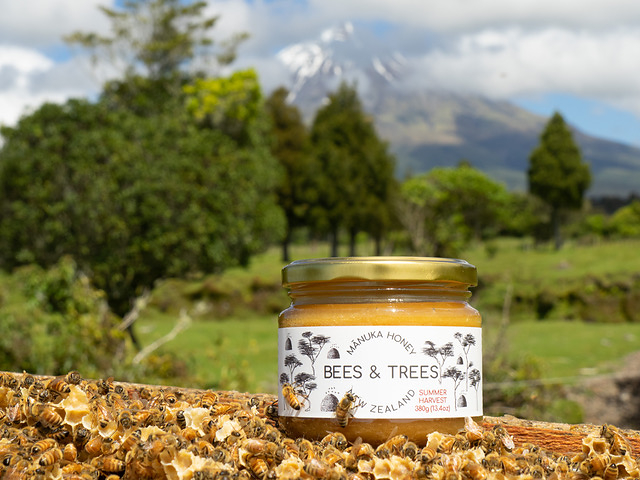
A family-owned New Zealand Mānuka honey brand hitting its 15th year in the U.S. market is not, on its own, a headline. What makes Bees & Trees worth watching is the operational model underneath the milestone — vertical integration from 1,200 to 1,500 owned hives in eastern Taranaki, through extraction, aging, and independent MGO testing, to a glass jar shipped directly to American consumers. That supply-chain architecture is increasingly the differentiator specialty food buyers and wellness-positioned operators are asking for when they evaluate premium honey SKUs.
The Product Tier Logic
Bees & Trees structures its range around independently verified MGO concentrations: 350+ MGO "Mid-Activity," 550+ MGO "High-Activity," and 830+ MGO "Founder's Reserve," priced from $33 to $65. Each batch is third-party tested before it ships. For operators building wellness menus — hotel breakfast programs, spa amenity kits, boutique café tea service — that tiered, documented potency ladder gives procurement teams a clear rationale to present to guests. It also reduces the sourcing risk that comes with unverified Mānuka imports, a documented problem in the category.
The production process adds another layer of differentiation. After harvest, honey is aged 12 to 24 months under controlled temperatures, minimally processed, and never pasteurized. The result is a shelf-stable product with a flavor profile — caramel richness, floral complexity, creamy texture — that performs across both wellness applications (spoonful, warm tea, lemon water) and culinary uses (cheese boards, savory glazes, breakfast service). That dual-use positioning is useful for operators trying to justify a higher unit cost to ownership.
Gifting Season Implications
The brand's timing around its anniversary is deliberate. Fall wellness routines and Q4 gifting represent the two highest-demand windows for premium honey, and Bees & Trees is moving into both with a $41 gift-box configuration paired with a wooden honey spoon. For hotel gift shops, resort amenity programs, and specialty food retailers managing holiday inventory, a ready-to-gift, story-forward product with a verifiable provenance claim is easier to merchandise than a generic sweetener SKU.
Distribution currently runs through the brand's direct-to-consumer channel, Amazon, and select specialty and independent retailers across the U.S. That footprint signals a brand still in active retail expansion — which matters for brokers and category managers evaluating where white space exists in the premium honey set. Operators sourcing for on-premise use have direct purchasing access, which can simplify procurement compared to brands locked into broadline-only distribution.
For specialty food buyers and F&B operators building out wellness or gifting programs, the Bees & Trees model offers a useful reference point: owned supply chain, documented quality metrics, and a price ladder that accommodates multiple program tiers. Whether the channel is a hotel minibar, a spa retail shelf, or a boutique grocer's holiday endcap, the brand's 15-year track record in the U.S. market provides the category credibility that supports a premium ask. See our Operator Intelligence coverage on premium ingredient sourcing and Brand Launch Department resources for specialty food retail readiness for related context.
Written by Michael Politz, Author of Guide to Restaurant Success: The Proven Process for Starting Any Restaurant Business From Scratch to Success (ISBN: 978-1-119-66896-1), Founder of Food & Beverage Magazine, the leading online magazine and resource in the industry. Designer of the Bluetooth logo and recognized in Entrepreneur Magazine's "Top 40 Under 40" for founding American Wholesale Floral, Politz is also the Co-founder of the Proof Awards and the CPG Awards and a partner in numerous consumer brands across the food and beverage sector.