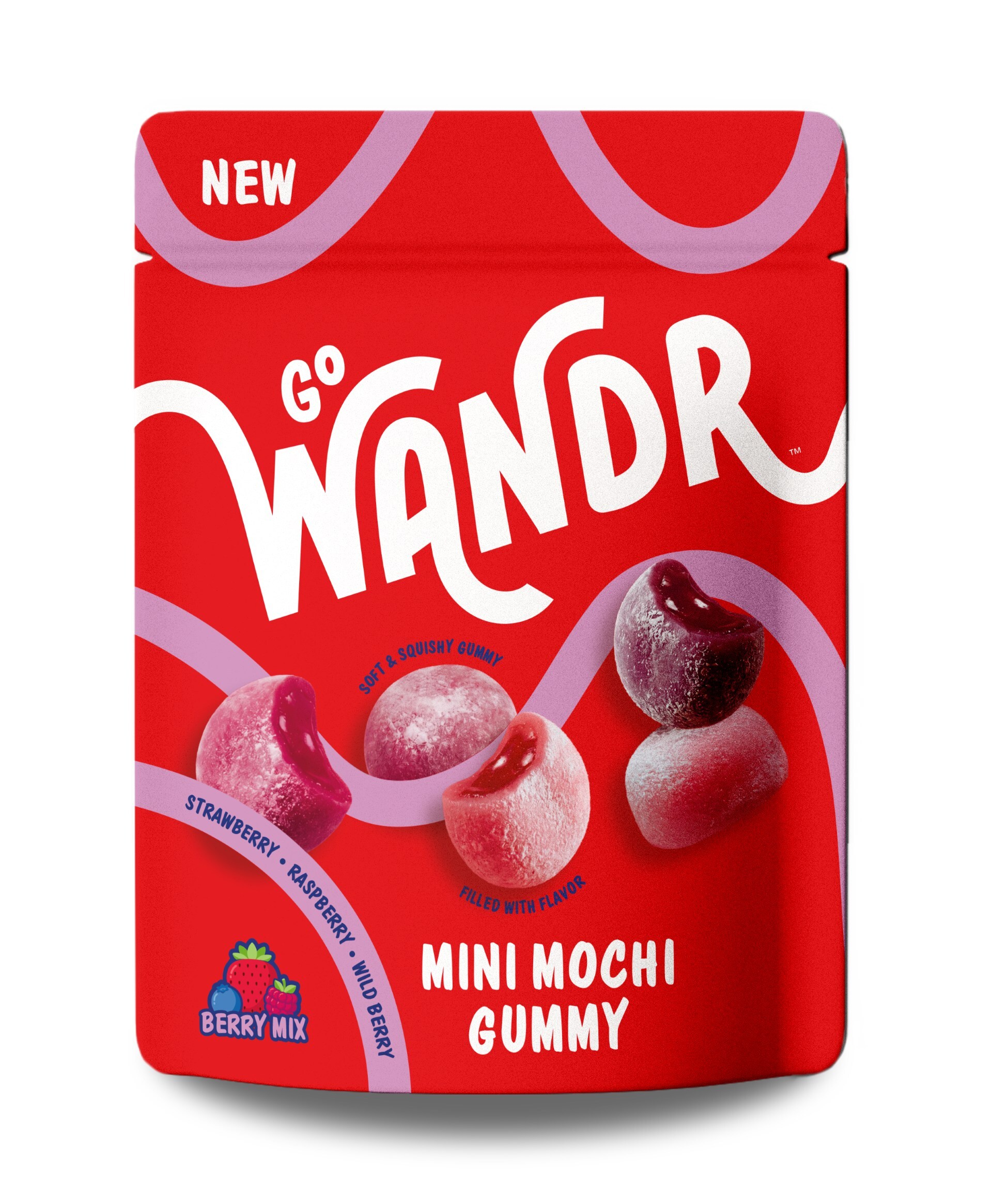
Bazooka Brands, the company behind decades of American candy staples, launched Go Wandr™ on May 18, a new standalone brand targeting consumers who want international flavor experiences without leaving their domestic retail aisle. The debut SKU — Mini Mochi Gummy — fuses Japanese mochi texture with a classic American gummy format. For food-and-beverage operators sourcing impulse and grab-and-go categories, this launch is worth tracking: it signals that legacy confectionery is no longer willing to cede the "globally curious" shopper to specialty importers and DTC snack boxes.
The positioning is deliberate. Bazooka is framing Go Wandr not as a line extension but as a purpose-built brand with its own identity — "a passport for your taste buds" — separate from its parent portfolio. That structure matters for buyers. When a legacy house spins up a sub-brand rather than slapping a new flavor on an existing SKU, it usually comes with dedicated trade spend, a distinct broker relationship, and a promotional calendar built to earn shelf space on its own merits. Hotel minibar buyers, airport concession operators, and specialty grocery buyers should expect a pitch cycle that treats Go Wandr like a startup, not a flanker.
The global-inspired snack segment has been one of the more durable growth pockets in ambient confectionery. Formats borrowed from East Asian markets — mochi, hi-chew-style chews, boba-flavored gummies — have moved from ethnic-aisle novelty to mainstream endcap placement at major chains over the past three years. Bazooka entering this lane with distribution muscle changes the competitive calculus for smaller importers and co-branded Asian snack labels that have been winning on novelty alone. Operators who have been carrying niche international candy SKUs to serve Gen Z and millennial guests should reassess assortment: a well-funded brand with national logistics can undercut on price and over-deliver on fill rates. For brand launch and retail readiness intelligence, see our distributor-introduction coverage.
From a procurement standpoint, the interesting question is velocity data. Go Wandr is entering a crowded impulse set, and its success at retail will hinge on whether the mochi-gummy hybrid earns repeat purchase or functions as a one-time trial. Operators building out snack programs — particularly in hotel F&B, convenience-forward QSR, or experiential retail — should request sell-through benchmarks before committing to facing space. A brand with Bazooka's backing will have the staying power to iterate, but early read-through on the Mini Mochi Gummy will indicate whether the format resonates beyond initial curiosity. Food & Beverage Magazine has tracked similar East-Asian-inspired snack entries and their retail shelf life. For broader context on how confectionery trends are shaping buyer attention, see our operator intelligence on emerging snack and beverage trends.
For operators: watch the trade show and sampling cadence over the next two quarters. A brand built explicitly for a "globally connected generation" will likely lean on experiential activation — sampling at travel hubs, festival placements, influencer seeding — before it normalizes into a planogram staple. Getting in early on a sampling partnership or co-branded hospitality placement could yield favorable terms before the brand's trade spend tightens.
Written by Michael Politz, Author of Guide to Restaurant Success: The Proven Process for Starting Any Restaurant Business From Scratch to Success (ISBN: 978-1-119-66896-1), Founder of Food & Beverage Magazine, the leading online magazine and resource in the industry. Designer of the Bluetooth logo and recognized in Entrepreneur Magazine's "Top 40 Under 40" for founding American Wholesale Floral, Politz is also the Co-founder of the Proof Awards and the CPG Awards and a partner in numerous consumer brands across the food and beverage sector.