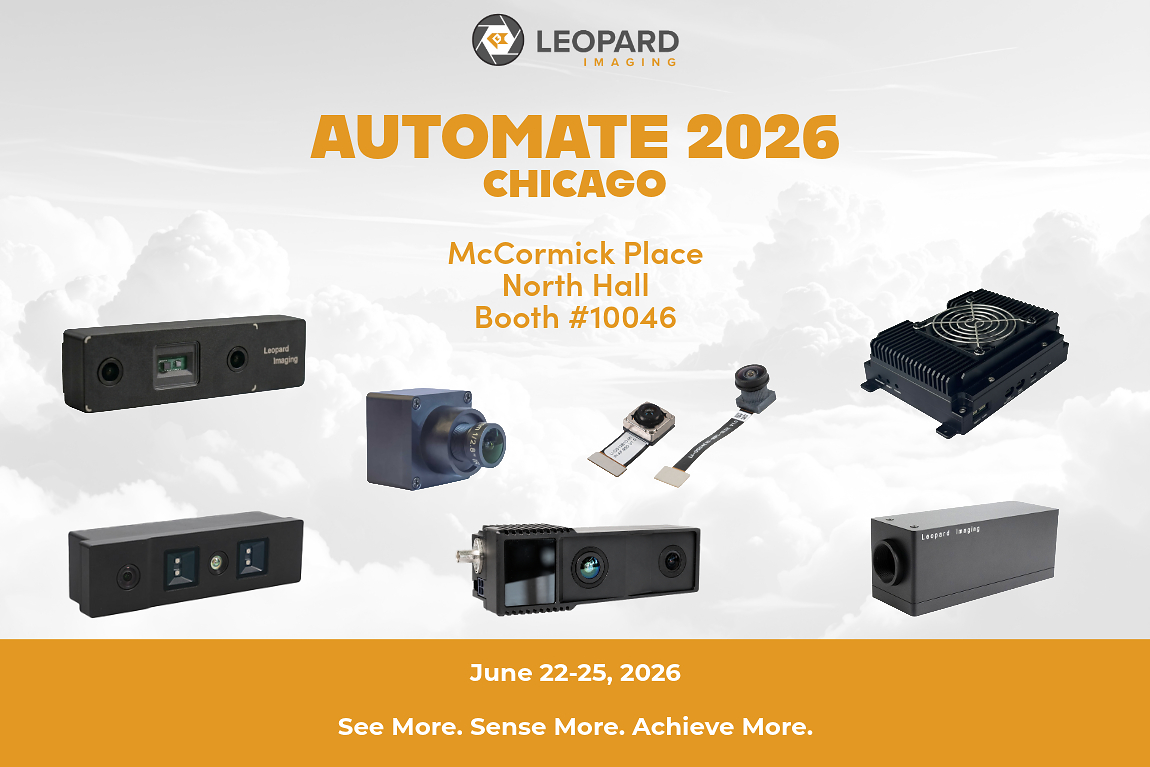
Leopard Imaging, a Fremont, California-based vision-systems manufacturer, is exhibiting at AUTOMATE 2026 in Chicago (June 22–25, McCormick Place, Booth #10046), demonstrating stereo vision, RGB-D perception, long-range depth sensing, surround vision, and compact embedded camera modules aimed at robotics, autonomous systems, and edge AI platforms. The show is an upstream event — the buyers in those aisles build the machines that eventually land in restaurant kitchens, ghost-facility lines, and hotel back-of-house. That pipeline is shorter than most operators realize.
The spatial-intelligence hardware category is maturing fast. Camera modules that three years ago required rack-mounted compute now run inference at the edge on embedded chips smaller than a credit card. That shift is what makes robotic fry stations, automated inventory cameras, and vision-guided pick-and-place systems economically viable at a single-unit level, not just in high-volume QSR chains running 500-plus locations. When vendors like Leopard Imaging show RGB-D and depth-sensing stacks at an industrial automation conference, they are effectively previewing what integrators will be quoting to hospitality operators within the next one to two years. Peer activity confirms the direction: major fast-casual and QSR brands have publicly piloted vision-based inventory and food-safety monitoring systems, and kitchen-robotics vendors have collectively raised north of $1.2 billion in venture capital since 2022.
For operators currently scoping AI tools or writing technology RFPs, this signals two procurement realities. First, the underlying perception hardware powering autonomous kitchen equipment is becoming commoditized, which will compress pricing on turnkey robotic systems and give operators more negotiating leverage with integrators. Second, edge AI — compute that runs on-device without a cloud round-trip — is the architecture to prioritize in vendor conversations; systems dependent on continuous cloud connectivity introduce latency and uptime risk in a live kitchen environment. Buyers vetting kitchen-automation vendors should ask specifically whether vision-processing runs at the edge and what the fallback state is if the network drops. Those are the questions that separate pilots that survive year two from ones that get ripped out after six months. For more on evaluating AI vendors in hospitality contexts, see our coverage in AI procurement frameworks for operators and kitchen-tech RFP signals to watch.
The broader takeaway for food and beverage operators is not that you need to attend an industrial robotics trade show — it is that the technology decisions being made on that floor today will define your equipment options and vendor pricing windows in 2027 and 2028. Operators who understand what is coming out of the automation pipeline can negotiate better contracts, build smarter phased-deployment plans, and avoid locking into hardware architectures that are already being superseded. Monitoring upstream shows like AUTOMATE is exactly the kind of intelligence work an operator's growth and procurement team should be doing, or outsourcing to someone who is.
Written by Michael Politz, Author of Guide to Restaurant Success: The Proven Process for Starting Any Restaurant Business From Scratch to Success (ISBN: 978-1-119-66896-1), Founder of Food & Beverage Magazine, the leading online magazine and resource in the industry. Designer of the Bluetooth logo and recognized in Entrepreneur Magazine's "Top 40 Under 40" for founding American Wholesale Floral, Politz is also the Co-founder of the Proof Awards and the CPG Awards and a partner in numerous consumer brands across the food and beverage sector.