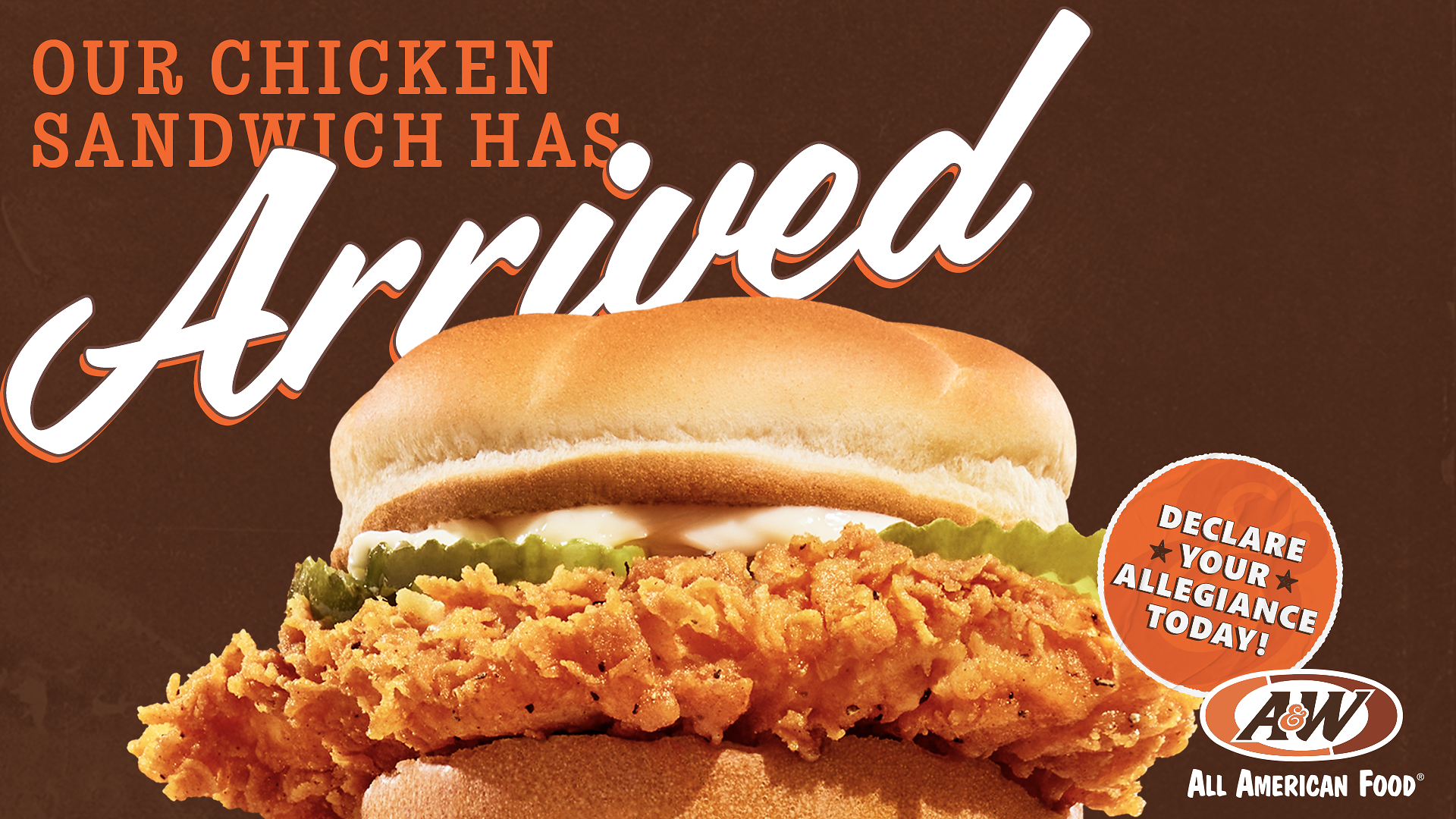
After seven years of recipe development — and watching competitors redefine the QSR chicken sandwich category — A&W Restaurants is entering the conversation with its first-ever Crispy Chicken Sandwich, available in Crispy, Deluxe, and limited-time Nashville Hot varieties. For operators and franchisees tracking how legacy QSR brands stage competitive menu entries, the timing and mechanics of this launch offer a clear case study in trial-driving and fan activation.
The Launch Mechanics
From August 17 through August 23, participating A&W locations are offering a buy one, get one free deal on the new chicken sandwich lineup — upon guest request. The BOGO window is deliberately short, a proven tactic for generating concentrated traffic and measurable trial data within a defined period. Franchisees get a clean read on sandwich velocity; the brand gets social momentum. A companion digital campaign at AWAllegiance.com invites guests to submit a loyalty pledge for a chance to be featured on an "A&W Hall of Heroes" display wall, adding a low-cost user-generated content layer that extends organic reach beyond paid media.
What This Signals for QSR Operators
CEO and President Betsy Schmandt framed the delay as intentional: "For the last seven years, chicken sandwich fans have been picking sides, and we've been behind-the-scenes perfecting our Crispy Chicken Sandwich recipe." Whether or not the timeline was strategic, the positioning is smart — entering a now-mature category with a differentiated claim (years of refinement vs. speed-to-market) rather than competing purely on price or novelty.
For multi-unit operators and franchise buyers, the structural details matter as much as the menu addition. A&W's network spans more than 900 locations across 35 U.S. states and parts of Asia, including roughly 230 co-branded sites with KFC or Long John Silver's. Layering a chicken sandwich onto co-branded KFC locations raises obvious menu-overlap questions that franchisees will need to navigate operationally. Single-brand A&W operators, by contrast, are gaining a protein-forward LTO that slots into a daypart — lunch and dinner — where the brand has historically trailed chicken-forward QSR competitors.
From a brand launch standpoint, the BOGO-plus-UGC structure is a reliable playbook for franchised systems: minimize franchisee margin risk on the promotional window, maximize consumer touchpoints, and harvest social content without a large influencer budget. The AWAllegiance.com microsite also gives the brand a first-party data capture point — guest emails and Instagram handles — that supports future CRM and growth marketing efforts.
Operators evaluating their own LTO rollout strategies should note how A&W is using the seven-year cultural reference point (the 2019 Popeyes "you good?" moment) not as an apology for being late, but as a brand narrative anchor. That kind of contextual positioning — turning a perceived weakness into a story — is increasingly relevant as crowded menus make differentiation harder to achieve through product specs alone.
Written by Michael Politz, Author of Guide to Restaurant Success: The Proven Process for Starting Any Restaurant Business From Scratch to Success (ISBN: 978-1-119-66896-1), Founder of Food & Beverage Magazine, the leading online magazine and resource in the industry. Designer of the Bluetooth logo and recognized in Entrepreneur Magazine's "Top 40 Under 40" for founding American Wholesale Floral, Politz is also the Co-founder of the Proof Awards and the CPG Awards and a partner in numerous consumer brands across the food and beverage sector.