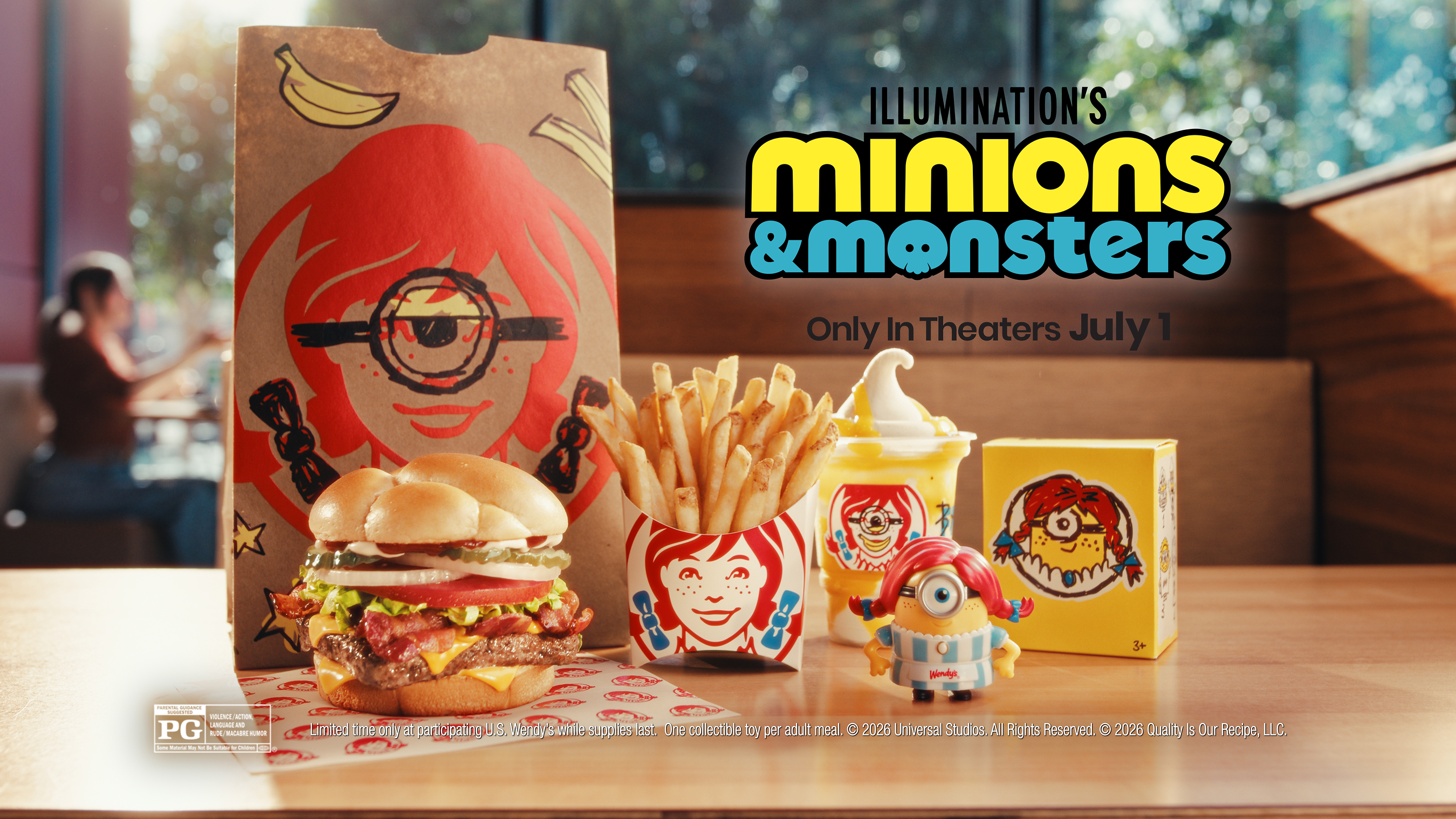
Wendy's has activated a tiered, film-timed promotional campaign around Illumination's Minions & Monsters, opening in theaters July 1, 2026. The program launched June 8 with a Kids' Meal tie-in and scales June 15 to an adult-facing "Minions & Monsters Meal" with blind box collectibles — a structure worth studying if you are building or pitching a brand partnership of your own.
The mechanics follow a pattern QSR chains have refined since the McDonald's Happy Meal made IP licensing a standalone traffic driver: phase one targets the under-12 household, phase two converts the adult in the car. Six themed Kids' Meal toys anchor the first wave; four exclusive Wendy's blind box collectibles anchor the second. Blind boxes carry secondary-market appeal that extends social shareability well past the theatrical window — an important detail for brands evaluating collectible SKUs as growth levers.
The menu addition is a limited-time Banana Frosty Swirl plus two co-branded beverages. LTOs tied to entertainment releases perform best when they carry flavor logic — something the Minions franchise, with its documented banana fixation, provides cleanly. For operators considering co-branded LTO strategy, the key benchmark is whether the flavor story is native to the IP or grafted onto it. Grafted items tend to underperform in social engagement metrics even when sales are solid.
The Los Angeles drive-thru takeover is the physical-media layer operators often undervalue. A geo-fenced, branded drive-thru in a media-dense market functions as earned-media bait: it generates local news pickups, influencer content, and geo-tagged social posts that amplify paid spend without additional media cost. If you operate multiple drive-thru units in a metro with entertainment industry concentration, this activation model is replicable at a fraction of a national chain's budget through programmatic geo-fencing and local influencer seeding.
For suppliers and brand owners watching from outside the QSR lane, the Wendy's-Illumination structure is a reference architecture: IP licensor supplies creative assets and co-marketing budget, operator supplies distribution and dwell-time. The exchange rate — who pays whom, and how much guaranteed media impression volume is required to close the deal — is where most emerging brands stall. Understanding that deal structure before entering a brand-launch or retail-readiness process will compress your negotiation timeline.
Written by Michael Politz, Author of Guide to Restaurant Success: The Proven Process for Starting Any Restaurant Business From Scratch to Success (ISBN: 978-1-119-66896-1), Founder of Food & Beverage Magazine, the leading online magazine and resource in the industry. Designer of the Bluetooth logo and recognized in Entrepreneur Magazine's "Top 40 Under 40" for founding American Wholesale Floral, Politz is also the Co-founder of the Proof Awards and the CPG Awards and a partner in numerous consumer brands across the food and beverage sector.