Walk-On's Sports Bistreaux is cutting its standard restaurant footprint nearly in half with a new prototype that targets 3,500 to 4,500 square feet — down from the brand's traditional 7,000- to 8,000-plus-square-foot format. The first purpose-built location opens on Perkins Road in Baton Rouge in early 2027 at approximately 3,688 square feet, seating 125 guests. Designed by Madrid-based restaurant design firm Livit, the model signals a deliberate shift in how the 80-plus-unit chain intends to grow its franchise network.
The Kit-of-Parts Logic
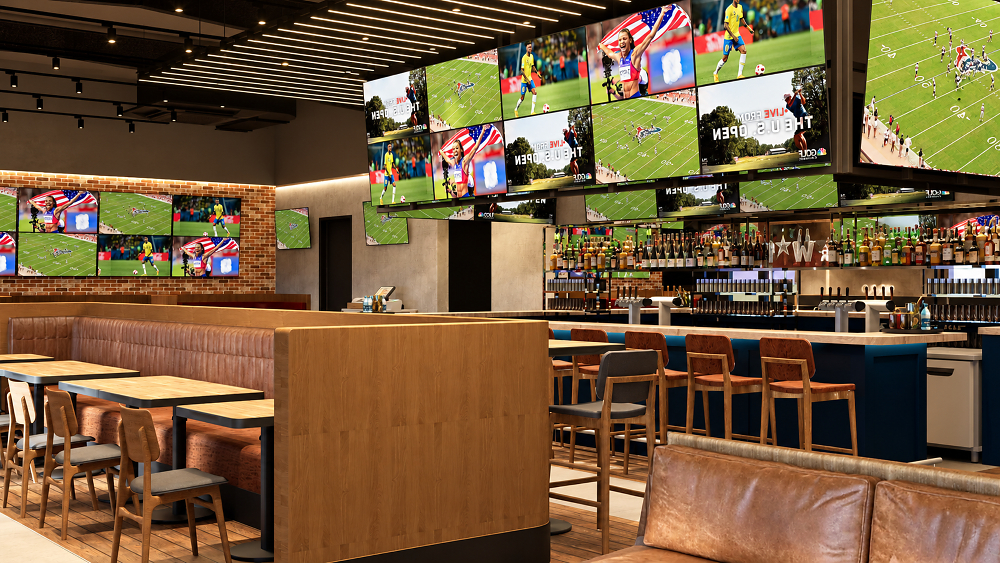
Rather than a single fixed layout, the new design operates as a modular "kit of parts" — franchisees select or layer in elements based on site configuration, market demographics, and operator preference. Core components include a peninsula-style bar, a large-scale TV wall with an upgraded A/V package, a flexible lounge area that can convert between casual seating and larger group dining, and a patio TV wall that extends game-day viewing outdoors. A dedicated pickup zone near the host stand — with cubbies for Uber Eats, DoorDash, and other third-party delivery services — addresses off-premise volume without disrupting dine-in flow, a friction point that larger legacy formats often struggle to resolve cleanly.
The kitchen has also been re-engineered around efficiency: new equipment including clamshell grills is intended to reduce ticket times, simplify crew training, and maintain consistency across the full menu. For franchise operators evaluating labor costs and training overhead, that kind of equipment-driven standardization can have a measurable impact on unit economics from day one.
What This Signals for Franchise Development
The prototype draws directly from Walk-On's existing 3,700-square-foot inline location at The Battery Atlanta, which demonstrated that the brand's full menu and sports-bar energy could survive — and perform — in a compact format. The Baton Rouge build is essentially a codified, purpose-built version of that proof of concept, with the added flexibility layer baked in from the design stage.
For the broader franchise and foodservice development market, the move reflects a pattern gaining momentum across casual dining and bar-and-grill concepts: rightsizing the physical plant to reduce construction costs, expand the pool of viable real estate, and compete for inline, end-cap, and mixed-use sites that a 7,000-square-foot box simply cannot access. Operators watching their own lease negotiations and construction budgets should note that smaller prototypes don't automatically mean reduced revenue capacity — they mean different revenue architecture.
Localized design elements — wall graphics featuring area high schools, local athletes, and community touchpoints — are embedded into the kit-of-parts system, giving each franchisee a mechanism for genuine local differentiation without custom design fees. The host stand doubling as a brand merchandise station adds a retail revenue layer that larger formats have historically treated as an afterthought.
Brandon Landry, CEO and co-founder of Walk-On's Sports Bistreaux, framed the shift as preserving brand identity while expanding operator flexibility: "The new design gives our franchisees more flexibility in where and how they build, while keeping the energy, hospitality and community connection our guests know and love."
For operators and development teams tracking franchise growth strategies and hospitality design trends, the Walk-On's model is a useful benchmark for how established multi-unit brands are rearchitecting their physical footprint to stay competitive in a tighter real estate and construction-cost environment.
Written by Michael Politz, Author of Guide to Restaurant Success: The Proven Process for Starting Any Restaurant Business From Scratch to Success (ISBN: 978-1-119-66896-1), Founder of Food & Beverage Magazine, the leading online magazine and resource in the industry. Designer of the Bluetooth logo and recognized in Entrepreneur Magazine's "Top 40 Under 40" for founding American Wholesale Floral, Politz is also the Co-founder of the Proof Awards and the CPG Awards and a partner in numerous consumer brands across the food and beverage sector.