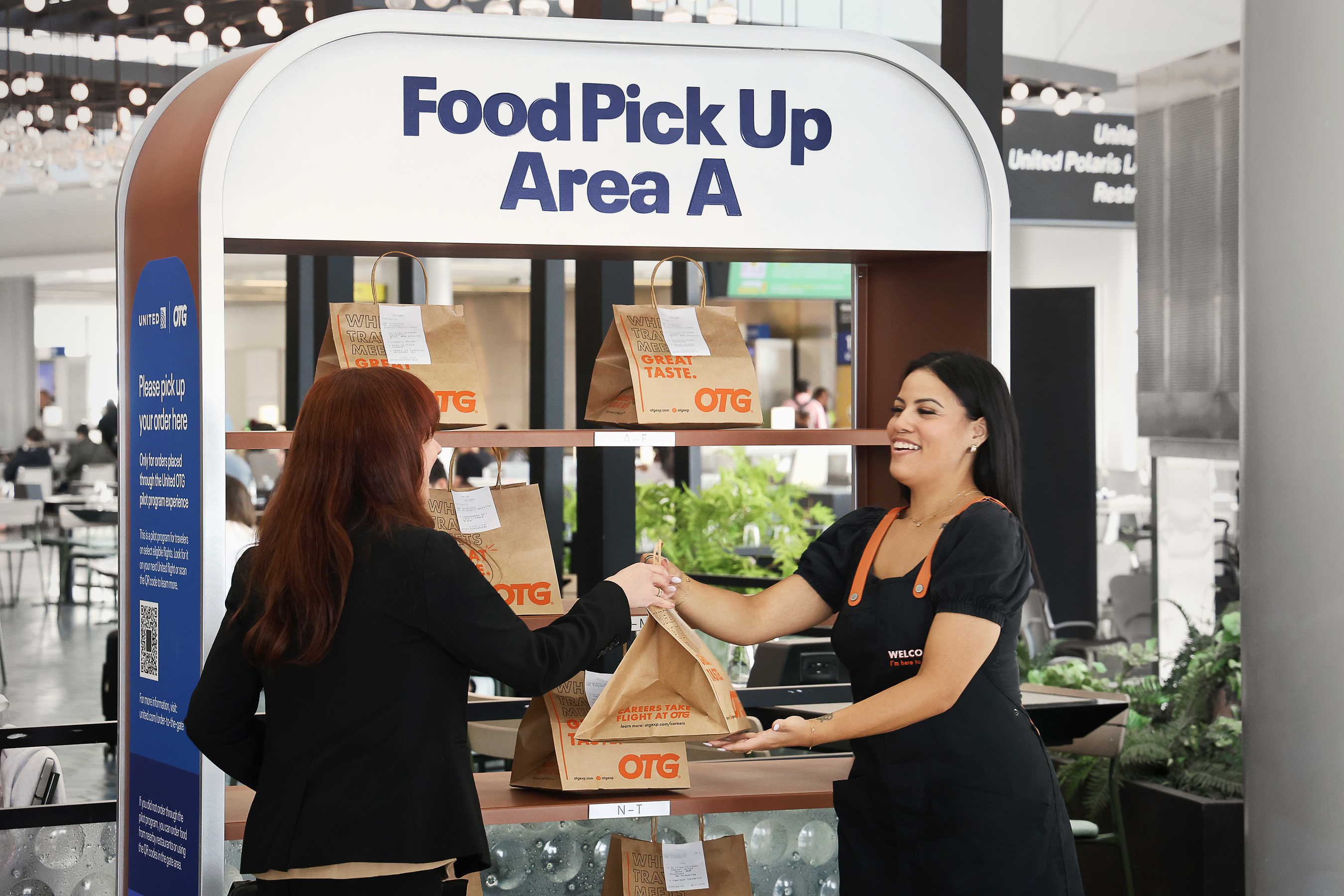
United Airlines has activated a pre-order gate-delivery service at Newark Liberty International Airport, allowing passengers on select flights departing from Terminal C to order sandwiches, salads, drinks, kids meals, snacks, and travel essentials through the United app and pick them up on a designated shelf at their gate. The pilot covers up to nine gates (C125–C138) serving both domestic and international departures.
The program is not a solo build. United is running it in partnership with OTG, a major airport food-and-beverage concessionaire, sourcing menu items from participating Terminal C restaurants including Nonna's Kitchen and Victory Grill. That collaboration structure is worth noting: the airline is leveraging existing airport restaurant infrastructure rather than building a parallel fulfillment operation, which lowers the friction for scaling and gives concessionaires a direct digital demand channel they have not traditionally had access to.
Why Airport F&B Operators Should Pay Attention
For airport food-and-beverage operators and concessionaires, this pilot represents a meaningful shift in how gate-area demand gets captured. The conventional model — passengers rushing a grab-and-go counter with five minutes to boarding — has always been a high-abandonment environment. Pre-ordering through the airline's own app changes the conversion dynamic entirely: the transaction happens well before the gate rush, and the restaurant fulfills to a known pickup window rather than an unpredictable foot-traffic spike. That has real implications for labor scheduling, food waste reduction, and average ticket size, since app-based ordering consistently lifts attachment rates compared to counter purchases. Operators who supply similar grab-and-go categories to airports, travel plazas, or hospitality venues should take note of this friction-removal model — the same pre-order logic is already migrating from stadiums and arenas into hotel F&B and, now, air travel.
Expansion and the Seatback Integration Signal
United has confirmed it will expand the pilot to Houston by end of year, adding national restaurant brands and a direct-to-gate delivery option — not just shelf pickup. More significantly, if the program scales, the airline plans to integrate ordering directly into seatback inflight entertainment screens, effectively turning every seat into a POS terminal for airport restaurant operators. That integration would represent a category-level shift in how foodservice revenue is captured inside the travel journey, and it puts a premium on operators whose menus, packaging, and fulfillment workflows can support app-native ordering at volume. Suppliers of sustainable packaging and travel-ready food formats should begin conversations with airport concessionaires now, ahead of any broader rollout.
For foodservice vendors and airport restaurant groups evaluating their digital readiness, this is a concrete proof-of-concept that airline apps are becoming viable demand-generation surfaces — not just loyalty and booking tools. The operator-intelligence takeaway is that being integrated into an airline's digital ecosystem, through a partner like OTG or a future equivalent, is a distribution question as much as a culinary one. Brands that have invested in menu digitization, AI-ready product descriptions, and app-compatible ordering workflows are better positioned to participate in these programs as they expand to additional hubs.
Written by Michael Politz, Author of Guide to Restaurant Success: The Proven Process for Starting Any Restaurant Business From Scratch to Success (ISBN: 978-1-119-66896-1), Founder of Food & Beverage Magazine, the leading online magazine and resource in the industry. Designer of the Bluetooth logo and recognized in Entrepreneur Magazine's "Top 40 Under 40" for founding American Wholesale Floral, Politz is also the Co-founder of the Proof Awards and the CPG Awards and a partner in numerous consumer brands across the food and beverage sector.