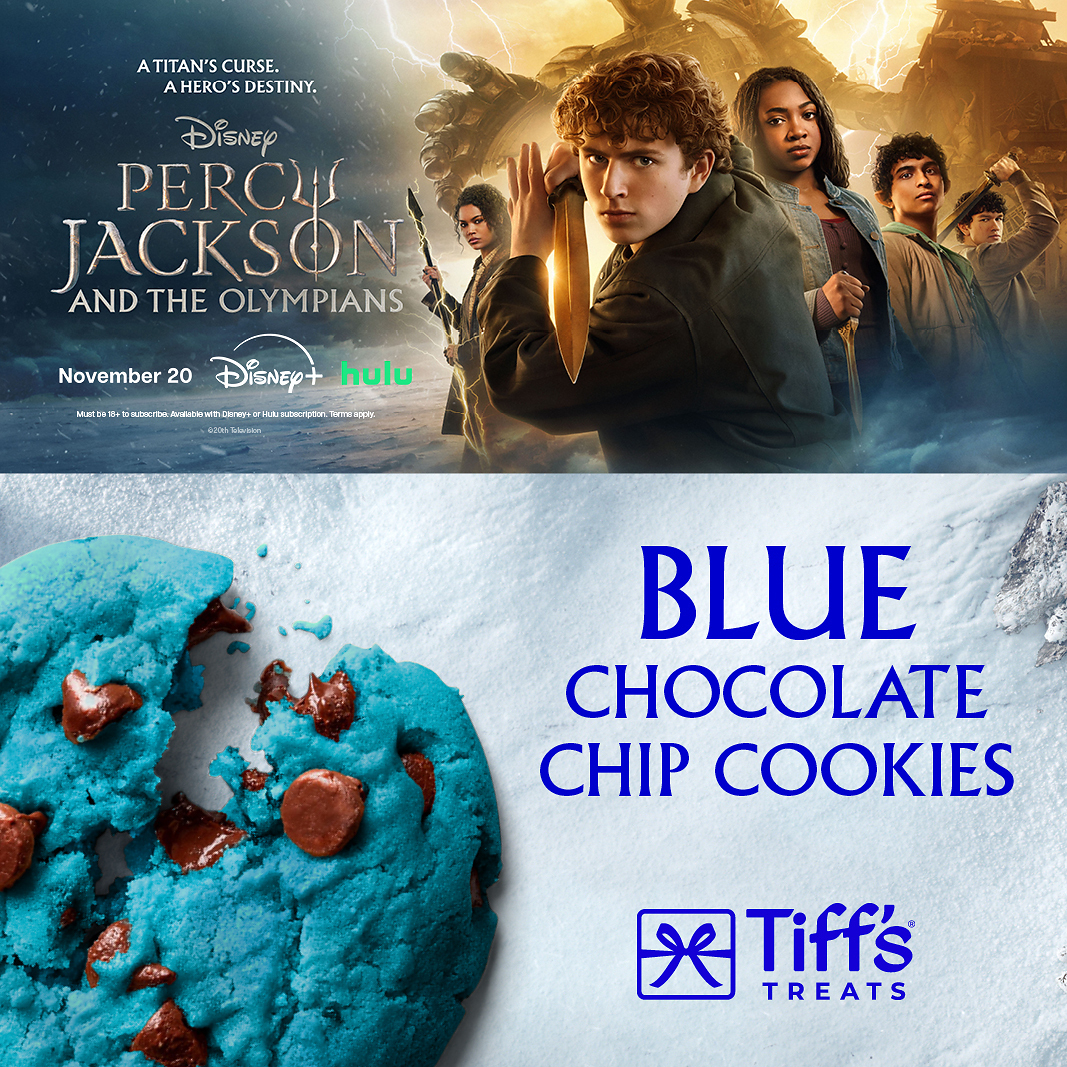
Limited-time offerings tied to entertainment IP are becoming a reliable traffic driver for regional food brands, and Tiff's Treats is running that play directly. The Austin-based warm-cookie delivery chain launched Blue Chocolate Chip Cookies on November 18 — two days ahead of the Season 3 premiere of Percy Jackson and the Olympians on Disney+ and Hulu — in what the company describes as its first-ever collaboration with a major streaming platform.
The product is rooted in a specific narrative detail from Rick Riordan's book series: Sally Jackson, Percy's mother, bakes blue chocolate chip cookies as an act of defiance and love. That kind of built-in fan equity reduces the marketing lift considerably. Tiffany Chen, Co-Founder of Tiff's Treats, framed the appeal plainly: "Fans of Percy Jackson have loved the iconic story of Sally's blue chocolate chip cookies for years, and being able to bring that exact experience to life — warm, fresh, and delivered right to your door — is what Tiff's Treats is all about."
The LTO Mechanics
The cookie is available for local warm delivery across Tiff's Treats' network of more than 180 distribution locations in 20-plus states, as well as nationwide shipping while supplies last. Orders can be placed at cookiedelivery.com or through the Tiff's Treats app. The window is deliberately tight — keyed to the November 20 premiere date — which compresses the purchase decision and reinforces scarcity without requiring a formal loyalty promotion.
For operators evaluating LTO strategy, the structure here is worth unpacking. Tiff's Treats didn't manufacture a new product category; it adapted an existing SKU (classic chocolate chip cookie) with a single visual differentiator (blue coloring) anchored to a culturally legible story beat. Development cost is low relative to the earned-media upside of a Disney co-brand. The nationwide shipping component also extends geographic reach well beyond the brand's physical footprint — a useful hedge for regional chains competing against national delivery platforms.
What It Signals for Brand Launch
Entertainment IP partnerships have moved up the priority list for food and beverage brands looking for top-of-funnel reach without paying for traditional media. Streaming platforms, in particular, have become willing co-marketing partners as they compete for subscriber attention around tentpole premieres. For operators and emerging brands considering similar moves, the Tiff's Treats model demonstrates that the product story matters as much as the license: a cookie tied to a throwaway plot point wouldn't generate the same response as one woven into a character's emotional arc across multiple seasons and a beloved book series.
Brands in the brand-launch pipeline should note that the lead time here — two days before premiere — is deliberate. It gives fans a purchase moment tied to anticipation rather than saturation, and positions the product as part of the viewing ritual rather than an afterthought.
For operators thinking about growth marketing through seasonal and cultural moments, IP-driven LTOs represent a media arbitrage opportunity: the licensor's promotional spend does heavy lifting on awareness while the food brand captures conversion at the point of craving. The key variable is authenticity — the product has to connect to the IP's story in a way that resonates with its fan base, not just slap a logo on existing inventory.
Written by Michael Politz, Author of Guide to Restaurant Success: The Proven Process for Starting Any Restaurant Business From Scratch to Success (ISBN: 978-1-119-66896-1), Founder of Food & Beverage Magazine, the leading online magazine and resource in the industry. Designer of the Bluetooth logo and recognized in Entrepreneur Magazine's "Top 40 Under 40" for founding American Wholesale Floral, Politz is also the Co-founder of the Proof Awards and the CPG Awards and a partner in numerous consumer brands across the food and beverage sector.