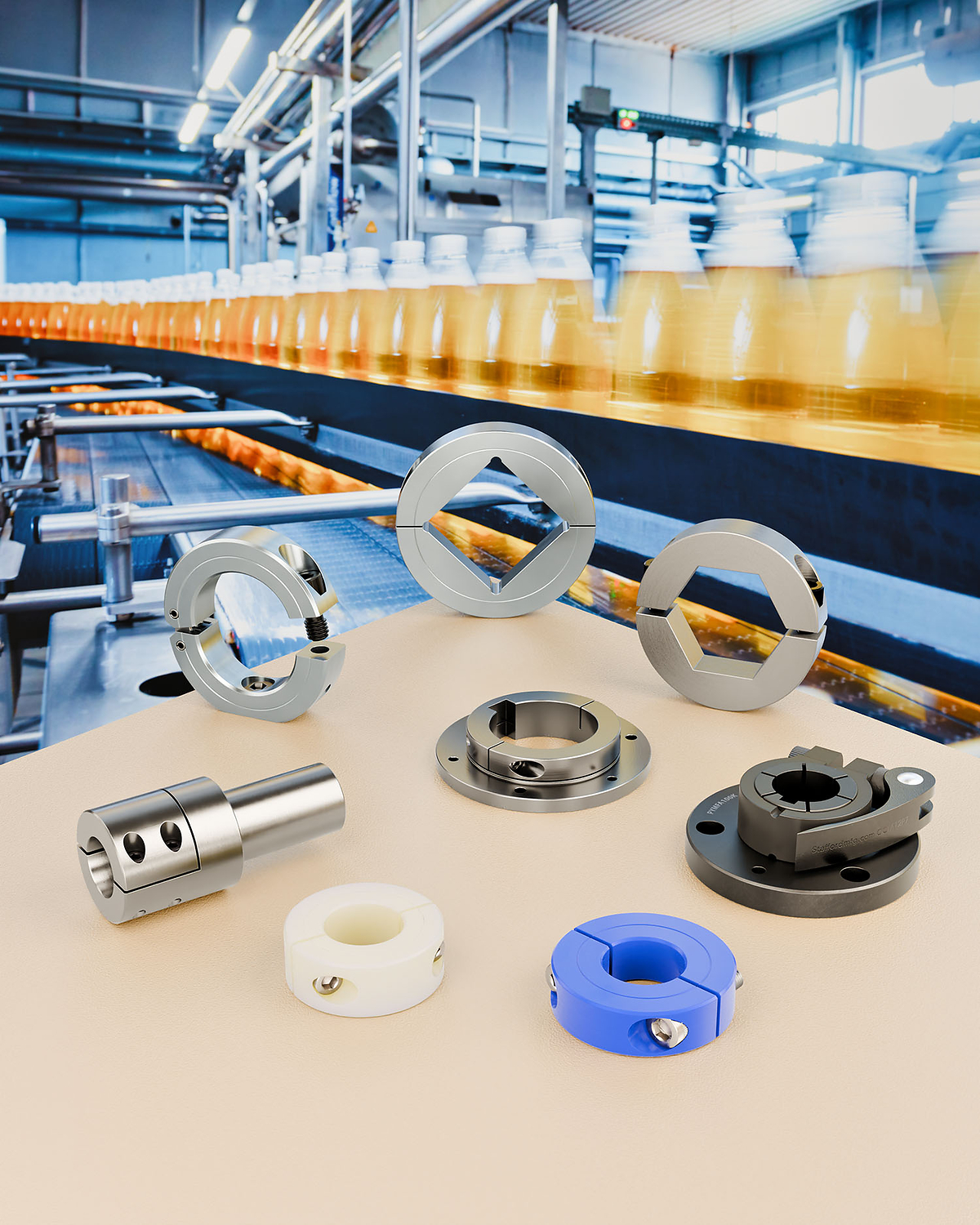
Operators running high-throughput food and beverage production lines have a new procurement option for a component category that rarely makes headlines but routinely causes compliance headaches: Stafford Manufacturing Corp. has introduced a full line of shaft collars, couplings, and flange mounts built specifically to meet USDA and FDA requirements in frequent wash-down environments.
The line covers conveyor and packaging systems across a range of bore geometries — round, square, and hex — machined from 303 and 316 stainless steel, food-grade Blue Acetal, Nylon, and Delrin®. Fasteners are 18-8 or 316 stainless steel, and the collars ship in both one- and two-piece designs. Size range runs from 0.25" to 16" I.D. depending on material, with Blue Acetal topping out at 2" I.D. and Nylon or Delrin® available from 1" to 4" I.D. Custom treatments — threaded and special bores, keyways, knurls — are available to spec.
Why Procurement Should Pay Attention
For food and beverage plant engineers and procurement teams, compliance at the component level is an area where shortcuts compound quickly. A shaft collar or coupling that is not rated for wash-down chemicals or USDA/FDA contact zones can trigger a line shutdown or a third-party audit flag. Sourcing from a single supplier that carries the full mechanical sub-assembly in compliant materials — rather than piecing together components from multiple vendors — reduces both paperwork burden and supply-chain fragmentation.
The Stafford line's breadth across material types is notable for operators who are managing mixed-equipment environments. A facility running both older belt conveyors and newer automated packaging lines may need stainless in one zone and food-grade polymer in another; consolidating that into one supplier relationship simplifies procurement intelligence and shortens lead times when a component fails mid-shift.
What This Signals for Equipment Sourcing
The timing reflects a broader pattern in food and beverage manufacturing investment. Capital spending on processing and packaging equipment has remained elevated as operators accelerate line automation to offset persistent labor pressure. When equipment spend goes up, so does demand for compliant mechanical sub-components — and suppliers who can document USDA and FDA approval status out of the box reduce the validation workload for plant managers.
For operators evaluating maintenance, repair, and operations (MRO) vendor lists or building out a preferred-supplier program, this kind of full-line, compliance-documented offering warrants a look. Delivery from stock — rather than custom lead times — also matters in an environment where unplanned downtime on food processing lines carries direct revenue impact. Pricing is configured by material, size, and configuration, so buyers should request a quote matrix early if they are sourcing across multiple line types.
Written by Michael Politz, Author of Guide to Restaurant Success: The Proven Process for Starting Any Restaurant Business From Scratch to Success (ISBN: 978-1-119-66896-1), Founder of Food & Beverage Magazine, the leading online magazine and resource in the industry. Designer of the Bluetooth logo and recognized in Entrepreneur Magazine's "Top 40 Under 40" for founding American Wholesale Floral, Politz is also the Co-founder of the Proof Awards and the CPG Awards and a partner in numerous consumer brands across the food and beverage sector.