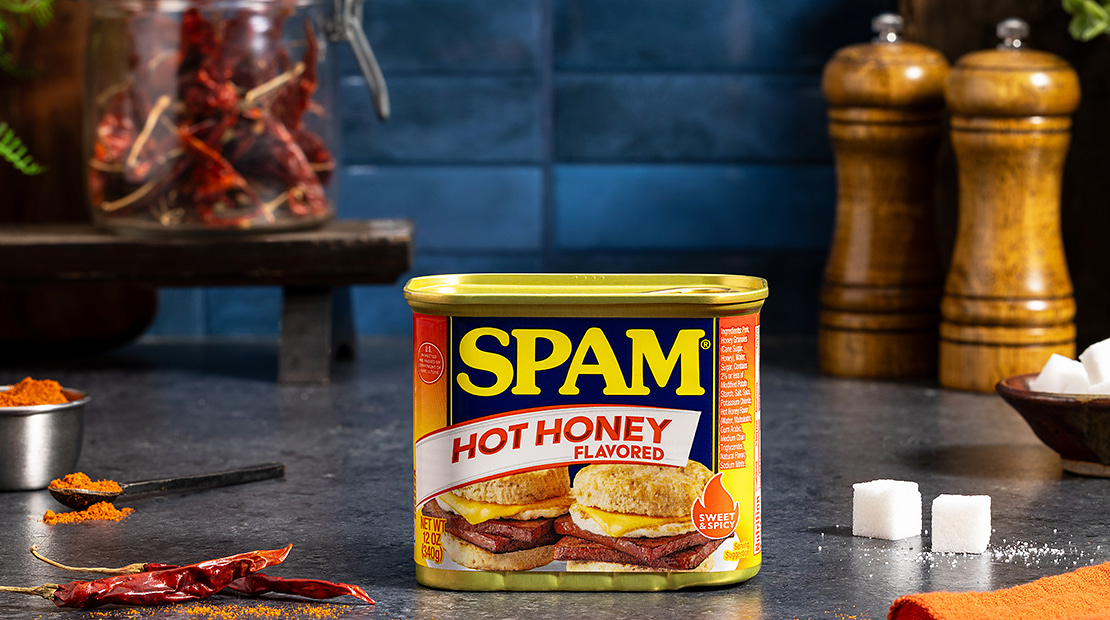
Hormel Foods' SPAM® brand is adding Hot Honey as a permanent variety — its first new full-time SKU in the sweet-heat segment — while anchoring the launch with a week-long limited-edition menu collaboration at Win Son Bakery, the Taiwanese-American café with locations in Brooklyn and Manhattan's East Village. The activation ran September 14–20 and featured a SPAM® Hot Honey breakfast sandwich on a scallion pancake and a fan tuan sticky rice roll. A co-branded streetwear merchandise capsule — T-shirt, hat, and tote — extended the brand footprint beyond the plate.
The Brand Launch Playbook
The structure here is worth dissecting for operators and brand managers watching how $12 billion CPG portfolios defend shelf position. Rather than a straight grocery launch supported by trade spend alone, Hormel is layering a culinary credibility play on top of retail distribution. Win Son Bakery has a documented, culturally specific point of view on Taiwanese-American food — its co-owners Trigg Brown and Josh Ku co-authored a Taiwanese American cookbook — which gives the collaboration authenticity that a conventional influencer post cannot replicate. The merch capsule further extends the campaign's earned-media surface area without requiring additional paid placement.
Sweet-heat is not a niche position in 2026. Hot honey has moved well beyond artisan retail into QSR menus, fast-casual LTOs, and mass grocery endcaps over the past three years. For a brand with SPAM®'s distribution breadth, entering the format as a permanent SKU rather than a limited-edition test signals category conviction — and puts pressure on competing shelf-stable protein brands to respond with their own flavor innovation. Operators sourcing canned proteins for back-of-house prep should expect expanded sweet-heat options across multiple suppliers over the next two purchase cycles.
What It Signals for Operators
The SPAM® x Win Son Bakery model reflects a broader pattern in brand launch strategy that F&B Department has tracked across grocery and foodservice: use a culturally resonant independent operator to validate a flavor or format, generate organic social content through that operator's audience, then harvest the halo for retail. The recipe is now on SPAM®'s own website, converting restaurant-goers into home cooks and reinforcing repeat purchase.
For foodservice buyers, the practical takeaway is simpler: hot honey as a flavor modifier is now shelf-stable and available at grocery scale, which reduces the friction for operators who want to incorporate it into prep without sourcing a separate honey-based condiment. Menu engineers at breakfast-forward concepts — hotel F&B included — should note that the scallion pancake sandwich format performed well enough for a credible NYC operator to put it on a limited menu, which is a useful proof-of-concept for brunch daypart experimentation.
Hormel's broader portfolio context matters here too. With over $12 billion in annual revenue and brands spanning PLANTERS®, APPLEGATE®, and JENNIE-O®, this is a company with the trade marketing infrastructure to support retail velocity on a new SKU. Independent operators sourcing from foodservice distributors should anticipate SPAM® Hot Honey appearing in broadline catalogs within the next quarter as retail distribution stabilizes.
Written by Michael Politz, Author of Guide to Restaurant Success: The Proven Process for Starting Any Restaurant Business From Scratch to Success (ISBN: 978-1-119-66896-1), Founder of Food & Beverage Magazine, the leading online magazine and resource in the industry. Designer of the Bluetooth logo and recognized in Entrepreneur Magazine's "Top 40 Under 40" for founding American Wholesale Floral, Politz is also the Co-founder of the Proof Awards and the CPG Awards and a partner in numerous consumer brands across the food and beverage sector.