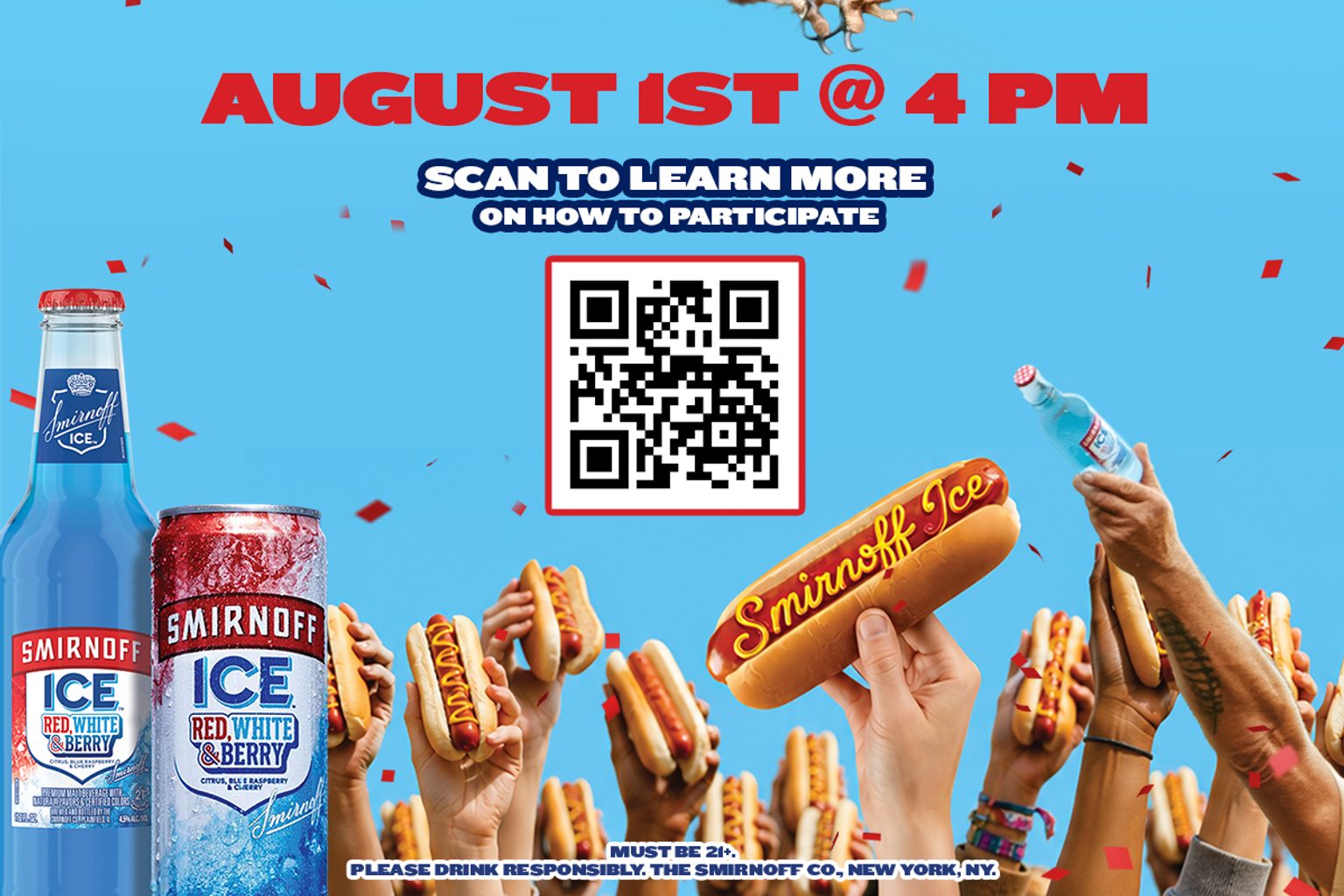
Smirnoff ICE is leaning hard into cultural stunt marketing this summer, anchoring a campaign around America's 250th anniversary with hot dog-themed Guinness World Records attempts, limited-edition merchandise, and social-first content built around its Red, White & Berry flavor. The activation is a textbook example of how ready-to-drink alcohol brands are competing for attention in a crowded convenience and off-premise channel — not on price, but on earned media and shareability.
What the Campaign Does
The program pairs the brand's existing Red, White & Berry SKU with a deliberately absurd hook: hot dogs. Two Guinness World Records attempts anchor the earned-media pitch, giving news desks and social creators a time-stamped event to cover. Limited-edition merchandise extends the campaign's shelf life beyond the stunt date, and the social content strategy appears designed to generate organic sharing rather than relying solely on paid amplification. For operators and retail buyers, the relevant signal here is that the brand is investing in occasion marketing rather than promotional price cuts — a strategy that protects margin and builds associative equity around summer consumption moments.
What RTD Operators Should Watch
The ready-to-drink and flavored malt beverage category has become one of the most promotion-saturated segments in off-premise beverage alcohol. Brands that rely on TPR (temporary price reductions) alone are watching their velocity numbers flatten as new entrants crowd the cooler. Stunt-and-merch campaigns like this one are a countermove: they drive trial through cultural relevance rather than discounting, and they give distributor reps a story to tell at the account level. For bar and restaurant operators who carry RTD options for off-premise or grab-and-go, understanding which brands are investing in demand creation — versus just fighting for end-cap space on price — helps inform ranging decisions. A brand actively generating social impressions around a specific occasion is more likely to drive incremental velocity than one competing purely on cost-per-unit.
The Guinness World Records mechanic is also worth noting from a brand-launch and experiential standpoint. It provides a verifiable, third-party-validated moment that wire services and local TV pick up reliably — essentially free media with a credibility stamp. Brands in the hospitality and foodservice space, from craft beverage suppliers to non-alc startups, have increasingly borrowed this playbook when they lack the media budget for broad paid reach. The combination of a record attempt, a culturally resonant food pairing (hot dogs on the Fourth of July weekend extension), and anniversary-year patriotism gives the campaign multiple hooks for different audience segments simultaneously.
For operators sourcing RTD and FMB products for summer programming — whether poolside, at a resort F&B outlet, or in a convenience-forward hotel market — the takeaway is practical: brands running this level of integrated campaign are typically seeing stronger consumer pull-through, which means less work for your floor staff to explain or upsell the product.
Written by Michael Politz, Author of Guide to Restaurant Success: The Proven Process for Starting Any Restaurant Business From Scratch to Success (ISBN: 978-1-119-66896-1), Founder of Food & Beverage Magazine, the leading online magazine and resource in the industry. Designer of the Bluetooth logo and recognized in Entrepreneur Magazine's "Top 40 Under 40" for founding American Wholesale Floral, Politz is also the Co-founder of the Proof Awards and the CPG Awards and a partner in numerous consumer brands across the food and beverage sector.