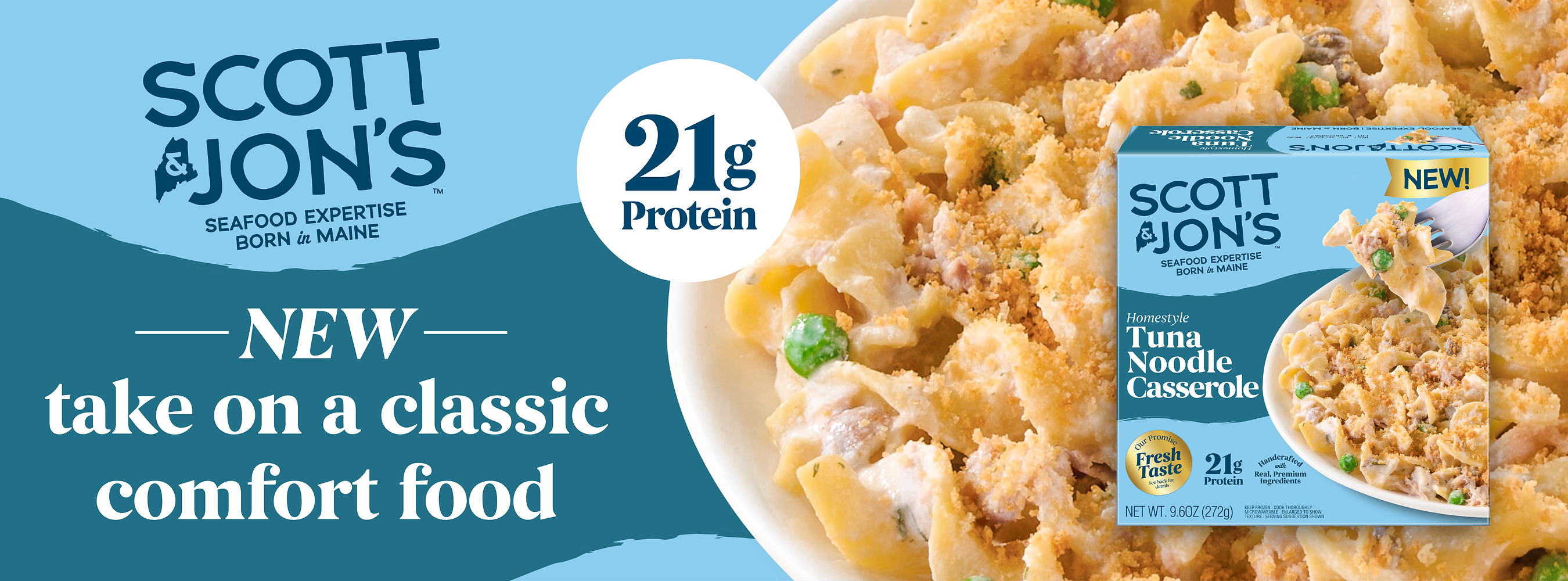
Maine-based frozen seafood brand Scott & Jon's is entering the tuna category for the first time with the launch of its Homestyle Tuna Noodle Casserole — a 21g-protein, sub-500-calorie frozen meal that cooks in four minutes and hits regional grocery shelves at Giant Eagle, Weis, Schnucks, Big Y, Market Basket, and Nugget this fall.
The SKU marks a deliberate portfolio expansion. The brand, founded by brothers Scott and Jon Demers, has built its identity around shrimp, salmon, and white fish. Adding tuna opens a distinct pantry-staple consumer occasion — comfort-driven, weeknight-ready — without cannibalizing existing items. For retail buyers evaluating frozen seafood sets, it positions Scott & Jon's as a broader seafood solutions vendor rather than a protein-specific niche play.
The Comfort Food Signal
The timing is not incidental. The National Restaurant Association ranked comfort foods the No. 2 overall trend in its 2026 What's Hot Culinary Forecast, with its chief economist Dr. Chad Moutray noting that "comfort and value are the twin pillars shaping America's menus right now." That trend has migrated from foodservice menus into retail freezer aisles, where shoppers are actively seeking familiar formats at accessible price points — exactly the territory a tuna noodle casserole occupies.
For operators and retail buyers tracking frozen meal dynamics, the broader pattern here is value-plus-nostalgia driving trial in a category that struggled post-pandemic with quality perception. Brands that can credibly claim improved ingredient quality — real milk, cream, and cheddar cheese in this case, rather than sodium-laden powder sauce — have room to grow share against legacy frozen dinner players.
Validation Before Distribution
Scott & Jon's leaned on consumer testing before committing to distribution. In a blind central location test among 103 consumers conducted in December 2025, the brand's recipe was preferred 2-to-1 over a leading competitive product, with statistically significant advantages across overall flavor, tuna flavor, pasta texture, sauce flavor, and vegetable flavor — all measures tested at the 95% confidence level. That kind of pre-launch validation data strengthens the retailer pitch and de-risks the slotting conversation.
For brand launch and buyer-deck purposes, blind-test results at that confidence level are meaningful proof points — not just marketing copy. Buyers at regional chains evaluating new frozen SKUs increasingly want category-relevant consumer data before committing shelf space, particularly in a value-sensitive environment where trial velocity matters.
Distribution is regional at launch, with a product locator at scottandjons.com/find-us being updated as coverage expands. That staged rollout is a sensible strategy for a first-time SKU in a new sub-category — it protects supply chain integrity and allows the brand to build velocity data in known-performing markets before pursuing national accounts.
Operators sourcing frozen meal programs for hospitality or convenience foodservice channels — particularly those building comfort-food-forward menus with high-protein positioning — should watch how this SKU performs in regional grocery before it potentially reaches broader distribution. The value-protein-comfort triangle is a durable consumer need that crosses both retail and foodservice channels.
For more on frozen seafood brand strategy and retail readiness, see our coverage of packaging and retail positioning and frozen category operator intelligence.
Written by Michael Politz, Author of Guide to Restaurant Success: The Proven Process for Starting Any Restaurant Business From Scratch to Success (ISBN: 978-1-119-66896-1), Founder of Food & Beverage Magazine, the leading online magazine and resource in the industry. Designer of the Bluetooth logo and recognized in Entrepreneur Magazine's "Top 40 Under 40" for founding American Wholesale Floral, Politz is also the Co-founder of the Proof Awards and the CPG Awards and a partner in numerous consumer brands across the food and beverage sector.