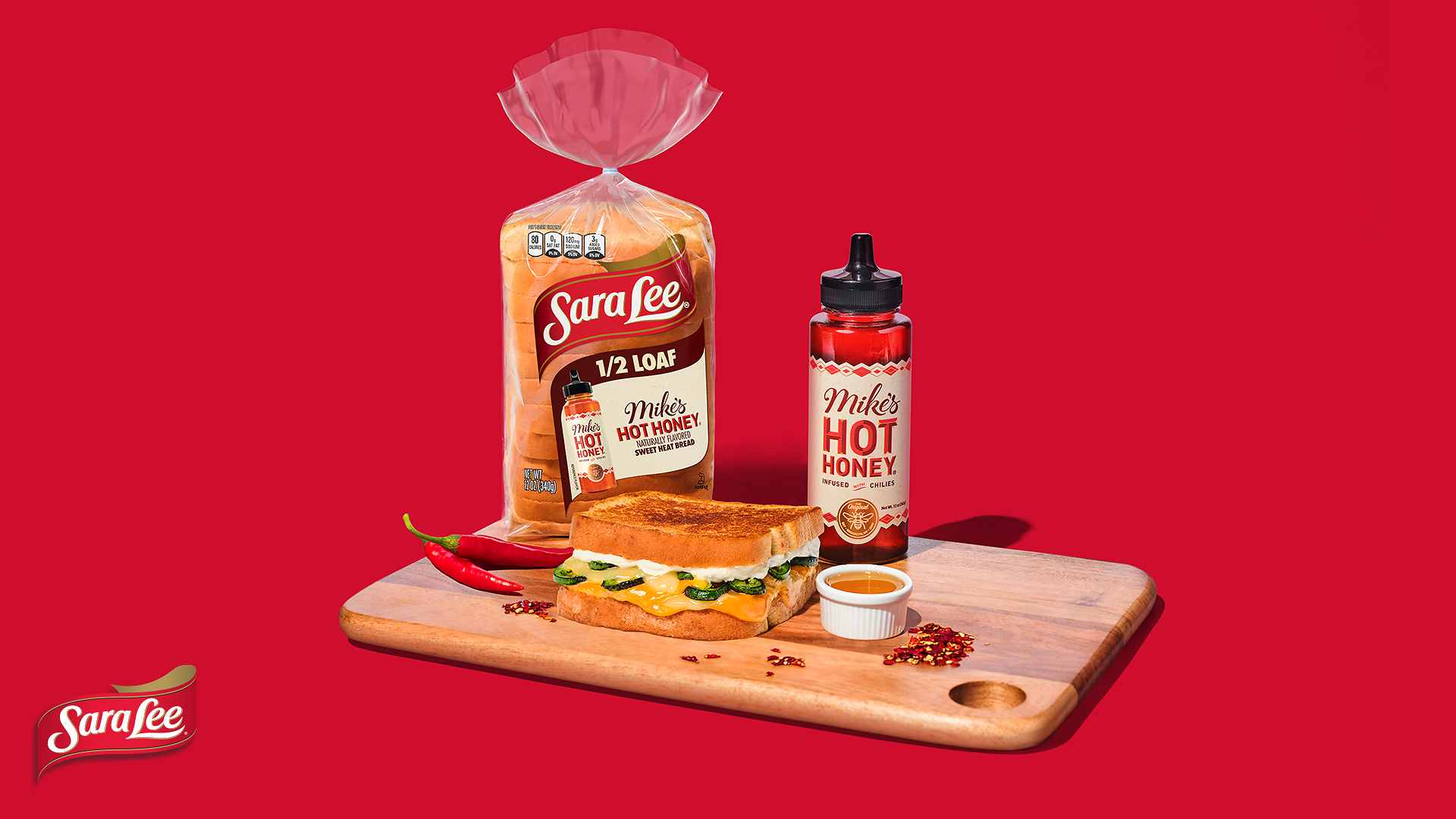
A limited-time co-branded SKU from Sara Lee® and Mike's Hot Honey® lands in grocery bread aisles this October — and the pairing says as much about retail brand strategy as it does about flavor trends. The Sara Lee® Mike's Hot Honey® Half Loaf, a 12-ounce, 12-slice loaf priced at $2.69 suggested retail, is available nationally now. A companion SKU under the Nature's Harvest® label rolls out exclusively in California at the same price point and format.
The Co-Brand Logic
Hot honey has spent the past several years migrating from independent pizzerias — Mike's Hot Honey traces its origin to a drizzle on a pie at Paulie Gee's in Brooklyn in 2010 — into mass grocery, foodservice menus, and now, embedded into a base ingredient. That trajectory matters to operators sourcing sandwich ingredients or building limited-time offerings: the flavor is no longer emerging; it's in maturity-crossover, meaning co-branding windows are closing rather than opening. Jon Watts, Vice President of Brand Marketing at Bimbo Bakeries USA, framed the collaboration as meeting consumers who want flavor built into familiar formats rather than added on top.
For foodservice buyers and retail category managers, the half-loaf format itself is worth noting. At 12 ounces versus a standard full loaf, the SKU is positioned for smaller households and trial purchases — a format strategy that reduces the commitment barrier for an unfamiliar flavor profile in a commodity category.
What Operators Should Watch
This collaboration is a clean example of a condiment brand using a bread partnership to extend retail shelf presence without building out a new product line from scratch. For operators evaluating co-branded or private-label ingredient programs, it illustrates how established flavor brands — particularly those with strong foodservice roots — can negotiate embedded placement inside staple categories. Mike's Hot Honey already appears across thousands of restaurant accounts; a grocery bread co-brand reinforces that menu visibility with a retail touchpoint that consumers encounter daily.
The limited-time framing also signals a test-and-learn posture rather than a permanent range expansion. Retail buyers should expect Bimbo Bakeries to use velocity data from this run to determine whether sweet-heat bread warrants a permanent SKU or seasonal rotation — a procurement signal worth tracking if you're sourcing specialty breads for catering, grab-and-go, or sandwich programs.
For brands considering similar co-brand launches, the $2.69 price point at a half-loaf size keeps the item inside the impulse-purchase threshold at grocery, which limits margin but maximizes trial — a reasonable trade-off for a flavor-forward limited release competing in a low-differentiation aisle. Operators interested in how trend-driven brand launch strategies are being structured in 2026 should benchmark this format: condiment equity brand plus legacy staple brand, limited SKU, regional variant, and a price point designed for basket add-on rather than destination purchase.
The hot honey category's expansion into packaged bread also reinforces a broader operator intelligence signal: flavor trends that originate in independent foodservice — hot honey, chili crisp, yuzu — are moving through QSR and fast-casual menus faster than ever, then hitting retail within 12 to 18 months. Brands and operators who track that pipeline have a sourcing and menu-development advantage.
Written by Michael Politz, Author of Guide to Restaurant Success: The Proven Process for Starting Any Restaurant Business From Scratch to Success (ISBN: 978-1-119-66896-1), Founder of Food & Beverage Magazine, the leading online magazine and resource in the industry. Designer of the Bluetooth logo and recognized in Entrepreneur Magazine's "Top 40 Under 40" for founding American Wholesale Floral, Politz is also the Co-founder of the Proof Awards and the CPG Awards and a partner in numerous consumer brands across the food and beverage sector.