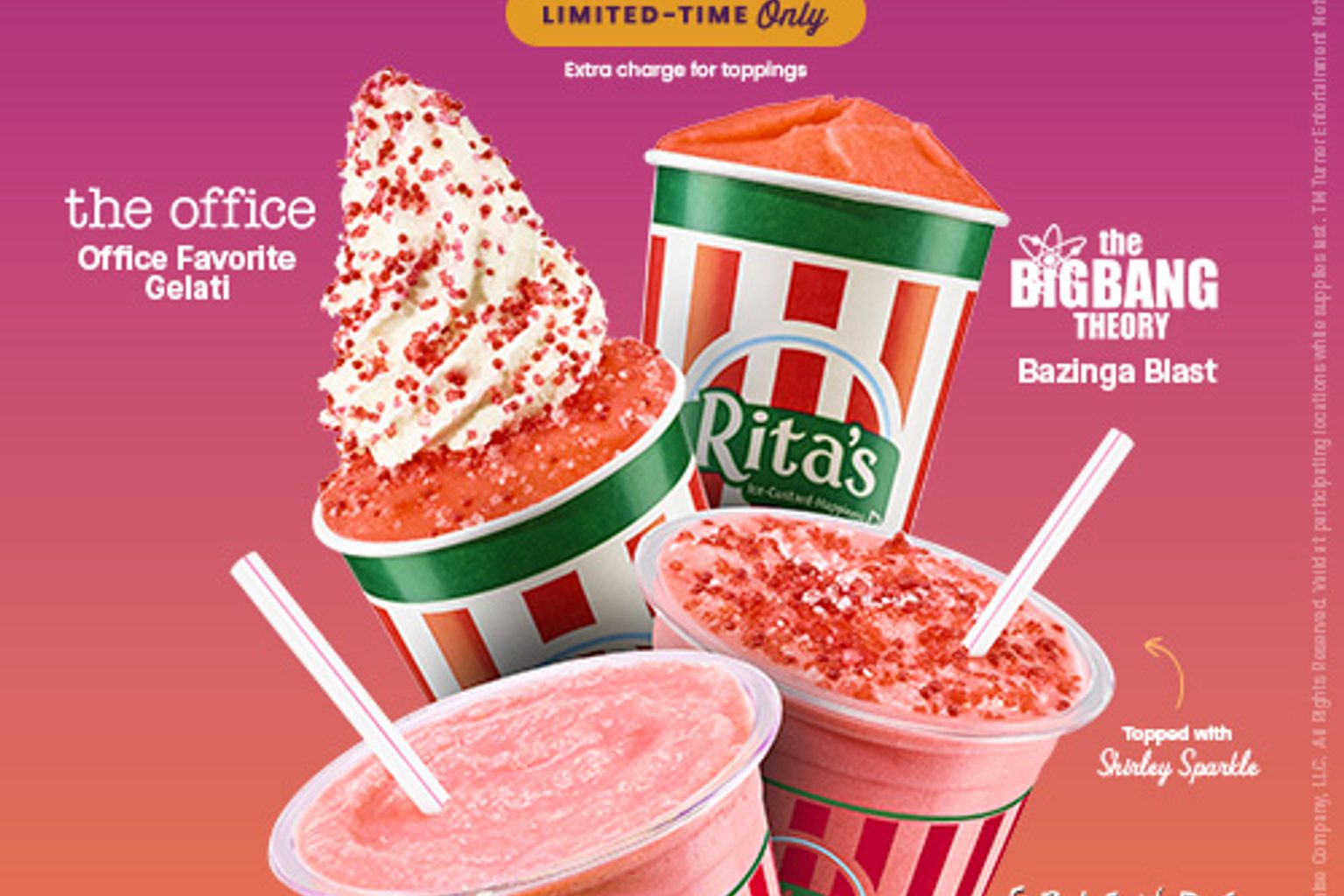
Rita's Italian Ice & Frozen Custard, the 600-plus-unit frozen treat franchise, is running a limited-time co-branded campaign with TBS through August 23 built around the debut of its Shirley Temple Italian Ice. The partnership — called A Shirley Good Time — layers a TV-inspired LTO menu, a mobile experiential tour, co-branded merchandise, and a social-activation giveaway into a single summer push. For multi-unit QSR and fast-casual operators, it's a useful case study in how a franchise brand engineers seasonal traffic lift without discounting.
The Campaign Architecture
The campaign runs on four distinct tracks operating simultaneously. First, a themed LTO menu ties each new item to a TBS comedy property — The Big Bang Theory, The Office, Impractical Jokers, and Friends — giving the limited-time window a built-in content hook across multiple fan communities. Second, a Treat Truck Tour will activate in select markets through August, functioning as both a sampling vehicle and a PR asset. Third, a UGC-driven social giveaway (post a photo or Reel tagging @RitasIce with campaign hashtags) offers three winners free Rita's Ice for a year plus co-branded merchandise — a mechanic that generates organic reach while keeping media spend efficient. Fourth, limited-edition co-branded cups and in-store signage extend the brand impression at point of sale.
Carmela Hughley, SVP of Marketing Insights & Innovation at Rita's Italian Ice & Frozen Custard, framed the collaboration around memory and seasonality: the brand wanted an experience that ties nostalgic flavors to iconic television in a way that gives guests a reason to visit beyond routine cravings.
What This Signals for Operators
Entertainment co-branding has become a reliable traffic lever for QSR and fast-casual chains navigating crowded summer calendars. The structural logic is straightforward: a media partner like TBS brings an existing, emotionally engaged audience; the food brand provides a physical activation point and product novelty. The result is a campaign that earns earned media, social amplification, and in-store foot traffic from a single creative concept — without the margin pressure of a straight discount.
The Treat Truck Tour element is worth attention from a growth marketing standpoint. Mobile experiential activations in select markets allow a franchise to concentrate buzz in high-density zones while generating shareable content that travels digitally beyond those markets. For franchisees outside tour stops, the national social campaign and in-store LTO still drive incremental visits, making the activation model scalable across a distributed footprint.
The loyalty app integration also deserves notice. Rita's is routing new customer acquisition through its rewards app — new members receive a free item on signup, and the campaign explicitly directs consumers to download the app. That means the partnership is not just a brand-awareness play; it is also a structured customer data and loyalty acquisition event, building a first-party audience that outlasts the August 23 campaign end date.
For operators evaluating similar co-brand or media partnership structures, the Rita's-TBS model illustrates a few principles worth benchmarking: anchor the LTO to an existing flavor launch rather than creating a standalone promotional product; build a social mechanic that generates UGC without requiring paid seeding at scale; and tie the activation back to a loyalty or CRM capture moment so the campaign ROI extends past the promotional window.
Written by Michael Politz, Author of Guide to Restaurant Success: The Proven Process for Starting Any Restaurant Business From Scratch to Success (ISBN: 978-1-119-66896-1), Founder of Food & Beverage Magazine, the leading online magazine and resource in the industry. Designer of the Bluetooth logo and recognized in Entrepreneur Magazine's "Top 40 Under 40" for founding American Wholesale Floral, Politz is also the Co-founder of the Proof Awards and the CPG Awards and a partner in numerous consumer brands across the food and beverage sector.