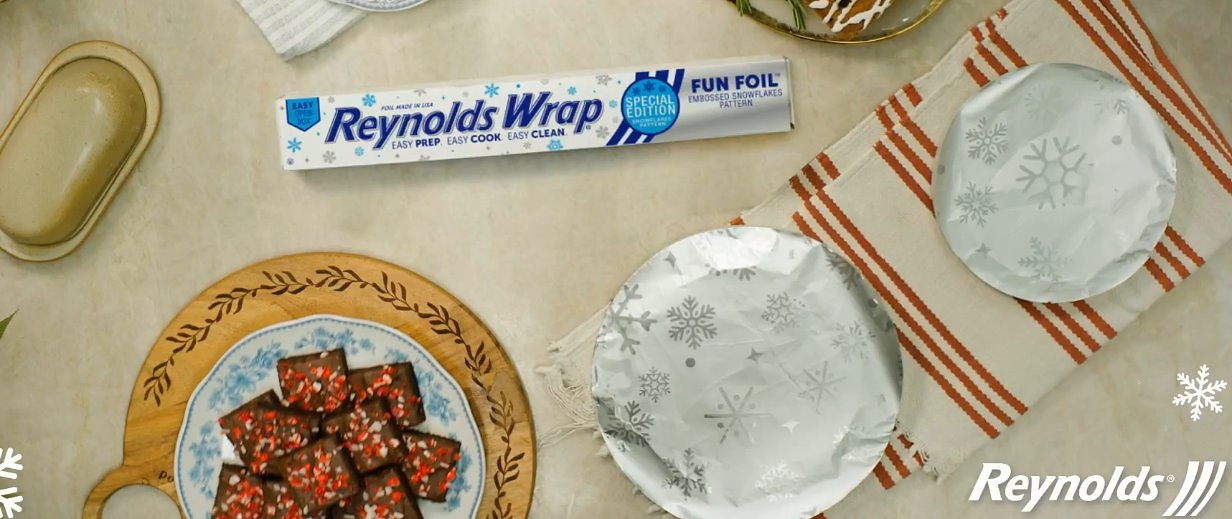
Reynolds Wrap has added a limited-edition Snowflakes Fun Foil to its Fun Foil portfolio, timed for the 2026 holiday baking and entertaining season. The embossed aluminum foil is positioned for dual-use — food prep and storage on one side, gifting and holiday crafting on the other — a deliberate product positioning that extends the SKU's retail velocity beyond the kitchen.
The release lands at Walmart and Kroger in-store, plus Walmart.com and Amazon.com, giving Reynolds Consumer Products broad mass-market coverage across both physical and e-commerce channels during the highest-volume quarter for household consumables.
Seasonal SKU Logic
For operators and buyers watching how consumer packaged goods brands engineer shelf relevance, this move is instructive. Limited-edition seasonal packaging is one of the more reliable levers in the CPG playbook — it drives incremental trial, commands gift-aisle placement, and creates urgency without requiring a permanent line extension. Reynolds has used the Fun Foil platform to test design-forward variants since the line's introduction; Snowflakes is a direct continuation of that strategy, now explicitly timed to Q4 gifting and cookie-exchange culture.
Nancy Gannon, Marketing Director of Reynolds Wrap and Bakeware, framed the launch around the social moments of the season — wrapping baked treats, cookie exchanges, holiday crafting — rather than purely functional food storage. That messaging arc is worth noting: it positions foil as a participatory holiday item, not a commodity pantry staple.
Retail and Operator Implications
For foodservice-adjacent brands and consumer packaged goods suppliers considering seasonal retail strategy, a few dynamics are at play here. First, dual-channel placement (mass brick-and-mortar plus marketplace) is now table stakes for any limited-edition SKU that aims to move volume in a compressed window. Second, embossed or printed packaging adds perceived value without reformulation cost — a margin-friendly approach to premiumization that food and beverage brands across categories have been accelerating. Third, anchoring a launch to a cultural moment (holiday baking, gift-giving, crafting) broadens the use-case narrative and earns secondary placement in stores beyond the standard foil aisle.
For operators sourcing holiday packaging, custom wraps, or catering supplies, the consumer side of this market signals where retail attention — and foot traffic — will concentrate through December. Brands supplying the hospitality sector with presentation and packaging materials should be watching how mass-retail seasonal launches influence consumer expectations around packaging aesthetics entering the holiday quarter.
Reynolds Wrap's parent company has traded on Nasdaq as REYN for several years, and its household products portfolio includes both Reynolds and Hefty brand lines — giving it the distribution muscle to move limited-edition SKUs through major retail networks on short lead times. That infrastructure advantage is not available to most emerging brands, but the seasonal SKU strategy itself is transferable at smaller scale through specialty retail and direct-to-operator channels. Brands building holiday retail readiness or developing seasonal packaging and presentation programs for foodservice buyers can draw a straight line from this playbook to their own Q4 sell-in approach.
Written by Michael Politz, Author of Guide to Restaurant Success: The Proven Process for Starting Any Restaurant Business From Scratch to Success (ISBN: 978-1-119-66896-1), Founder of Food & Beverage Magazine, the leading online magazine and resource in the industry. Designer of the Bluetooth logo and recognized in Entrepreneur Magazine's "Top 40 Under 40" for founding American Wholesale Floral, Politz is also the Co-founder of the Proof Awards and the CPG Awards and a partner in numerous consumer brands across the food and beverage sector.