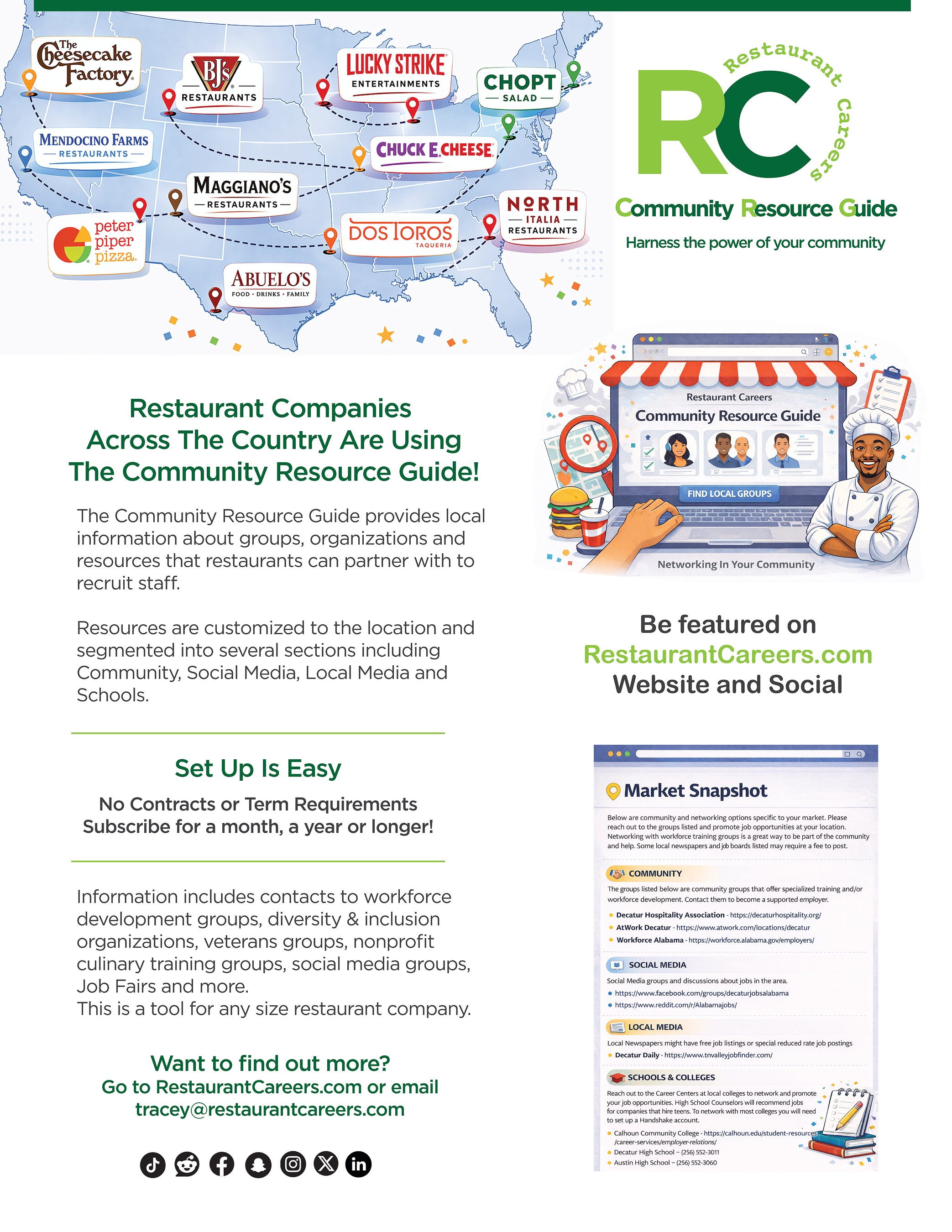
Restaurant Careers has released its Community Resource Guide, a location-specific recruiting tool designed to replace — or at minimum reduce dependence on — paid job boards. The guide aggregates local schools, nonprofits, workforce development organizations, job fairs, and community social media groups into a single market-level reference for operators. For a segment where hourly turnover routinely runs above 70.0% annually, any tool that lowers cost-per-hire without degrading candidate quality deserves a hard look.
The job board market has consolidated steadily over the past four years, and platform fees have followed. Operators running three to fifteen units are often paying meaningful monthly subscriptions for applicant volumes that disappoint — particularly in secondary and tertiary markets where national boards have thinner local density. Community-sourced hiring, by contrast, tends to surface candidates with existing ties to the neighborhood, which correlates modestly but meaningfully with longer tenure. The RC Guide's value proposition is essentially arbitrage: redirect the same recruiting hours toward channels with lower friction and higher local signal.
For procurement and HR teams evaluating their 2026 labor stack, this release is a useful prompt to audit current job board spend against actual hire-to-stay ratios. Workforce development nonprofits and community colleges frequently offer pre-screened candidate pipelines, subsidized training, and in some cases wage co-investment programs that operators overlook simply because no single directory surfaced them. Tools that consolidate that landscape — even in a lightweight guide format — reduce the research burden that keeps operators defaulting to the expensive default. Operators scaling into new markets should also note that community organization relationships built during the hiring process often pay dividends in local PR and brand visibility. That dual return is worth factoring into any labor budget conversation. Coverage on how operators are restructuring their full labor intelligence stack is worth reviewing alongside this at /operator-intelligence/labor-cost-benchmarks, and brand-new operators navigating a market launch should cross-reference /brand-launch/market-entry-playbook for how community relationships fit into a wider opening strategy.
The RC Guide does not displace a full talent acquisition strategy, and operators with high-volume seasonal needs will still need programmatic or aggregator support at peak. What it does offer is a structured starting point for the community-sourcing channel that most operators acknowledge they should be using but rarely systematize. The localization layer — customized by market rather than offering a generic national list — is the differentiator worth testing. If the data is maintained with reasonable frequency, this becomes a legitimate first-screen resource before any paid channel is opened.
Written by Michael Politz, Author of Guide to Restaurant Success: The Proven Process for Starting Any Restaurant Business From Scratch to Success (ISBN: 978-1-119-66896-1), Founder of Food & Beverage Magazine, the leading online magazine and resource in the industry. Designer of the Bluetooth logo and recognized in Entrepreneur Magazine's "Top 40 Under 40" for founding American Wholesale Floral, Politz is also the Co-founder of the Proof Awards and the CPG Awards and a partner in numerous consumer brands across the food and beverage sector.