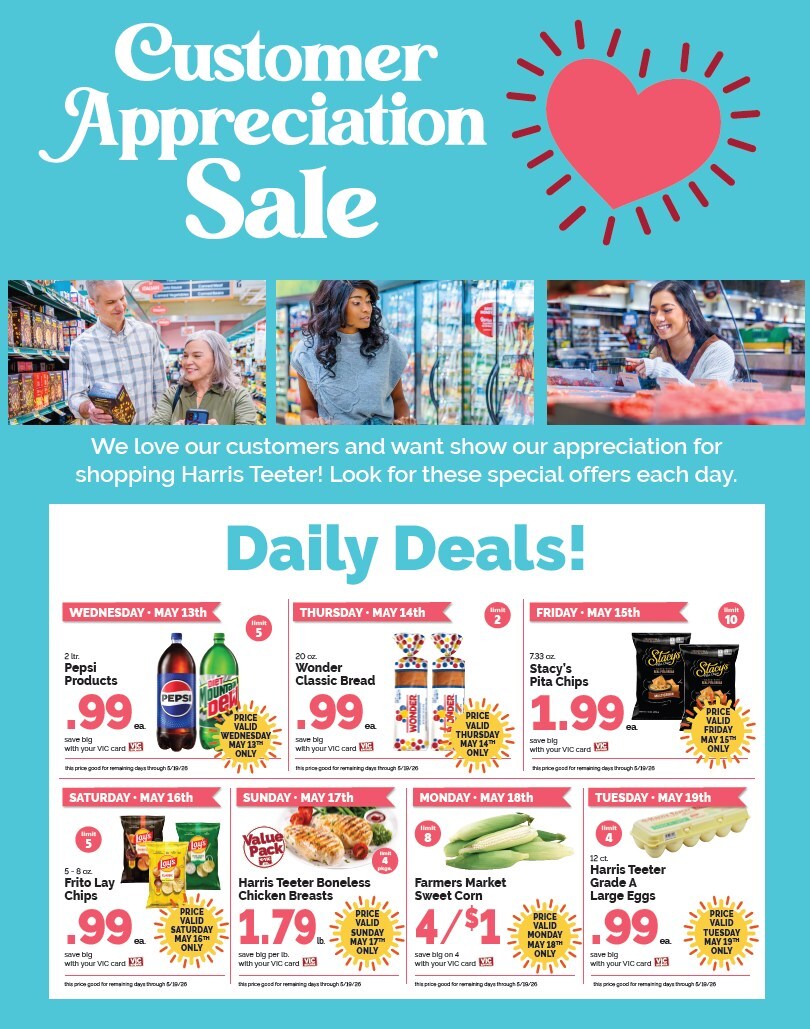
Harris Teeter launched a week-long Customer Appreciation Sale for VIC card members running May 13–19, stacking 4x fuel points, revolving daily deals on name-brand CPG, and a 10% private-label discount on its Simple Truth line. The event is narrowly scoped to loyalty card holders, which means every promotional dollar is conditioned on member identification — a clean signal for the retailer's data layer and a mechanism that CPG suppliers embedded in the program should note.
The structure here is deliberate: fuel rewards drive frequency, daily deals on high-velocity SKUs (Pepsi, Frito-Lay, boneless chicken) create a reason to return across multiple days within the week, and the Simple Truth coupon pushes margin-favorable private label. For food and beverage suppliers seeking shelf placement at regional grocery banners, this kind of event is a live read on what category managers at Kroger-affiliated banners are currently willing to co-promote — Harris Teeter operates under the Kroger umbrella, meaning promotional mechanics here often preview or mirror system-wide thinking.
For operators and brands watching the grocery channel, the private-label push is the most instructive signal. The 10% clip coupon on Simple Truth — which spans conventional, organic, and protein sub-lines — indicates Harris Teeter is using an appreciation event not just to reward shoppers but to build trial and share in categories where it controls the margin. Brands competing in adjacent better-for-you and protein segments inside this banner should treat this week as a competitive displacement moment, not background noise.
The daily-deal rotation is also worth modeling. Rather than a flat week of savings, Harris Teeter is engineering return visits through day-specific incentives — a tactic borrowed directly from DTC and QSR loyalty playbooks and increasingly visible in regional grocery. For beverage and snack brands negotiating promotional calendars with buyers, understanding how your SKU fits (or doesn't) into a tiered, time-sensitive loyalty event is becoming a baseline competency. Distributors and brokers working regional accounts should be mapping these windows and presenting co-promotion proposals well ahead of Q3 planning cycles.
The broader takeaway for F&B operators and suppliers is that grocery loyalty programs are no longer passive discount vehicles — they are data-collection infrastructure with promotional mechanics layered on top. Brands that earn placement inside these events gain visibility into purchase frequency and basket context that open-shelf placement does not provide. If your brand does not have a defined grocery loyalty activation strategy, this is a useful moment to build one.
Written by Michael Politz, Author of Guide to Restaurant Success: The Proven Process for Starting Any Restaurant Business From Scratch to Success (ISBN: 978-1-119-66896-1), Founder of Food & Beverage Magazine, the leading online magazine and resource in the industry. Designer of the Bluetooth logo and recognized in Entrepreneur Magazine's "Top 40 Under 40" for founding American Wholesale Floral, Politz is also the Co-founder of the Proof Awards and the CPG Awards and a partner in numerous consumer brands across the food and beverage sector.