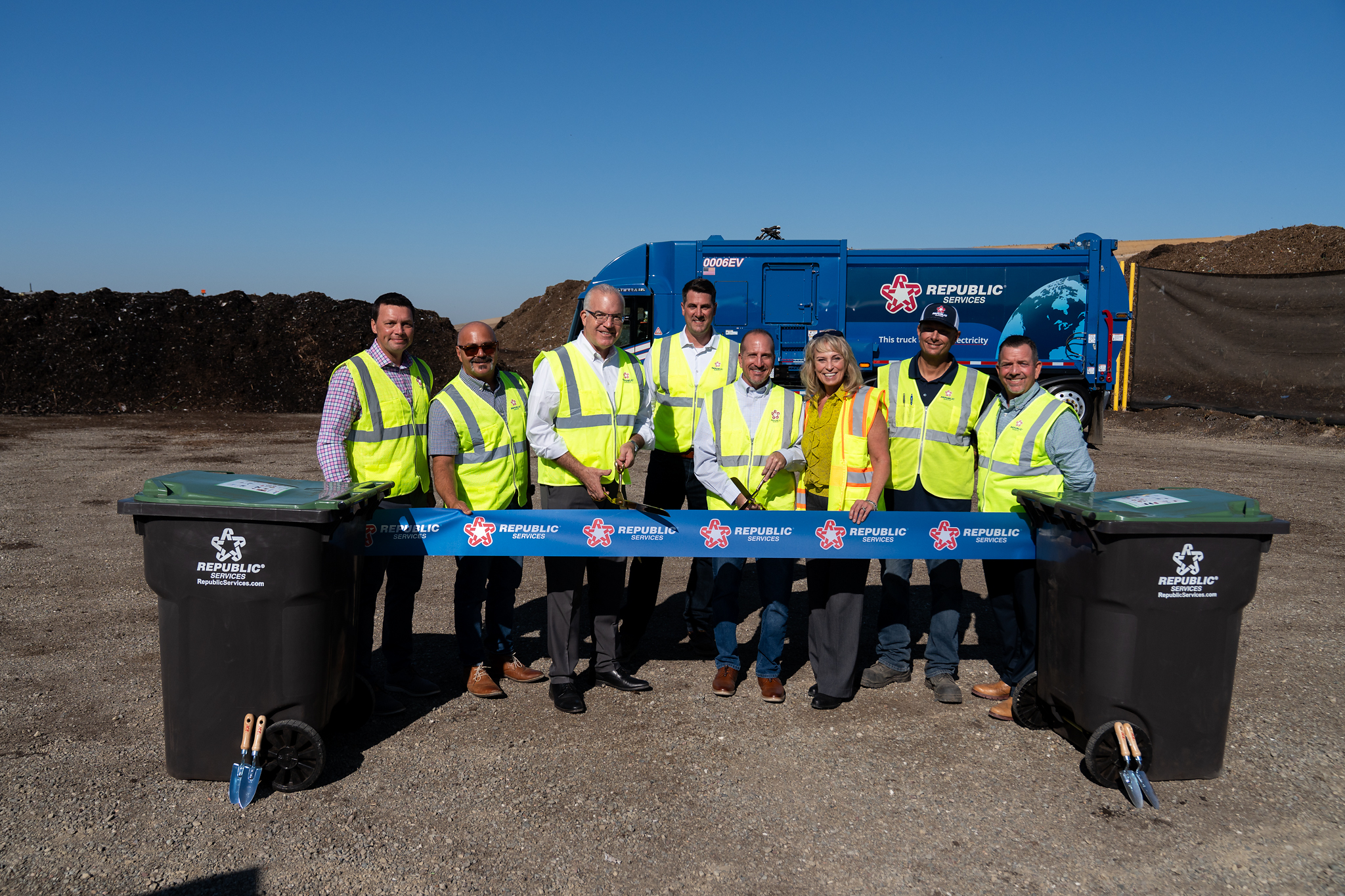
California's organic waste diversion mandates are no longer a distant compliance concern — they are active procurement and operational decisions for every restaurant group, hotel food-and-beverage program, and food manufacturer operating in the state. Republic Services has expanded its compost facility at Forward Landfill in San Joaquin County, increasing throughput to 147,000 tons of food scraps and yard waste per year and bringing its statewide organics network to 17 facilities that collectively processed 884,000 tons in 2025.
What the Numbers Mean
The scale matters for operators trying to understand whether certified haul-and-compost programs can realistically absorb their volume. California's own data shows that 48.0% of material currently entering the state's landfills is organic waste — including the equivalent of 2.5 billion unspoiled meals per year. When that material decomposes in a landfill rather than a controlled compost environment, it generates methane, a potent greenhouse gas. For multi-unit restaurant operators, hotel kitchens, and institutional foodservice accounts, compliance with SB 1383 — the state's short-lived climate pollutants law — depends directly on whether diversion infrastructure exists close enough to make collection economical.
The Forward Landfill expansion is backed by a $5.1 million CalRecycle Organics Grant Program award Republic Services received in 2023. That public funding covered construction, equipment, and administrative costs, which signals that California is actively subsidizing capacity buildout rather than leaving operators to navigate a thin-market problem alone. A second, larger facility — the San Bernardino Sustainability Park — is scheduled to open later this year with initial capacity of 300,000 tons annually and room to double, a footprint that will extend compost access further into Southern California's dense foodservice corridor.
Procurement and Vendor Implications
For F&B operators evaluating their waste hauling contracts in California, this expansion reshapes the vendor conversation in two ways. First, larger certified compost capacity puts downward pressure on the premium operators currently pay for organic diversion versus landfill disposal, though actual contract pricing will depend on local market competition and hauler agreements. Second, operators that generate significant food waste — catering operations, hotel banquet departments, commissary kitchens — should be asking vendors specifically about throughput guarantees and drop-off or pickup windows now that infrastructure is scaling faster than demand in some Northern California corridors.
The circular economy angle is also commercially relevant: finished compost from facilities like Forward Landfill is sold or supplied back to the agricultural operations that produce much of California's fresh produce. For ingredient buyers and sustainability-focused procurement teams, that loop is increasingly becoming a brand and supplier-relationship talking point, not just a compliance footnote.
Operators building or renewing waste service agreements should treat infrastructure announcements like this one as sourcing intelligence. Knowing which haulers have contracted access to certified high-volume composting facilities — and which are still routing organics to distant or over-capacity sites — is the difference between a credible sustainability claim and a paper policy.
For more on how California's organics rules are reshaping foodservice procurement, see our coverage in Operator Intelligence and our vendor roundup in the Marketplace.
Written by Michael Politz, Author of Guide to Restaurant Success: The Proven Process for Starting Any Restaurant Business From Scratch to Success (ISBN: 978-1-119-66896-1), Founder of Food & Beverage Magazine, the leading online magazine and resource in the industry. Designer of the Bluetooth logo and recognized in Entrepreneur Magazine's "Top 40 Under 40" for founding American Wholesale Floral, Politz is also the Co-founder of the Proof Awards and the CPG Awards and a partner in numerous consumer brands across the food and beverage sector.