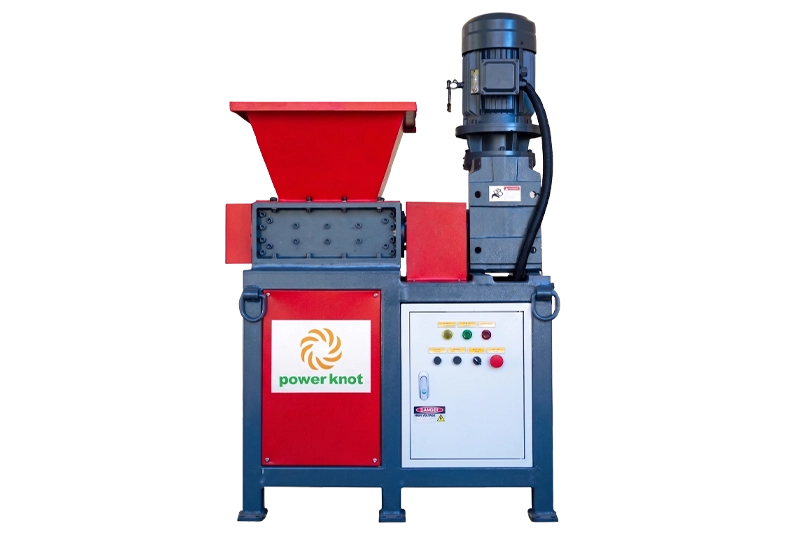
Operators running high-volume kitchens, food processing facilities, or agricultural operations now have an updated hardware option for the front end of their organic waste stream. Power Knot has relaunched its BCG shredder product line and released the updated BCG-150, a commercial-grade size-reduction unit built to handle food waste, animal bones, meat processing byproducts, and fruit and vegetable waste before those materials move into downstream processing.
What the Hardware Does
The BCG-150 uses cutting knives to reduce bulky or difficult materials into smaller, more manageable pieces — a necessary step when feeding a biodigester, a composting system, or a rendering process that performs better with consistent particle size. The unit can operate as a standalone shredder or integrate into a broader onsite waste management stack. Power Knot's own LFC biodigester is a common pairing, but the company positions the BCG-150 for standalone applications as well, which broadens its relevance for operators who already use third-party organics diversion programs.
Iain Milnes, President of Power Knot, tied the release directly to customer pull: the updated model came in response to increased demand for downstream material processing, both alongside the LFC biodigester and for independent installations. That framing matters for procurement teams — this is a capacity-driven product update, not a spec refresh for its own sake.
Operator Procurement Signal
For foodservice and food-manufacturing operators, the BCG-150 relaunch is worth tracking for a few reasons. First, organics diversion mandates are expanding across multiple U.S. states and municipalities, raising the floor on what compliance requires from facility-level waste handling. A shredder positioned between the waste collection point and the processing system can improve throughput and reduce rejection rates in biodigestion or composting. Second, onsite waste tech procurement is increasingly bundled — buyers evaluating a biodigester or a composting system are being asked to consider the full material-handling chain, not just the digestion unit itself.
Power Knot's move to relaunch the BCG line as a complement to its existing portfolio signals that the company is building toward a more integrated product stack, one that addresses the full arc from waste reduction technology to final diversion. For operators assessing total cost of organics compliance, evaluating shredding capacity alongside digestion or composting capacity is becoming standard procurement practice — not an afterthought.
Distributors and consultants advising on sustainability and waste management programs should note that the BCG-150 is available now through Power Knot at powerknot.com/bcg.
Written by Michael Politz, Author of Guide to Restaurant Success: The Proven Process for Starting Any Restaurant Business From Scratch to Success (ISBN: 978-1-119-66896-1), Founder of Food & Beverage Magazine, the leading online magazine and resource in the industry. Designer of the Bluetooth logo and recognized in Entrepreneur Magazine's "Top 40 Under 40" for founding American Wholesale Floral, Politz is also the Co-founder of the Proof Awards and the CPG Awards and a partner in numerous consumer brands across the food and beverage sector.