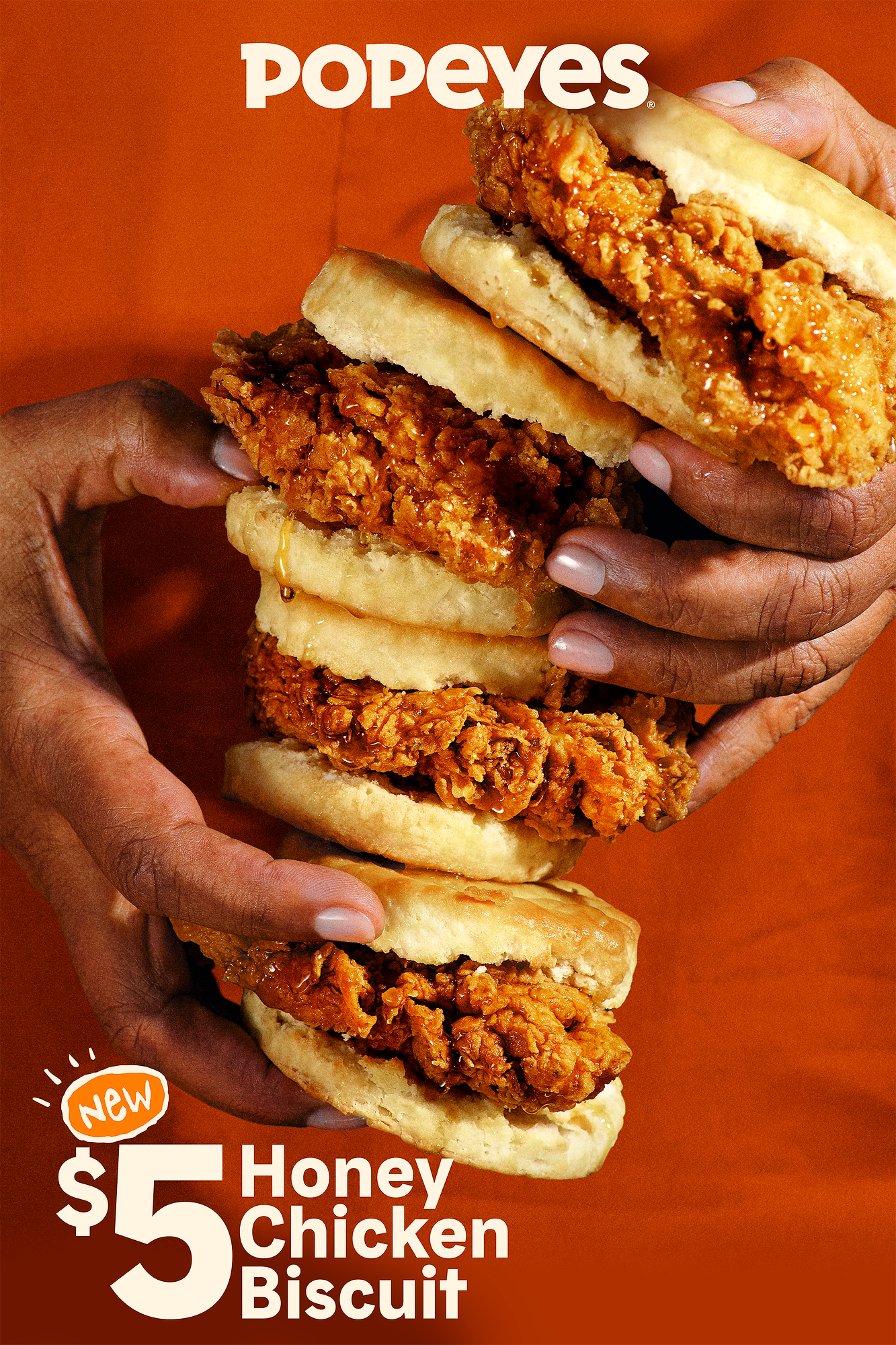
Popeyes has added the Honey Chicken Biscuit to its national menu at a $5 price point, available across participating restaurants, the Popeyes app, and Popeyes.com as of September 28. The item — THAT Chicken from Popeyes on a larger buttermilk biscuit with two honey sauce sachets — follows a pattern worth watching: the chain is converting an organic, social-media-driven fan behavior into a formalized, engineered product at a defensible everyday price.
The Menu Math
For QSR and fast-casual operators, the Honey Chicken Biscuit is a textbook example of low-cost innovation with high perceived value. Popeyes is not introducing a new protein, a new cooking technique, or a new supplier relationship. It is reconfiguring existing, already-amortized SKUs — chicken, biscuit, honey — into a net-new menu occasion. The result is a handheld that competes in the breakfast and snack daypart without requiring a separate back-of-house build. At $5, it also stakes out ground against competitors pressing upward on sandwich pricing across the QSR chicken segment, where average transaction values have climbed steadily over the past two years.
Signal for Operators
The launch rides directly on the brand's "THAT Chicken from Popeyes" national campaign — a deliberate sequencing that gives operators a content-to-conversion pipeline. The campaign establishes the brand narrative; the new SKU gives consumers a fresh transaction reason within the same media cycle. That alignment between brand media spend and menu calendar is a model that independent operators and emerging chains can replicate at smaller scale, particularly through geo-fenced digital campaigns and daypart-specific push notifications.
Matt Rubin, Popeyes Chief Marketing Officer, framed the item as proof that "culinary care turns flavors people already love into something entirely new." The more useful read for operators is structural: social listening identified an existing consumer behavior — fans manually combining chicken, biscuit, and honey — and product development simply codified it. That feedback loop, from organic UGC to menu innovation, is increasingly how large QSR chains de-risk new item launches before committing to supply chain changes.
What Operators Should Track
Popeyes operates more than 4,000 locations in the U.S. and globally, giving it the distribution leverage to make a $5 item viable at margin. Smaller operators cannot assume the same unit economics, but the strategic logic transfers: identify your highest-engagement flavor combinations in guest reviews, social comments, and order-modifier data, then engineer a formal offering around the behavior customers are already exhibiting. For brands thinking about menu trend intelligence and LTO planning, this launch is a clear reminder that innovation does not always require a new ingredient — sometimes it requires better attention to what guests are already doing with what's on your menu.
The Honey Chicken Biscuit is available all day, positioning it across breakfast, lunch, and snack occasions — a daypart flexibility that supports higher attachment rates without requiring operational complexity.
Written by Michael Politz, Author of Guide to Restaurant Success: The Proven Process for Starting Any Restaurant Business From Scratch to Success (ISBN: 978-1-119-66896-1), Founder of Food & Beverage Magazine, the leading online magazine and resource in the industry. Designer of the Bluetooth logo and recognized in Entrepreneur Magazine's "Top 40 Under 40" for founding American Wholesale Floral, Politz is also the Co-founder of the Proof Awards and the CPG Awards and a partner in numerous consumer brands across the food and beverage sector.