
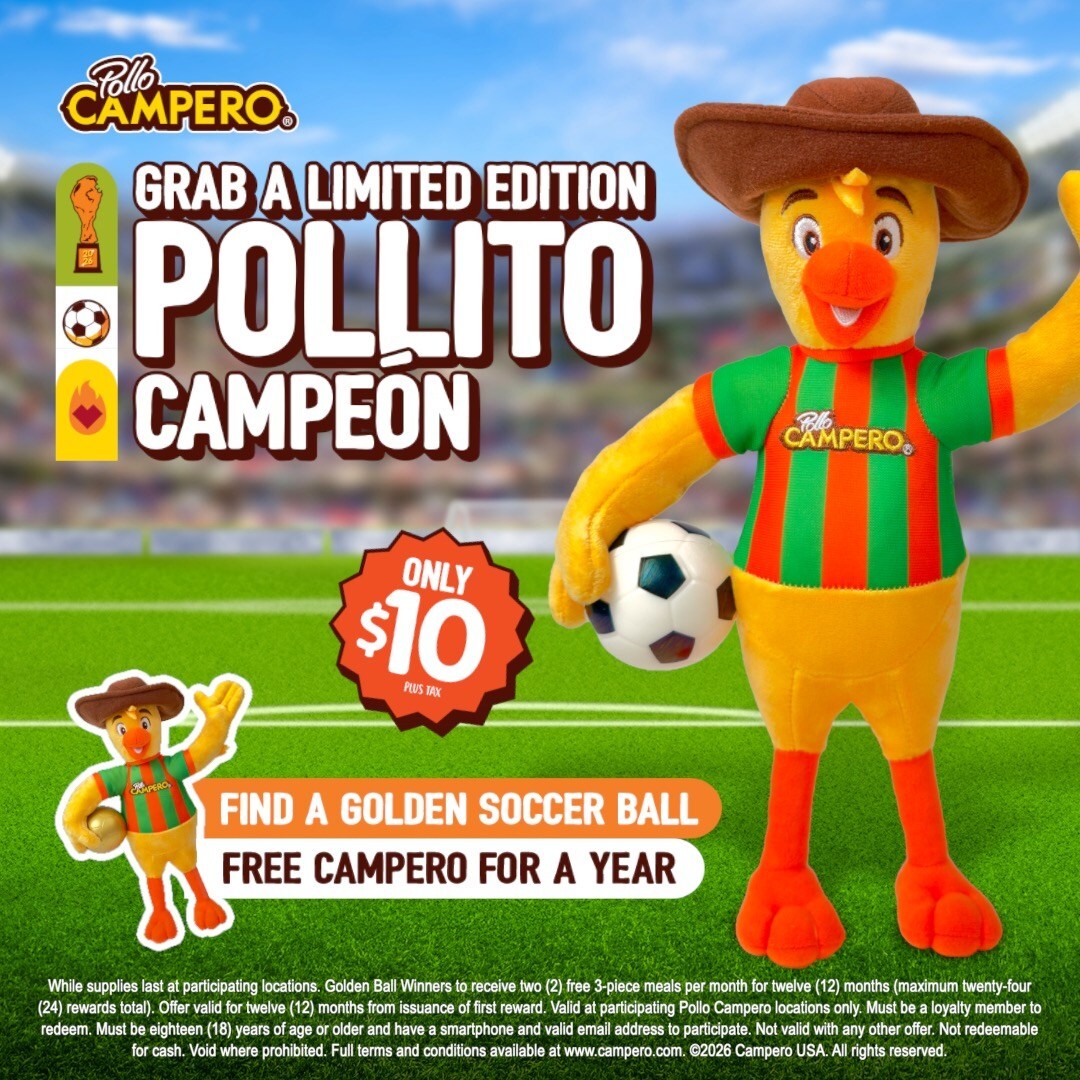
Pollo Campero has launched a soccer-season sweepstakes called Pollito Campeón, giving guests 5,000 chances to win free Campero for a year tied to a plush golden ball giveaway. The Dallas-headquartered chain — founded in Guatemala and now with a growing U.S. footprint concentrated in Texas and other high-Latino-density markets — is positioning itself squarely inside the watch-party occasion at a moment when soccer viewership in the United States is at a generational peak.
The timing is deliberate. Summer 2026 is shaping up as the most saturated soccer media window in U.S. history, with major international tournaments drawing both broadcast and streaming audiences that skew heavily toward the exact consumer the chain already serves. For operators watching how QSR and fast-casual brands allocate seasonal promotional budgets, this is a useful benchmark: Campero is not buying a jersey sponsorship or a broadcast spot — it is driving incremental visits through a prize-ladder mechanic that gives every transaction a reason to convert.
The sweepstakes format is worth noting for any brand considering a summer activation. Prize-ladder structures — where a large number of attainable wins (5,000 in this case) sits underneath a headline prize — tend to generate higher participation rates than single-grand-prize contests because the perceived odds feel actionable. Brands running similar mechanics in convenience and fast-casual have reported lift in transaction frequency during the promotional window, particularly when the prize is product-denominated rather than cash, because it reinforces brand loyalty rather than rewarding price sensitivity. Operators evaluating seasonal promotion structures should weigh whether their own loyalty programs can support a similar mechanic without heavy POS reconfiguration.
From a brand-positioning standpoint, Campero is doing something tactically smart: it is aligning its cultural identity — Guatemalan heritage, family occasion, flavor-forward chicken — with an event that its core guest already cares about, rather than chasing a trend that requires consumer education. That is a cleaner brief for any agency or in-house team managing creative. The plush golden ball as a physical artifact also gives the campaign a social-media dimension without requiring a dedicated influencer budget, since guests who receive the item are likely to post organically.
For operators and brand marketers benchmarking their own summer spend, the Campero play illustrates a repeatable framework: anchor to a cultural moment your core guest owns, use a high-count prize structure to drive visit frequency, and keep the creative artifact tactile enough to earn organic reach. Vendors building promotional tech stacks for fast-casual brands should take note — the brands winning these windows are the ones that can execute prize logistics at scale without friction at the point of sale.
Written by Michael Politz, Author of Guide to Restaurant Success: The Proven Process for Starting Any Restaurant Business From Scratch to Success (ISBN: 978-1-119-66896-1), Founder of Food & Beverage Magazine, the leading online magazine and resource in the industry. Designer of the Bluetooth logo and recognized in Entrepreneur Magazine's "Top 40 Under 40" for founding American Wholesale Floral, Politz is also the Co-founder of the Proof Awards and the CPG Awards and a partner in numerous consumer brands across the food and beverage sector.

