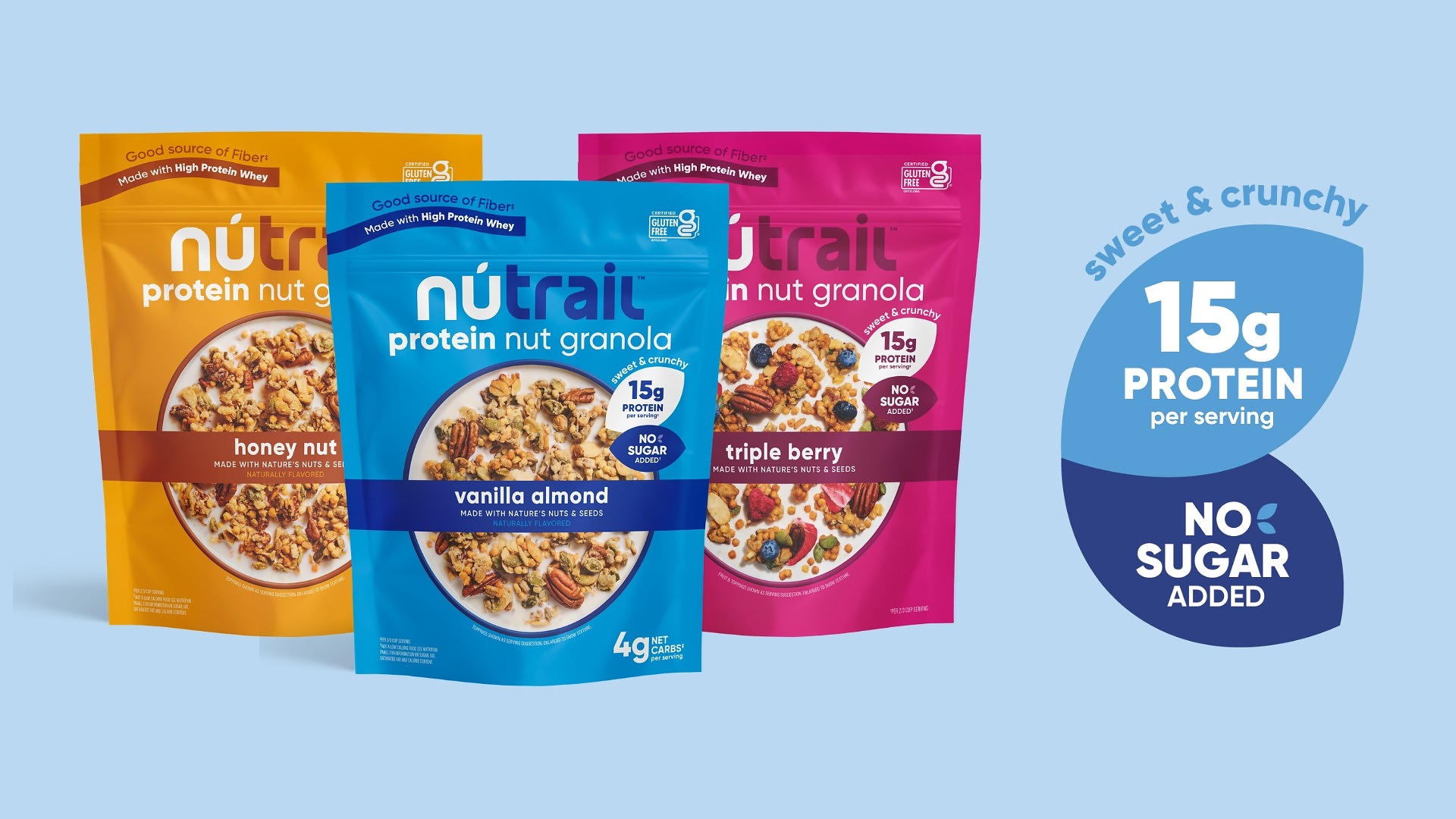
NuTrail, which holds the #1 position in the no-sugar-added granola segment, is launching Protein Nut Granola nationally across eight major retail chains — including Walmart, Target, Sprouts, Publix, Safeway/Albertsons, Meijer, Amazon, and select Sam's Club locations. The line delivers 15 grams of protein per serving, carries a certified gluten-free designation, and contains 1 to 3 grams of total sugar with no added sugar. It launches in four SKUs: Vanilla Almond, Honey Nut, Triple Berry, and Peanut Butter.
The Category Argument
The brand's retail pitch rests on two converging consumer trends. According to the International Food Information Council (IFIC), 75% of consumers are actively trying to reduce sugar intake, while 70% are trying to increase daily protein. A separate 2025 Insite Pulse study cited by NuTrail identifies whey as the top preferred protein source among granola shoppers — which is why the formula pairs nuts and seeds with high-protein whey crisps rather than leaning on plant-based alternatives. For buyers evaluating shelf allocation in the better-for-you breakfast set, that dual-claim position — low sugar and high protein — reduces the need to choose between competing macro trends.
Retail Footprint and Distribution Intelligence
The breadth of this launch is notable. Simultaneous placement across mass (Walmart, Target), natural (Sprouts), grocery (Publix, Safeway/Albertsons), club (Sam's Club), and online (Amazon) at launch signals that NuTrail secured distribution commitments before going public with the product — not a test-and-expand rollout. That execution profile is consistent with a brand that already has established buyer relationships from its existing granola line. Operators and distributors in the foodservice and specialty retail channel should note that NuTrail is positioning this as a flagship extension, not a limited release. The accompanying brand campaign, "Real Good. Feel Good.," is designed to unify the broader portfolio under a wellness identity rather than serve as a single-product ad push.
What This Signals for Buyers and Vendors
For procurement teams at regional grocery chains that did not land in this initial rollout, the window to negotiate placement is likely narrow — the brand will have velocity data from Walmart and Target within 90 days that will either strengthen or constrain its leverage in secondary retailer conversations. For foodservice operators and hospitality purchasing managers watching the better-for-you breakfast category, this launch reinforces a broader shift: whey-based protein formats are migrating from sports nutrition adjacency into mainstream breakfast sets, and the absence of added sugar is becoming a baseline expectation rather than a premium differentiator.
Brands in the operator intelligence space and buyers navigating brand launch decisions should treat this rollout as a reference case for how an established better-for-you brand engineers a multi-door launch — leading with proven positioning, locking distribution ahead of announcement, and tying creative to a portfolio-wide brand identity rather than a single SKU.
Written by Michael Politz, Author of Guide to Restaurant Success: The Proven Process for Starting Any Restaurant Business From Scratch to Success (ISBN: 978-1-119-66896-1), Founder of Food & Beverage Magazine, the leading online magazine and resource in the industry. Designer of the Bluetooth logo and recognized in Entrepreneur Magazine's "Top 40 Under 40" for founding American Wholesale Floral, Politz is also the Co-founder of the Proof Awards and the CPG Awards and a partner in numerous consumer brands across the food and beverage sector.