The New Orleans Marriott has completed a full renovation of all 1,333 guest rooms and suites at its 555 Canal Street property, alongside a top-to-bottom redesign of its M Club lounge — one of the most comprehensive physical investments the flagship convention hotel has made in recent memory. For operators and suppliers tracking group-travel infrastructure spend, the move is a concrete signal that large convention properties are prioritizing physical product upgrades as the primary lever for capturing convention and leisure demand in competitive urban markets.
What Changed
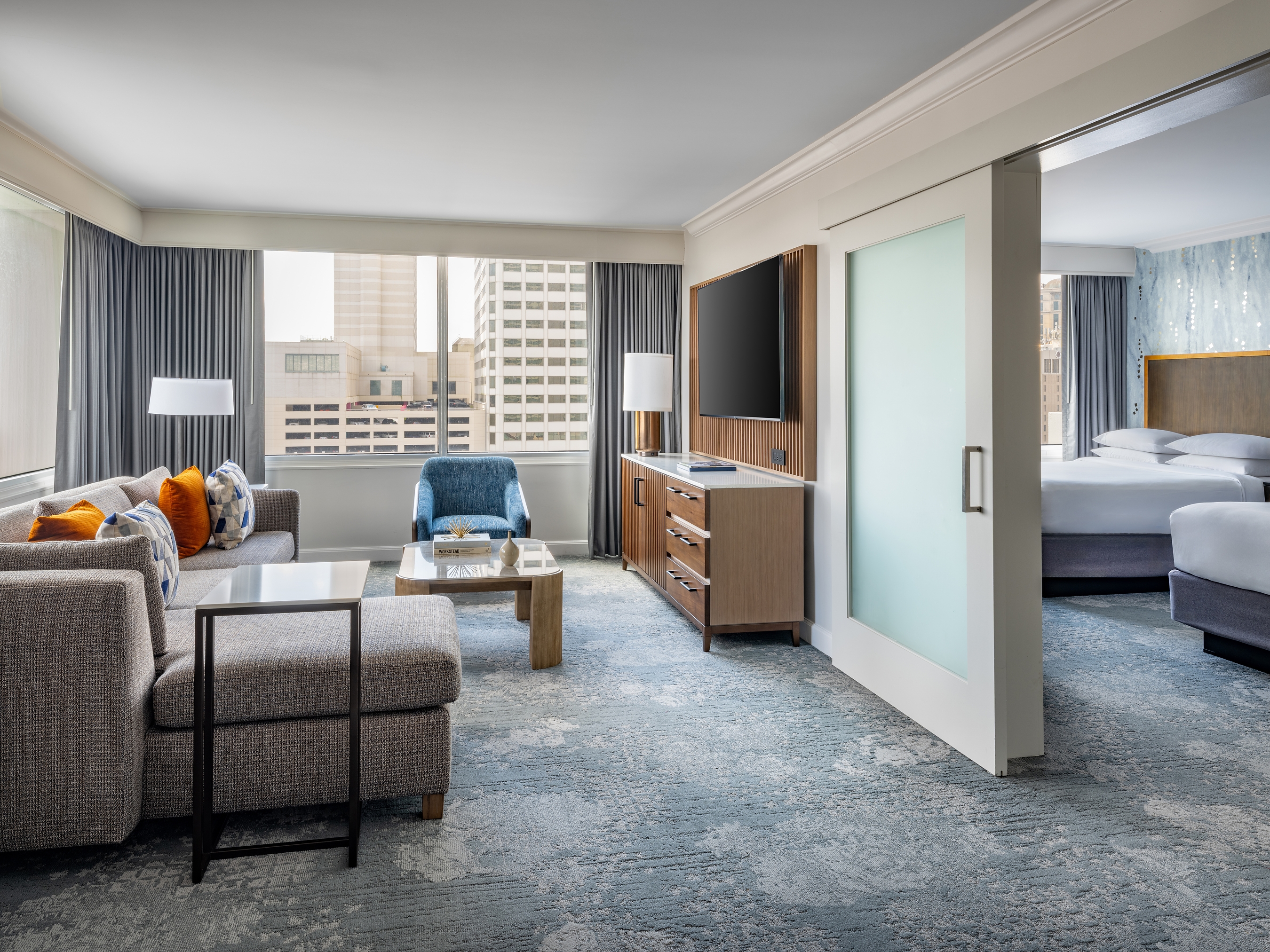
The room renovation goes beyond cosmetic refresh. Double/Double configurations were converted to Queen/Queen layouts, and King room chaise lounges now convert to full-size beds — a direct response to the group and family travel segments that drive occupancy at convention-adjacent properties. New walk-in showers, marble vanities, illuminated mirrors, and sliding barn doors replace dated bathroom fixtures across most of the inventory. Suite upgrades are more extensive: five new Queen/Queen Crescent City suites were added, wet bars were rebuilt with wood cabinetry and gold-accented hardware, and flagship spaces — including the Presidential Suite, Mayor's Suite, Governor's Suite, and two-bedroom General Manager's Suite — received residential-grade finishes designed for extended stays and in-suite entertaining.
The M Club redesign serves Marriott Bonvoy Elite members with updated seating, a neutral-with-teal palette, and a statement glass-orb chandelier. The space is deliberately configured to support both focused work and social use across dayparts — a configuration increasingly common as elite-tier lounge design catches up to coworking norms.
The F&B Footprint
For food and beverage operators and suppliers, the on-site outlet mix is the more instructive story. The property runs five distinct concepts: 5Fifty5 Restaurant for full-service New Orleans cuisine; Canal Street Burger Bar for premium casual; 55 Fahrenheit as a handcrafted cocktail bar; Canal Street Pantry covering grab-and-go pastries, sandwiches, and pizza; and a Canal Street Pantry Café operating as a licensed Starbucks location. That breadth — from white-tablecloth to grab-and-go to licensed CPG — reflects how large convention hotels are managing F&B revenue across radically different daypart and guest-type demands under one roof. Operators running hotel dining programs at similar scale should note the deliberate tiering: each outlet has a distinct price point and occasion, reducing internal cannibalization while maximizing capture across traveler segments.
The property also holds more than 86,000 square feet of flexible meeting space, with signature venues on the 41st floor overlooking the Mississippi River. That meeting infrastructure, combined with proximity to the Ernest N. Morial Convention Center and Caesars Superdome, positions the hotel's F&B program to serve a high volume of contracted group catering — a revenue stream that rewards operators who invest in back-of-house capacity and standardized banquet menus alongside their consumer-facing outlets.
What Operators Should Watch
General Manager Frank Zumbo framed the investment in terms of the city's identity: "Located in a city that was Built to Host, we are proud to continue evolving this iconic hotel while remaining a trusted destination at the center of the city's business, cultural, and entertainment districts." The language is promotional, but the underlying capital decision reflects something operators across hospitality should track — renovation cycles at major convention properties are compressing, and the hotels completing upgrades now are locking in preferred-vendor relationships and group contracts ahead of those that haven't moved yet.
For F&B vendors, distributors, and equipment suppliers targeting the convention-hotel segment, a newly renovated property typically triggers a parallel procurement review. Upgraded bar buildouts, new kitchen pass-throughs, and repositioned outlet concepts all create entry points for vendor relationships that can run five to ten years. Understanding where a property is in its renovation cycle is basic operator intelligence that purchasing-side vendors often overlook.
Properties in comparable markets — large convention cities with a mix of leisure and corporate group demand — are watching moves like this closely. If the New Orleans Marriott's renovation drives measurable rate or occupancy gains in its first year post-completion, expect peer properties to accelerate their own capital timelines. That's the kind of brand launch and repositioning signal worth tracking for anyone selling into the hotel segment.
Written by Michael Politz, Author of Guide to Restaurant Success: The Proven Process for Starting Any Restaurant Business From Scratch to Success (ISBN: 978-1-119-66896-1), Founder of Food & Beverage Magazine, the leading online magazine and resource in the industry. Designer of the Bluetooth logo and recognized in Entrepreneur Magazine's "Top 40 Under 40" for founding American Wholesale Floral, Politz is also the Co-founder of the Proof Awards and the CPG Awards and a partner in numerous consumer brands across the food and beverage sector.