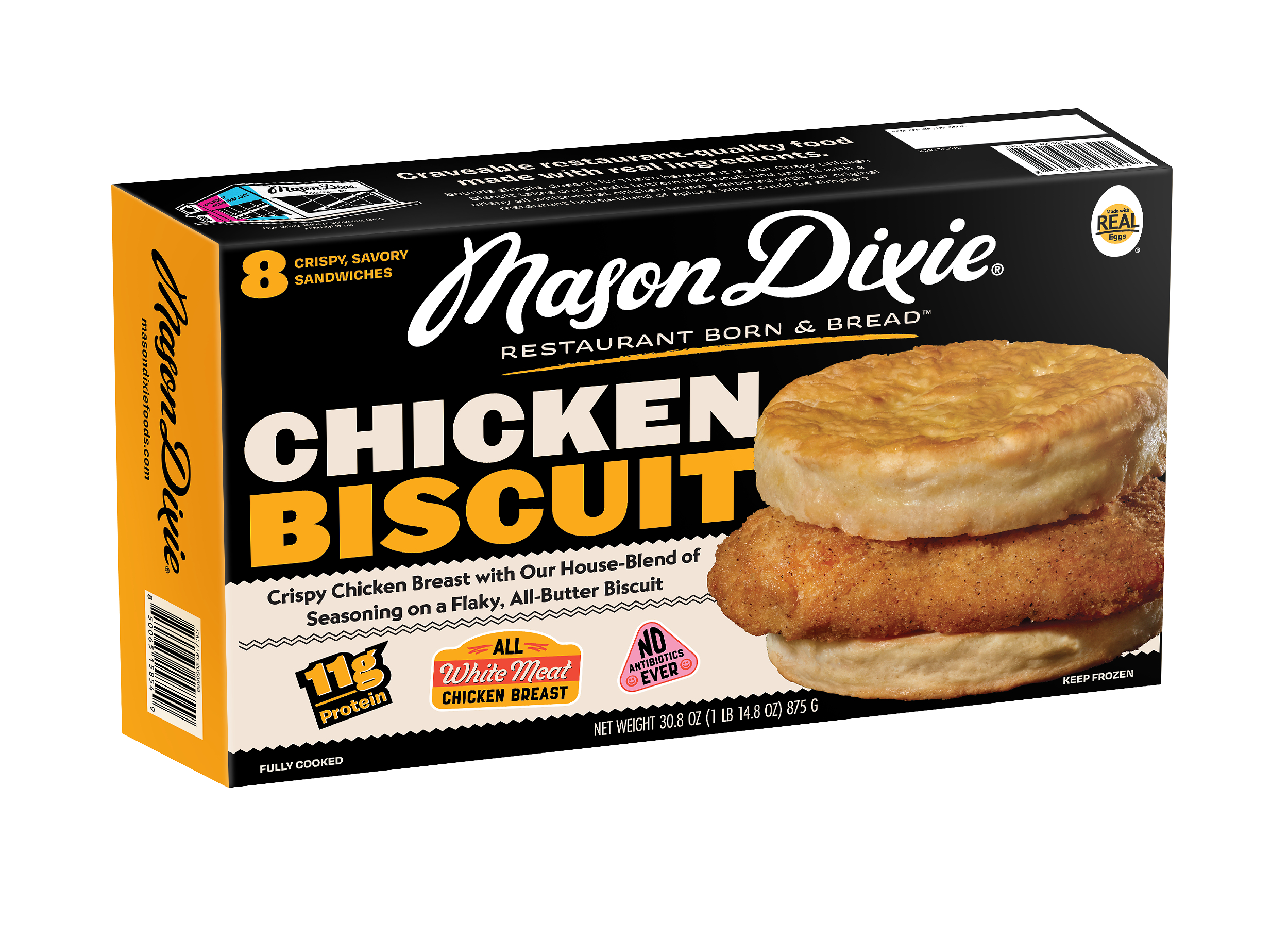
Mason Dixie Foods is placing its Chicken Biscuit Sandwich into Costco freezer cases this month, targeting Northeast, Bay Area, and San Diego locations with an eight-count box priced at $15.99. The move extends a Costco relationship that has become a meaningful distribution pillar for the Baltimore-based brand, which already sells into more than 6,000 retail doors including Whole Foods Market, Sprouts, Giant, and Harris Teeter.
The sandwich pairs Mason Dixie's all-butter buttermilk biscuit with antibiotic-free chicken breast seasoned in the brand's original restaurant spice blend. It clocks in at 11 grams of protein per sandwich, heats in under three minutes, and carries no preservatives, corn syrup, artificial colors or flavorings — a spec sheet designed to stand in direct contrast to the fast-food chicken biscuit it is positioned to replace at home.
The Club-Channel Play
Launching exclusively through Costco — and regionally at that — is a deliberate retail strategy, not a bandwidth constraint. Club-channel exclusives let emerging frozen brands build velocity data at high unit volume before negotiating a broader SKU expansion or a national rollout. For Mason Dixie, a regional Costco debut also doubles as a proof-of-concept for the chicken biscuit format specifically, separate from its established biscuit and breakfast burrito lines. Buyers at conventional grocery and specialty chains will be watching sell-through rates closely before greenlighting a broader placement.
The chicken sandwich category remains one of the highest-frequency purchase occasions in both foodservice and retail frozen. Clean-label competitors have carved out shelf space in the frozen breakfast set, but the combination of a from-scratch biscuit base with an antibiotic-free breast filet at a club-channel price point is a meaningful differentiation argument. At roughly $2.00 per sandwich at retail, Mason Dixie is pricing below the average quick-service chicken biscuit while leaning into the premium ingredient story.
What Operators and Buyers Should Track
For foodservice distributors and retail buyers evaluating the frozen breakfast segment, Mason Dixie's Costco expansion is a signal worth noting. Brands that build club-channel velocity credibly before pitching conventional grocery tend to negotiate from a stronger position. The regional launch structure — three distinct Costco markets — also reflects how sophisticated frozen brands are sequencing distribution to manage supply chain risk while generating regionally comparable data.
Founder and CEO Ayeshah Abuelhiga built the brand's origin story around a single restaurant product that sold out daily before it ever reached retail. That heritage gives Mason Dixie a narrative that resonates with the clean-label buyer segment that has driven growth across the natural and specialty frozen aisle. Brands with authentic founder stories and verifiable ingredient standards continue to outperform category averages in that channel, according to trends tracked across the operator intelligence beat.
For procurement teams managing hotel breakfast programs or convenience-oriented foodservice accounts, the product's three-minute heat time and protein density make it a format worth evaluating as a back-of-house shortcut that still meets clean-label guest expectations.
Written by Michael Politz, Author of Guide to Restaurant Success: The Proven Process for Starting Any Restaurant Business From Scratch to Success (ISBN: 978-1-119-66896-1), Founder of Food & Beverage Magazine, the leading online magazine and resource in the industry. Designer of the Bluetooth logo and recognized in Entrepreneur Magazine's "Top 40 Under 40" for founding American Wholesale Floral, Politz is also the Co-founder of the Proof Awards and the CPG Awards and a partner in numerous consumer brands across the food and beverage sector.