The Move
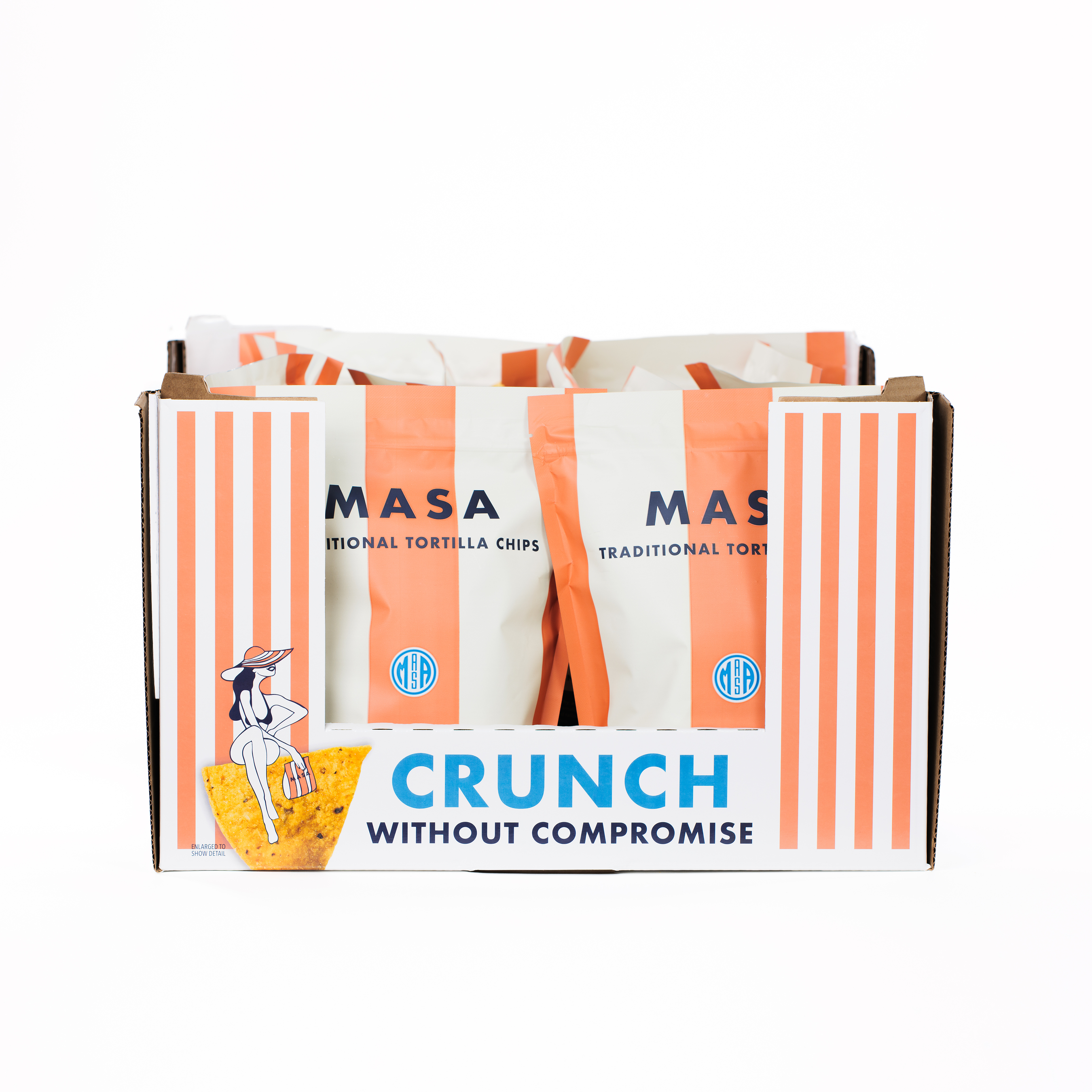
Ancient Crunch is placing its MASA tortilla chip line into 55 Costco locations across Washington and Oregon — its first club-channel placement and a meaningful signal for premium snack brands eyeing warehouse retail as a volume lever. The brand's Original flavor, made with organic nixtamalized corn, salt, and 100% grass-fed and finished beef tallow, will hit the floor in the larger-format packaging that Costco members expect.
The Costco entry is notable not just for the door count but for what it says about where the clean-label snack category is in its maturity curve. MASA already holds shelf space at Sprouts, Erewhon, Wegmans, Whole Foods Market, Target, The Fresh Market, and HEB — a distribution arc that moved from specialty-natural to mass in roughly the same window that seed-oil-free and animal-fat positioning shifted from niche wellness messaging to mainstream consumer interest. The brand now produces more than 400,000 bags per month and claims the number-one tortilla chip position at select retail partners.
What Buyers Should Watch
Club retail operates on fundamentally different terms than conventional grocery. Buyers demand high velocity, limited SKU complexity, and packaging scaled for multi-unit purchase — all filters that wash out emerging brands early. A 55-door Costco pilot in a defined geographic region is a disciplined test: enough volume to stress-test production and logistics, contained enough to optimize before a potential national rollout. For operators and procurement teams evaluating snack and ingredient suppliers, this pattern — specialty-natural to premium grocery to club — is becoming a reliable indicator of which emerging food brands have supply-chain infrastructure behind the marketing story.
The three-ingredient formulation (corn, salt, tallow) also matters for foodservice and retail buyers paying attention to the seed-oil conversation. As consumer demand for clean-label and minimally processed snacks continues to reshape the snack aisle, brands that can point to simple, verifiable ingredient lists are gaining buyer confidence faster than those with longer, more complex panels. MASA's positioning maps directly onto that shift.
What This Signals
For brand launch and retail-readiness strategy, the MASA trajectory is a useful benchmark. The brand used specialty retail — Erewhon, The Fresh Market — to build credibility and velocity data, then leveraged that performance record to open conventional and mass channels. Costco represents the capstone of that sequence for the Pacific Northwest. Steven Rofrano, CEO of Ancient Crunch, framed the partnership around Costco's own quality positioning, noting that the retailer's "longstanding commitment to quality and value" made it a natural fit — language that signals the pitch was made on ingredient standards and unit economics, not promotional spending alone.
For agencies and growth teams working with emerging food and beverage brands navigating retail expansion, the MASA case reinforces a consistent principle: club-channel entry works best as a proof-of-scale moment, not a launch vehicle. Brands that arrive at Costco with existing velocity data and a clean supply chain story convert the buyer conversation far more efficiently than those pitching club as their first major retail bet.
Written by Michael Politz, Author of Guide to Restaurant Success: The Proven Process for Starting Any Restaurant Business From Scratch to Success (ISBN: 978-1-119-66896-1), Founder of Food & Beverage Magazine, the leading online magazine and resource in the industry. Designer of the Bluetooth logo and recognized in Entrepreneur Magazine's "Top 40 Under 40" for founding American Wholesale Floral, Politz is also the Co-founder of the Proof Awards and the CPG Awards and a partner in numerous consumer brands across the food and beverage sector.