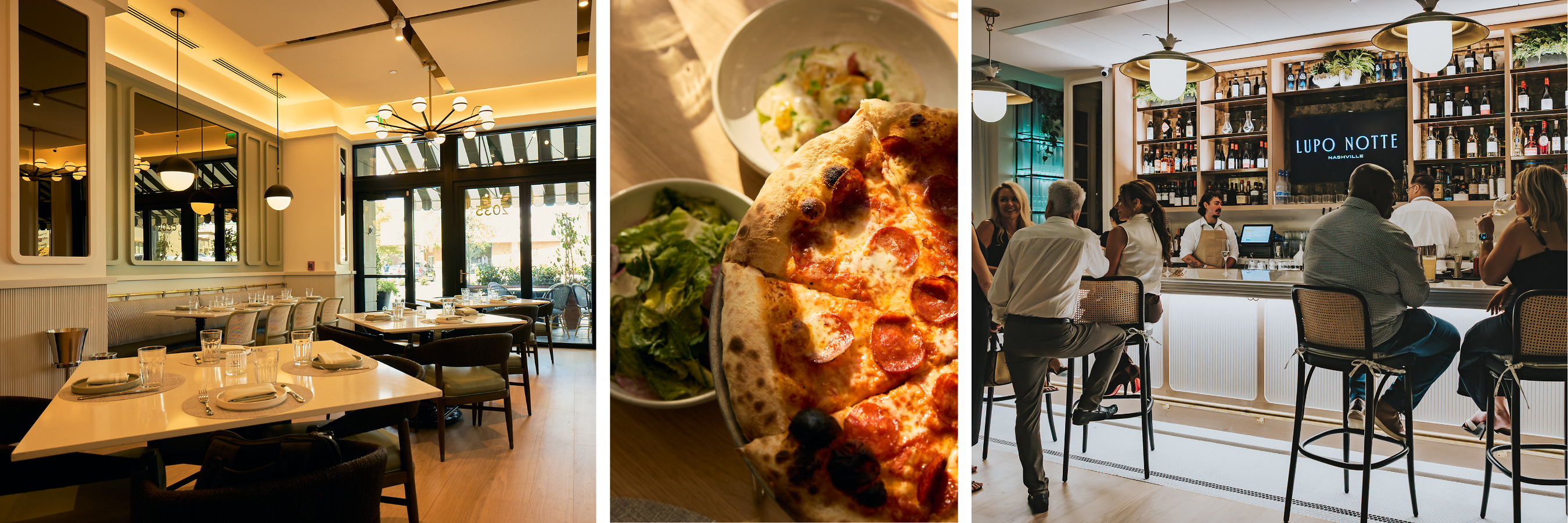
Southern Land Company, a Nashville-based national real estate developer with a $5 billion project pipeline, opened Lupo Notte on September 16 at its Vertis Green Hills mixed-use flagship — marking the company's first foray into full-service restaurant operations. The move is worth tracking for operators and hospitality vendors alike: it represents a growing pattern of vertically integrated developers building out proprietary F&B programs as permanent amenity anchors, not afterthoughts leased to third-party tenants.
The Concept and Kitchen
Executive Chef Owen Lane — a Tennessee native with nearly 30 years in hospitality, including stints at Nashville's Pastis and Audrey — leads the kitchen. The menu leans into upscale Italian with house-made pasta (sweet corn-filled Agnolotti is a signature), Neapolitan-style pizzas on 48-hour fermented dough fired in a three-deck oven, and a wagyu-veal meatball shareable built around premium sourcing. The beverage program centers on Italian-inspired craft cocktails and an international wine list weighted toward Italian varietals. General Manager David Rehrmann brings prior experience from A Voce in New York City and multiple Nashville openings, a hire that signals Southern Land is building this as a serious hospitality operation, not a lifestyle amenity running on thin margins.
The 3,100-square-foot space — designed in collaboration with Nashville firm HASTINGS Architecture — seats roughly 110 indoors and 20 across two patios, with a glass-walled conservatory bar, an eight-seat Chef's Counter facing an open kitchen, and a courtyard presence intended to function as a neighborhood landmark. Dinner service runs nightly; lunch and online ordering are planned for later in the fall.
What This Signals for Operators
Southern Land already operates dining at Westhaven Golf Club in Franklin, Tennessee, so Lupo Notte is less a pivot than a deliberate escalation. The company is using F&B as a value-creation layer inside its real estate — a strategy that large mixed-use developers have been executing in gateway markets for years but is now filtering into regional markets like Nashville with more sophistication.
For independent operators and regional groups, this matters on two levels. First, it intensifies competition for culinary talent in mid-sized markets. When a well-capitalized developer enters the restaurant space with a seasoned GM and a 30-year chef, it tightens an already constrained labor pool. Second, it raises the design and experience bar for upscale Italian in a market that already has strong competition. Operators competing in the $50–$80 per-cover segment in Nashville should treat Lupo Notte as a benchmark, not background noise.
From a vendor and supplier intelligence perspective, the sourcing approach — locally procured ingredients, wagyu beef, house-made pasta programs — is consistent with what premium Italian concepts across the country are executing as they differentiate on provenance rather than price. Suppliers positioned in the local and regional farm-to-table channel in Middle Tennessee have a clear pitch opportunity here as Lupo Notte scales into lunch service. Operators building or refreshing Italian programs can also use this launch as a brand positioning reference point when approaching buyers and investors in similar mixed-use environments.
Written by Michael Politz, Author of Guide to Restaurant Success: The Proven Process for Starting Any Restaurant Business From Scratch to Success (ISBN: 978-1-119-66896-1), Founder of Food & Beverage Magazine, the leading online magazine and resource in the industry. Designer of the Bluetooth logo and recognized in Entrepreneur Magazine's "Top 40 Under 40" for founding American Wholesale Floral, Politz is also the Co-founder of the Proof Awards and the CPG Awards and a partner in numerous consumer brands across the food and beverage sector.