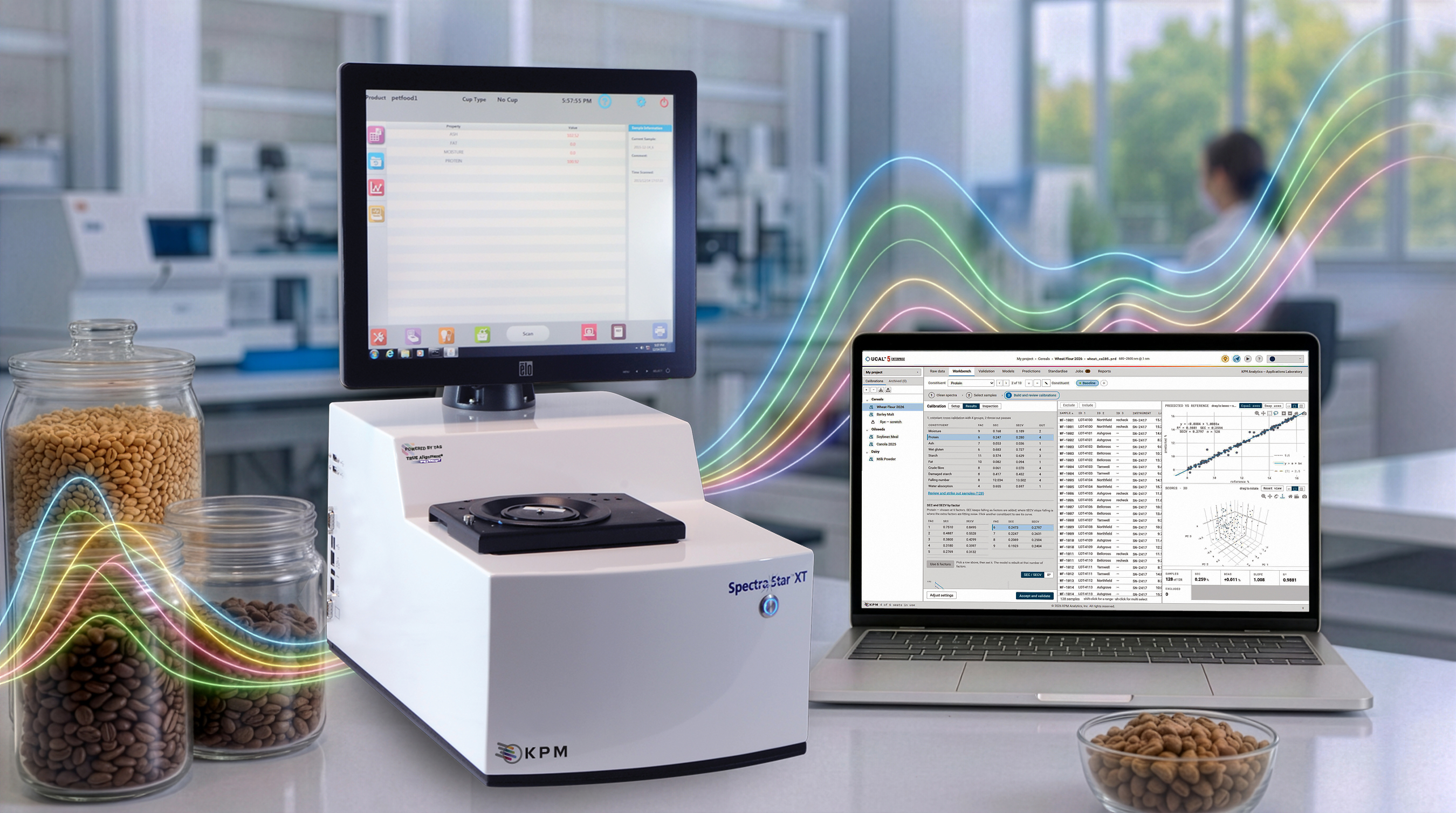
Food and feed quality labs running near-infrared analyzers now have a guided calibration platform that reviews their work against industry standards in real time. KPM Analytics has released UCAL 5, a patent-pending NIR calibration customization platform for its SpectraStar XT Series analyzers, available today with a 30-day free trial of the Pro edition.
For procurement and lab operations teams, the significance is practical: miscalibrated NIR instruments are a persistent source of product quality failures in food manufacturing, grain handling, and ingredient procurement. UCAL 5 addresses the root cause directly — most calibration failures trace back to inadequate sample coverage or skipped validation steps, not bad mathematics.
How the Platform Works
UCAL 5 organizes calibration into four steps — data collection, workbench development, validation, and publishing — and wraps each step in three embedded tools. UCAL Insight acts as a live reviewer, checking sample counts, laboratory value ranges, and validation coverage at every stage, flagging issues green, yellow, or red with plain-language explanations drawn from ASTM E1655 and ISO 12099 standards. UCAL Autopilot runs a parallel calibration from the same dataset, presenting its best result alongside the user's with a side-by-side comparison of every setting that differs. Fifteen built-in lessons provide in-context coaching, from first principles through publishing a validated calibration file — no prior calibration experience required.
"Most calibrations do not fail because the math is wrong," said Yuegang Zhao, President of KPM Lab Solutions and Chief Commercial Officer at KPM Analytics. "They fail because the samples did not cover the range, or because nobody checked the calibration against new samples before it went on the instrument."
Calibration Library and Fleet Deployment
For operators managing multiple instruments across a production network, UCAL 5 connects to KPM's web store, which carries more than 250 pre-built calibrations for food, feed, and agricultural products — covering commodities from alfalfa hay and canola meal to cheddar cheese, sold by measured property (moisture, protein) or in 15 ready-made bundles. Operators can purchase a calibration library with its underlying spectra, open it in UCAL 5, add facility-specific samples, and publish a customized calibration file that loads across an entire SpectraStar XT fleet via KPMLink cloud management software.
The platform ships in three tiers. UCAL 5 Lite is currently bundled with new SpectraStar XT analyzers and supports four calibration methods with up to 500 user samples per calibration. Pro unlocks 18 methods — including Modified PLS and three neural network approaches — plus advanced sample selection and instrument standardization tools, with no sample ceiling, making it appropriate for labs building from years of historical data. Enterprise deploys Pro capabilities to full laboratory teams via a company server, licensed per user, with project-level sharing controls. All editions support 11 languages and open existing UCAL 4 project files without data loss; UCAL 4 users can upgrade to Pro at a discount.
What This Signals for Operators
The release reflects a broader pattern in food and ingredient quality technology: vendors are embedding standards compliance and decision-support directly into instrument software rather than leaving it to analyst judgment. For procurement teams evaluating analytical instrumentation, that shift changes the calculus — a platform that enforces ASTM and ISO checkpoints at every calibration step reduces the training burden and lowers the risk of out-of-specification product reaching further down the supply chain.
Food manufacturers and co-packers investing in AI-assisted quality and procurement intelligence should note that UCAL 5's Autopilot function — running a machine-generated calibration in parallel with the analyst's — is an early indicator of how instrument vendors will compete on embedded AI capability, not just hardware specification, over the next product cycle. Labs evaluating NIR procurement decisions in 2026 and 2027 should ask vendors specifically how their software validates calibration coverage and whether compliance checks are automated or manual.
Written by Michael Politz, Author of Guide to Restaurant Success: The Proven Process for Starting Any Restaurant Business From Scratch to Success (ISBN: 978-1-119-66896-1), Founder of Food & Beverage Magazine, the leading online magazine and resource in the industry. Designer of the Bluetooth logo and recognized in Entrepreneur Magazine's "Top 40 Under 40" for founding American Wholesale Floral, Politz is also the Co-founder of the Proof Awards and the CPG Awards and a partner in numerous consumer brands across the food and beverage sector.