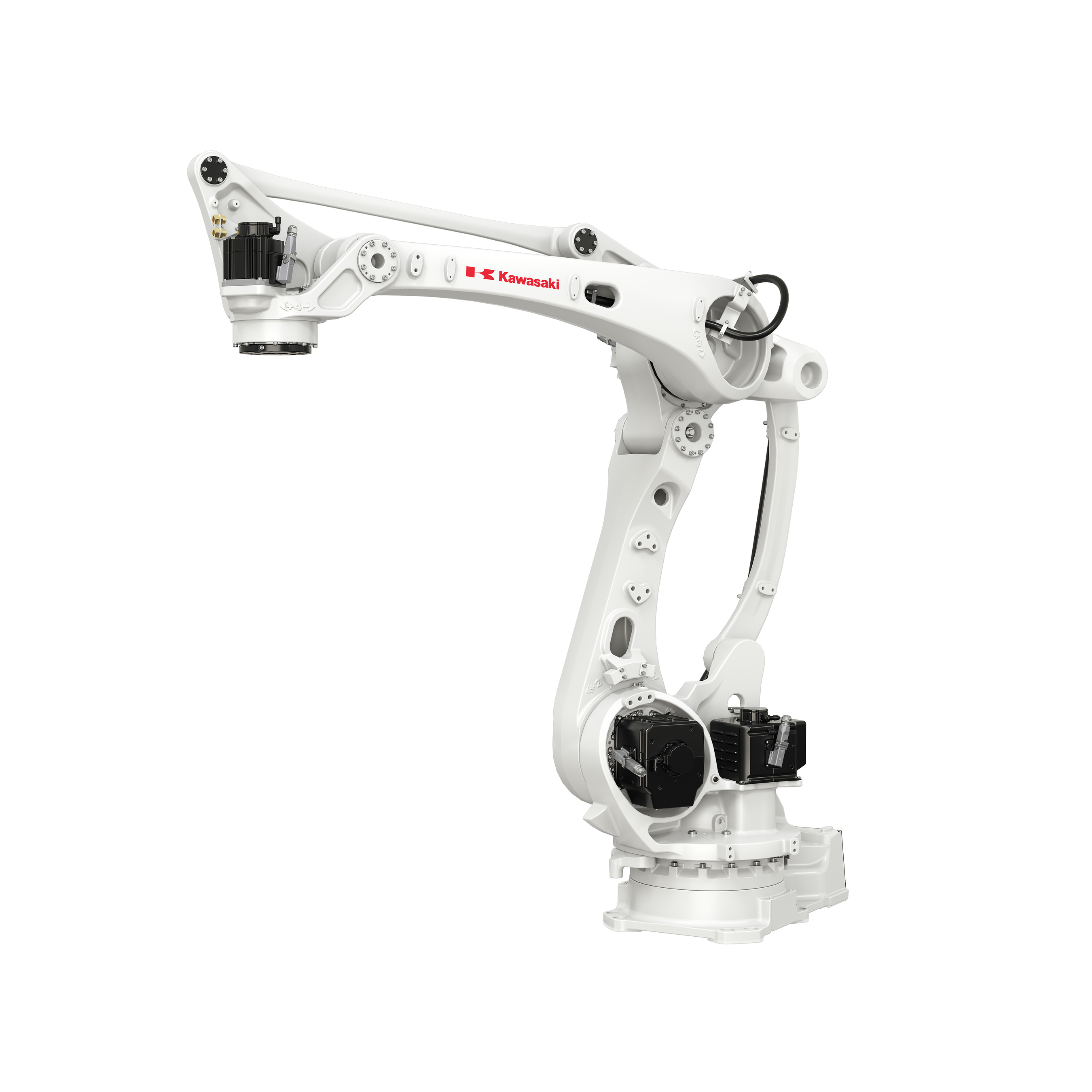
Kawasaki Robotics (USA), Inc. will debut the CP110L palletizing robot at PACK EXPO International 2026 (Oct. 18–21, McCormick Place, Chicago), marking its first North American appearance and signaling a direct play for food, beverage, and consumer packaged goods manufacturers navigating constrained production environments.
The timing is deliberate. According to PMMI's 2026 Robotics in Packaging & Processing report, 61.0% of end users surveyed plan to increase robotics investment over the next 12 months. Kawasaki is positioning the CP110L squarely in that window — not as a flagship industrial showcase, but as a practical answer to the floor-space problem that stalls palletizing automation projects in existing food and beverage facilities.
The Hardware Case
The CP110L carries a 110-kg payload, reaches 2,505 mm, and processes up to 2,200 cases per hour under specified operating conditions. Its ceiling-height requirement of 2,242 mm and a revolute-axis interference radius of 453 mm are the numbers operators should flag: both are designed for production lines where vertical clearance is limited and adjacent equipment cannot be relocated. A hollow-wrist cable-routing design reduces interference with surrounding machinery, and an onboard power-regeneration function recovers energy during deceleration — a practical efficiency gain in high-cycle palletizing where vertical movement is constant.
Paul Marcovecchio, Director GI Industries at Kawasaki Robotics (USA), Inc., framed the design intent plainly: "The CP110L was developed around that reality. It gives customers another way to increase palletizing capacity without assuming they have unlimited floor space or ceiling height."
What Operators Should Watch
Kawasaki is bringing two additional demonstrations to PACK EXPO that round out its end-of-line story for food and beverage buyers. An R Series case-packing cell integrated by Design For Making showcases the RS013N robot — 13-kg payload, 1,460-mm reach — with an expandable architecture that allows vision, additional tooling, and safety tech to be added as production scales. Separately, IRIS Factory Automation's modular RPZ-U palletizing platform is paired with the RS025N (25-kg payload, 1,885-mm reach), positioned as a turnkey integration for operations that cannot afford extended downtime for retooling.
For procurement teams at mid-size food manufacturers and co-packers, the three-system lineup gives meaningful optionality: a compact high-speed palletizer, a scalable case-packer, and a modular turnkey cell. That range matters when capital budgets vary and production line layouts rarely match catalog assumptions. The CP110L also expands Kawasaki's CP Series from 110 to 700 kg, so integrators building multi-SKU lines have a continuous payload ladder to design around.
Operators evaluating end-of-line automation for food and beverage packaging should treat PACK EXPO as a live procurement moment, not just a trade floor. Demos running actual multi-format product handling — the CP110L was shown palletizing both boxed dog food and bagged cat food without a tooling change — compress the proof-of-concept cycle that typically adds months to automation timelines. For operators tracking the broader shift toward hospitality and foodservice automation, this category of compact, high-throughput robotics is moving from pilot to standard specification faster than most facility managers have budgeted for.
Written by Michael Politz, Author of Guide to Restaurant Success: The Proven Process for Starting Any Restaurant Business From Scratch to Success (ISBN: 978-1-119-66896-1), Founder of Food & Beverage Magazine, the leading online magazine and resource in the industry. Designer of the Bluetooth logo and recognized in Entrepreneur Magazine's "Top 40 Under 40" for founding American Wholesale Floral, Politz is also the Co-founder of the Proof Awards and the CPG Awards and a partner in numerous consumer brands across the food and beverage sector.