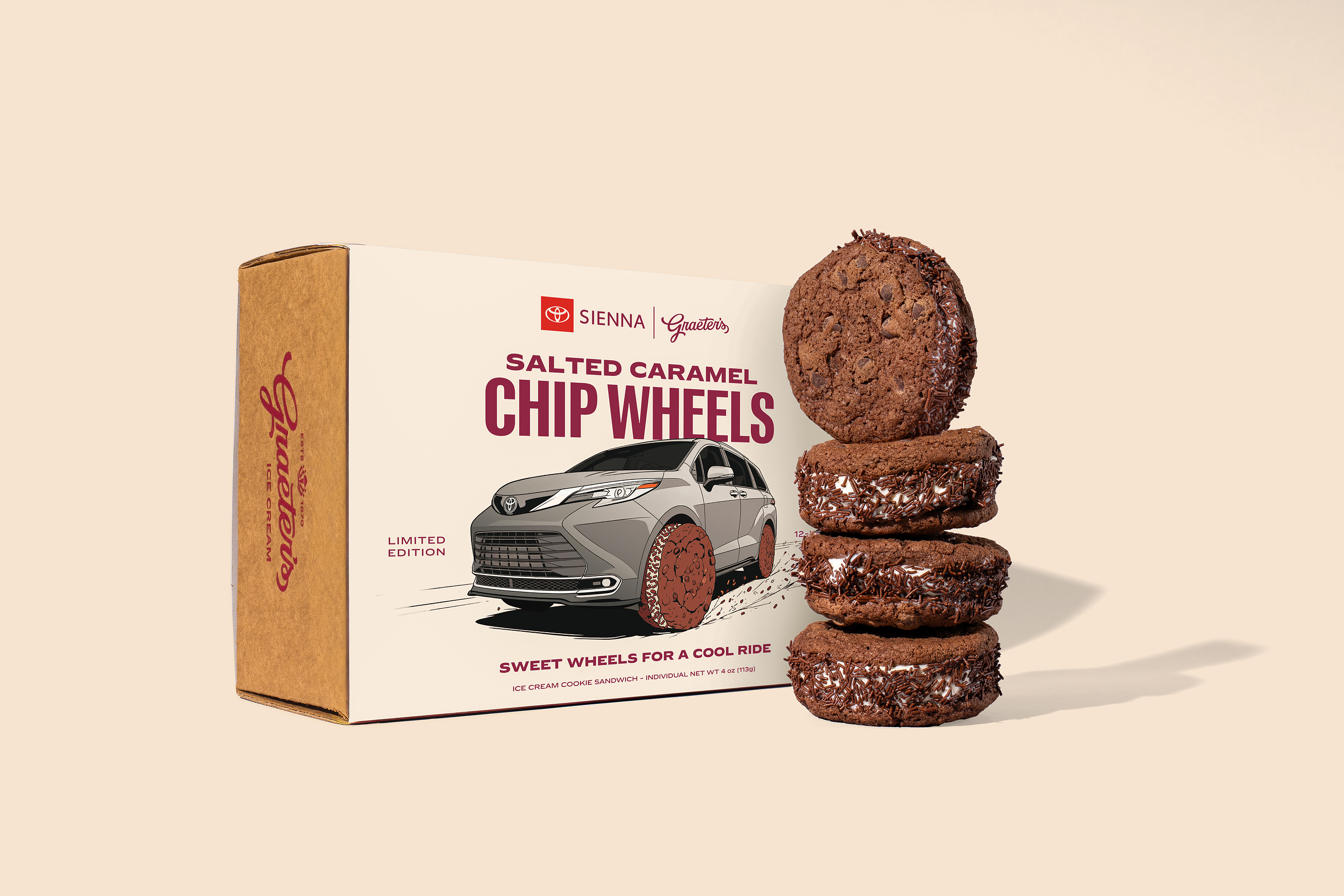
Cincinnati-based Graeter's Ice Cream has launched a limited-edition Salted Caramel Chip Wheel in partnership with Toyota's 2026 Sienna — a co-branded product designed explicitly around the Sienna Platinum grade's available FridgeBox™, an integrated front-console cooler with both cool and freeze modes. The 12-pack is available exclusively online via direct-to-consumer shipping at Graeters.com/Toyota while supplies last.
The product itself — salted caramel ice cream sandwiched between made-from-scratch double chocolate chip cookies and rolled in chocolate jimmies — is a limited spin on Graeter's existing Chip Wheelies line. But the strategic mechanics here are what operators and brand managers should focus on: this is a CPG brand using a vehicle feature as the distribution hook.
The Co-Brand Logic
For Graeter's, this partnership extends national DTC reach with Toyota's marketing infrastructure behind it. The brand already ships more than 300,000 pints annually and sits in more than 2,000 grocery stores across the U.S., but this activation targets a different purchase moment — families in transit — and ties product trial to a durable consumer asset (the vehicle). Richard Graeter, fourth-generation president and CEO, noted the shared values angle: "We see that philosophy in Toyota. The Sienna and Graeter's Ice Cream may be very different products, but we share a commitment to quality, craftsmanship and creating something families can truly enjoy."
Owen Peacock, marketing general manager at Toyota, framed the FridgeBox as the connective tissue: the Sienna's freeze mode is designed to keep frozen treats, including Graeter's Chip Wheels, solid during transit. The co-brand is less about shelf placement and more about demonstrating a vehicle feature through a premium consumable — Toyota gets a tangible, shareable product demo; Graeter's gets a national media platform and a new audience of family-vehicle buyers.
What This Signals for Brand Operators
Cross-category co-branding — food brands pairing with non-food consumer products — is a proven mechanism for premium CPG labels to punch above their regional footprint without committing to traditional retail expansion. For independent food and beverage brands with strong regional identity, aligning with a nationally advertised consumer product can deliver impressions that paid media alone cannot efficiently buy. The key variables: product fit must be functional (here, the FridgeBox tie-in is literal), the storytelling must survive scrutiny beyond the press release, and DTC fulfillment infrastructure must be in place before launch.
Graeter's 60-retail-store footprint and existing national shipping operation make this a lower-risk activation than it would be for an emerging brand. That said, the exclusivity model — online only, while supplies last — creates urgency and controls inventory exposure, a smart hedge for a limited-edition SKU built around a marketing moment rather than a permanent line extension.
For foodservice and hospitality operators watching co-brand strategy, this collaboration is a useful case study in brand launch mechanics that extend reach without wholesale distribution commitments. It also reflects a broader trend in operator intelligence: premium regional brands are increasingly willing to structure product innovation around a partner's feature set rather than leading with their own channel strategy.
Written by Michael Politz, Author of Guide to Restaurant Success: The Proven Process for Starting Any Restaurant Business From Scratch to Success (ISBN: 978-1-119-66896-1), Founder of Food & Beverage Magazine, the leading online magazine and resource in the industry. Designer of the Bluetooth logo and recognized in Entrepreneur Magazine's "Top 40 Under 40" for founding American Wholesale Floral, Politz is also the Co-founder of the Proof Awards and the CPG Awards and a partner in numerous consumer brands across the food and beverage sector.