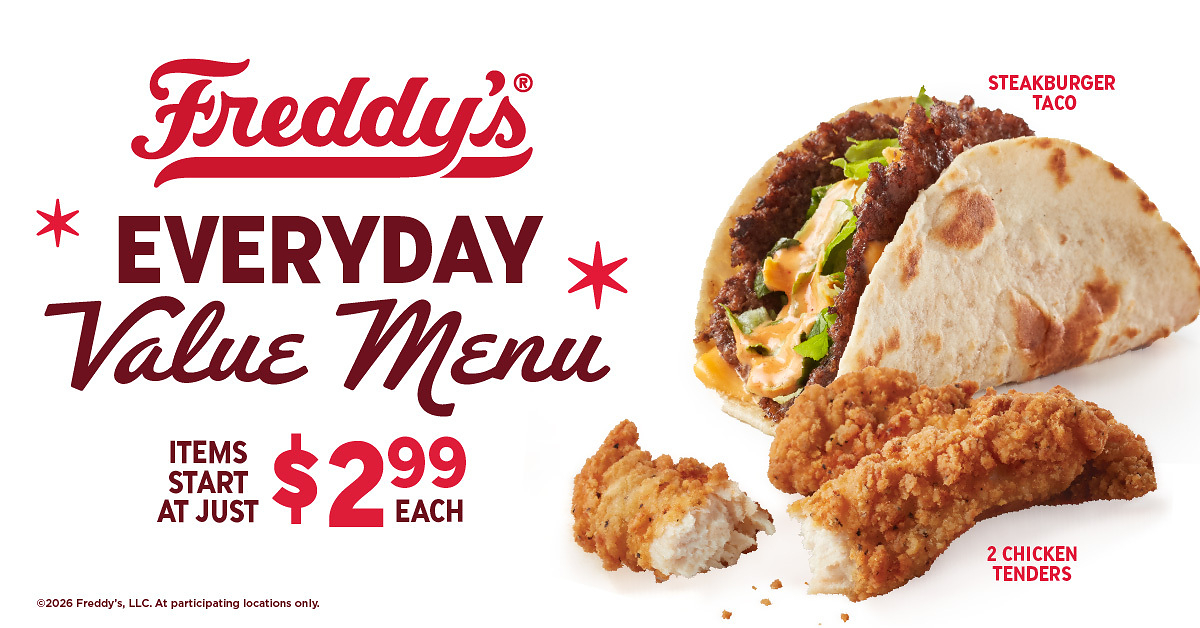
Freddy's Frozen Custard & Steakburgers](https://freddys.com) is testing a formal Everyday Value Menu at participating locations across seven states, anchoring four items at starting prices of $2.99 to $3.49. The limited-time test covers Arizona, Colorado, Kentucky, New Jersey, New Mexico, Nevada, and Texas, and is accessible via drive-thru, in-restaurant dining, and the Freddy's mobile app. For operators tracking how 600-plus-unit fast-casual brands are responding to consumer price sensitivity, the move is worth watching — it's a structured menu-architecture decision, not a one-off promotion.
The Menu and the Math
The four items on the Everyday Value Menu are purpose-built for snack and light-meal occasions: a Steakburger Taco starting at $3.49, a two-piece Chicken Tenders order at $3.49, an all-beef Hot Dog at $3.49 (upgradeable to a Chili Cheese Dog for an additional $1.50), and a Chocolate Chip Custard Cookie at $2.99. Each item maps to a different daypart or appetite occasion, which suggests Freddy's is using the test to identify traffic patterns rather than simply defend against competitor discounting. Erin Walter, Freddy's CMO, framed it around experience as much as price: "Beyond price, we believe great value is about delivering the quality and experience that makes Freddy's special."
What the Test Signals
Fast-casual brands with strong brand equity have generally resisted the kind of deep discounting that plagued QSR in 2024 and 2025. Freddy's approach — isolating value items within a defined menu tier rather than applying blanket discounts — reflects a more surgical strategy that preserves average check integrity on the core menu while creating a lower entry point for trial and frequency. This is the same menu-engineering logic that drives franchise-level pricing conversations in operator intelligence and is increasingly relevant as franchisees navigate food cost variability and labor pressure simultaneously.
The seven-market footprint also tells a story. These states span multiple competitive density tiers — Nevada and Texas are high-velocity fast-casual markets; Kentucky and New Mexico offer a read on value responsiveness in mid-sized markets. If Freddy's is running this as a genuine data-gathering exercise, franchisees in non-test markets should expect internal reporting on attach rates, average check impact, and repeat visit lift before any national rollout decision. For brand launch and limited-time offer planning, the structure here — defined items, defined markets, defined channels — is a replicable model.
What Operators Should Watch
The mobile app inclusion matters. Gating value-menu access (or at minimum, promoting it) through the Freddy's app keeps transaction data tied to identifiable guests and feeds loyalty and CRM infrastructure. That data layer is what separates a value menu from a true growth instrument. Operators building their own limited-time value strategies should consider whether their POS and loyalty stack can capture item-level attach data at this granularity — without it, a value test produces foot traffic numbers but not actionable menu intelligence.
For suppliers and packaging vendors working with fast-casual franchises, Freddy's move is a demand signal: when a 600-unit chain formalizes a value tier, it creates predictable volume for component items and packaging SKUs at defined price points. Watch the test window for a rollout decision.
Written by Michael Politz, Author of Guide to Restaurant Success: The Proven Process for Starting Any Restaurant Business From Scratch to Success (ISBN: 978-1-119-66896-1), Founder of Food & Beverage Magazine, the leading online magazine and resource in the industry. Designer of the Bluetooth logo and recognized in Entrepreneur Magazine's "Top 40 Under 40" for founding American Wholesale Floral, Politz is also the Co-founder of the Proof Awards and the CPG Awards and a partner in numerous consumer brands across the food and beverage sector.