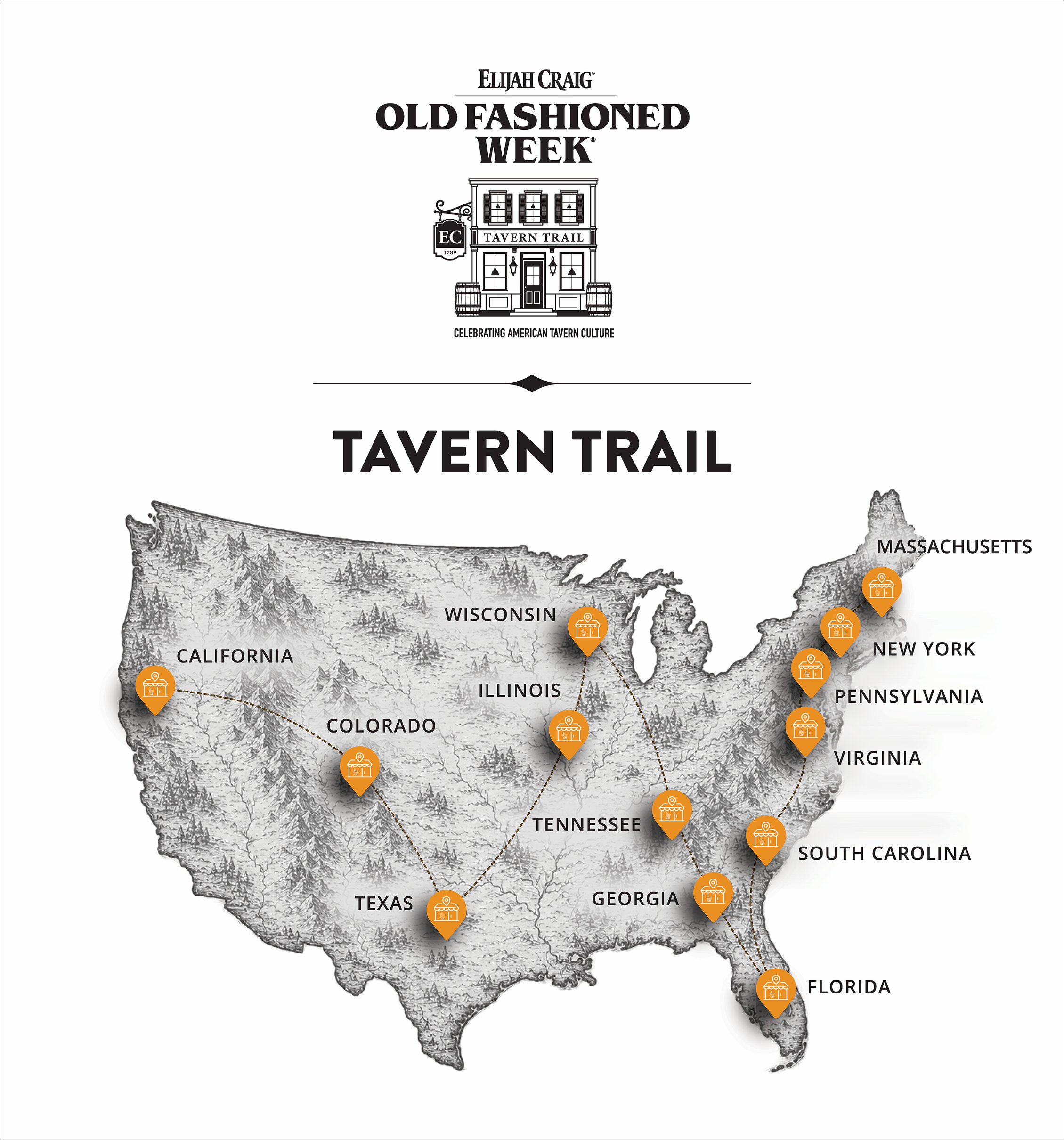
Elijah Craig is expanding its annual Old Fashioned Week into physical territory with the debut of the Old Fashioned Tavern Trail — a curated collection of 70 bars and taverns across the United States running October 9–18. The trail is a meaningful upgrade to what has grown into one of the more operationally structured brand activations in the premium bourbon segment, now reaching more than 12,000 participating accounts annually.
The Program Structure
The Tavern Trail highlights participating Old Fashioned Week venues — drawn from that broader account base — ranging from colonial-era taverns to contemporary cocktail bars positioning themselves as community third spaces. Guests can locate participating establishments through a "Find a Bar" tool at oldfashionedweek.com. For every Old Fashioned sold at a participating venue during the 10-day window, $1 is directed to the Southern Smoke Foundation, which delivers emergency financial relief and no-cost mental health services to hospitality workers. Since founding the program in 2020, Elijah Craig has pledged over $600,000 to Southern Smoke and allied hospitality organizations across the U.S., Canada, and the U.K.
What Operators Should Track
For on-premise operators and beverage directors, the Tavern Trail structure is worth studying as a vendor-funded activation model. Elijah Craig is essentially doing the consumer marketing — building a destination map, driving foot traffic via brand channels, and providing a cause-marketing wrapper — while operators capture the incremental cover and cocktail revenue. The $1-per-drink donation mechanism also gives front-of-house staff a genuine talking point beyond the liquid itself, which translates directly to ticket attachment and repeat visits during the campaign window.
The timing against America's 250th anniversary is deliberate positioning by the brand. Max Stefka, Associate Vice President at Elijah Craig Bourbon, noted that consumers are prioritizing analog experiences and togetherness — a trend well-documented in operator intelligence on on-premise beverage spend and one that premium spirits suppliers are racing to capitalize on. The Tavern Trail framing taps that sentiment without requiring operators to build or fund the narrative themselves.
Implications for Beverage Programs
For operators considering supplier partnerships heading into the 2026 holiday stretch, this activation illustrates what a well-resourced brand can bring to the table beyond a pour cost negotiation. The combination of a structured charitable giving mechanism, a consumer-facing discovery tool, and a defined campaign calendar reduces the operational lift for participating bars considerably. Beverage directors evaluating brand launch partnerships and on-premise activation should benchmark the Elijah Craig model: the brand funds the consumer marketing infrastructure, the operator delivers the experience, and a third-party foundation provides the credibility layer.
Elijah Craig Small Batch — produced by Heaven Hill Distillery and first brought to market in 1986 — is the featured expression for the campaign, positioned as the standard Old Fashioned build across participating venues.
Written by Michael Politz, Author of Guide to Restaurant Success: The Proven Process for Starting Any Restaurant Business From Scratch to Success (ISBN: 978-1-119-66896-1), Founder of Food & Beverage Magazine, the leading online magazine and resource in the industry. Designer of the Bluetooth logo and recognized in Entrepreneur Magazine's "Top 40 Under 40" for founding American Wholesale Floral, Politz is also the Co-founder of the Proof Awards and the CPG Awards and a partner in numerous consumer brands across the food and beverage sector.